
Some recursive algorithms solve the same subproblem over and over: these are overlapping subproblems. Memoization remembers the answer to every subproblem the first time it is computed and then returns the stored result. This often turns exponential time into polynomial time.
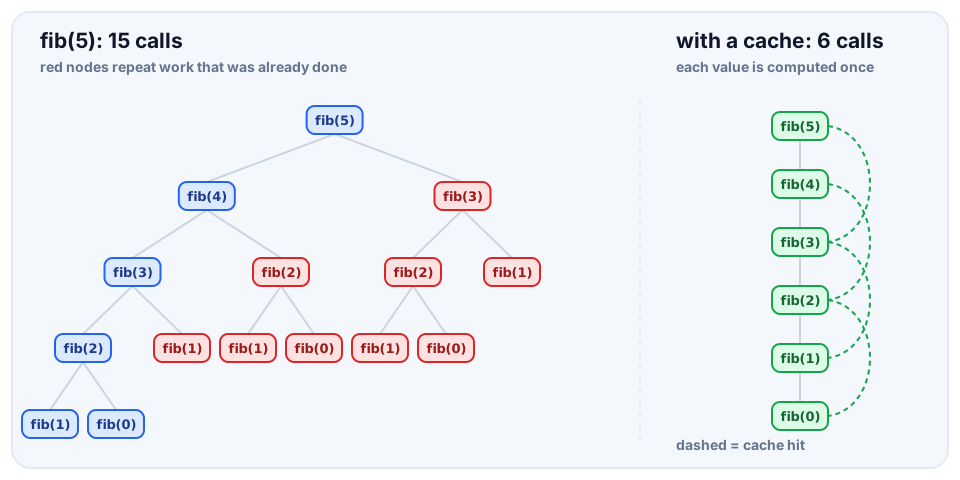
fib(5): 15 calls with repeats, 6 values with a cacheFibonacci: the exponential blow-up
fib(n) calls fib(n-1) and fib(n-2), and each of them does the same again. For example fib(3) is computed twice in the tree of fib(5). The number of calls grows roughly like 1.618^n.
calls = 0

def fib(n):
    global calls
    calls += 1
    return n if n < 2 else fib(n - 1) + fib(n - 2)

for n in (10, 20, 25):
    calls = 0
    fib(n)
print(n, calls)10 177
20 21891
25 242785Manual memoization: a dictionary
The simplest way is to keep results in a dict. The function first checks n in memo, returns at once on a hit, otherwise computes and stores. Now every n is computed only once.
calls = 0
memo = {}

def fib(n):
    global calls
    calls += 1
    if n in memo:
        return memo[n]
    memo[n] = n if n < 2 else fib(n - 1) + fib(n - 2)
    return memo[n]