Service Provider Networks: MPLS, BGP and BNG

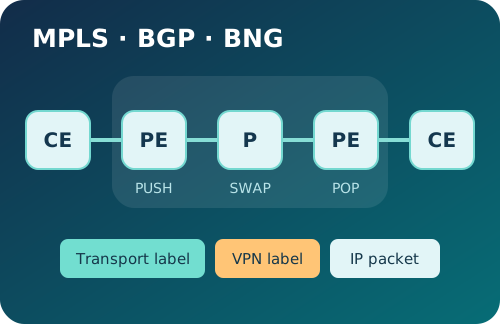
MPLS: CE — PE — P — PE — CE
19 modules · 81 lessons · 19 labs
For network engineers with CCNA-level foundations
EVE-NG · GNS3 · Cisco · Huawei
Subscription
from 30 AZN a month
From the first label stack to your own provider network. Understand transport and services, build VPNs, protect paths and connect subscribers, with two examples per topic and Cisco/Huawei practice.

Lessons are taught live in Azerbaijani and Russian.

Before you start

You need IPv4/IPv6, OSPF/IS-IS, iBGP/eBGP fundamentals and CLI. Use EVE-NG/GNS3; Containerlab requires a compatible image with MPLS forwarding. The first lesson contains the shared addressing plan and topology.

How the course works

Each module contains three to five lessons with explanations, two worked scenarios, quizzes and text exercises. The last lesson of each module provides Cisco and Huawei lab fragments, prerequisites, verification commands, expected results and a negative test. Walkthrough animations support manual steps, playback and pause.

Basic Cisco labs use IOS-XE; advanced SR/EVPN uses IOS-XR. Huawei labs use MPLS-capable VRP and NetEngine/NE40E for SP/BNG features. Image and licence support matters. Text exercises check answers; operational network results must be verified on equipment.

Follow the curriculum in order. Player minutes estimate theory; labs need additional time.

Capstone: a provider network

6–8 provider routers, redundant RR, three customers, L3VPN and Ethernet VPN, inter-AS, TE/SR, QoS, BNG, OAM and provisioning automation. Defence requires connectivity, isolation, failure tests, measurements and reproducible rollback.

How do we teach?

Learning stages

01

Webinar

Students join the lesson live. At the end of each lesson, students are sent a video recording of the class.
02

Homework

Every assignment is based on the topic covered in the webinar. Homework helps you reinforce the material and understand it better.

03

Working with a mentor

The teacher stays in touch with the group both during the course and outside class. Any questions get answered right away.

04

Portfolio

During the course you'll complete several projects on different topics — they'll show employers what you can do.

Self-paced learning

The full curriculum in your personal account

81 topics with theory, examples and practice. The first 3 are free, the rest come with a subscription.

MPLS fundamentals4 topics
  1. Why operators use MPLS
  2. LER, LSR, PE, P, CE and tables
  3. Label format, stack and MTU
  4. Push, swap, pop and PHP: lab
Core IGP4 topics
  1. Loopbacks and addressing
  2. OSPF and IS-IS in SP networks
  3. Metrics, ECMP and BFD
  4. TE extensions and IGP lab
LDP4 topics
  1. LDP discovery and TCP sessions
  2. FEC, bindings and continuous LSPs
  3. DU, retention and ordered control
  4. LDP–IGP sync and filtering: lab
Provider BGP4 topics
  1. iBGP, next hops and full mesh
  2. Route reflectors and confederations
  3. Policies, communities and best path
  4. MP-BGP address families: RR lab
BGP/MPLS L3VPN5 topics
  1. VRFs and overlapping addresses
  2. RD, RT, VPNv4 and VPNv6
  3. PE–CE: static, OSPF and eBGP
  4. RT-Constrain, VRF-Lite and Internet access in a VRF
  5. Hub-and-spoke, extranet and two customers
Inter-AS, CsC and IPv64 topics
  1. Inter-AS Option A
  2. Inter-AS options B and C
  3. Carrier Supporting Carrier
  4. 6PE, 6VPE and inter-domain lab
Fast convergence and Unified MPLS4 topics
  1. IP FRR (LFA/rLFA), microloops and Graceful Restart
  2. BGP PIC, Add-Path and multipath in VPNv4
  3. BGP Labeled Unicast and Seamless MPLS
  4. Lab: LFA/rLFA, BGP PIC and convergence measurement
Multicast over MPLS: PIM and mVPN4 topics
  1. PIM and Multicast in the Provider Network
  2. Rosen mVPN: MDT and mGRE
  3. NG-MVPN: BGP MVPN, mLDP and P2MP
  4. Lab: IPTV over mVPN with mLDP
L2VPN: VPWS, VPLS and EVPN4 topics
  1. VPWS and pseudowires
  2. VPLS, split horizon and H-VPLS
  3. EVPN-MPLS and MAC mobility
  4. VPWS, VPLS and EVPN lab
EVPN and L2VPN redundancy4 topics
  1. Customer multihoming: PW redundancy, MC-LAG and EVPN ESI
  2. EVPN Type 5, IRB and the anycast gateway
  3. EVPN-VXLAN for data centres and DCI with EVPN-MPLS
  4. Lab: dual-homed CE, EVPN all-active and Type 5
MPLS traffic engineering5 topics
  1. RSVP-TE and TED
  2. CSPF, explicit paths and affinity
  3. Auto-bandwidth and admission control
  4. RSVP-TE: facility and detour, P2MP, inter-domain TE
  5. RSVP-TE and FRR lab
Segment routing4 topics
  1. SR-MPLS, SIDs and SRGB
  2. Prefix and adjacency SIDs
  3. TI-LFA, SR Policy and Flex-Algo
  4. LDP migration and TI-LFA lab
SR-TE and SRv64 topics
  1. SR-TE: ODN, Color, Binding SID and PCE
  2. Flex-Algorithm and Micro-loop Avoidance
  3. SRv6: SRH, SIDs, Behaviors and L3VPN
  4. Lab: SR-TE ODN for a Critical VRF and an SRv6 Comparison
MPLS QoS4 topics
  1. DiffServ: DSCP and TC
  2. Uniform, Pipe and Short-Pipe
  3. Queues, shaping and policing
  4. PE QoS and DiffServ-TE lab
Access and BNG5 topics
  1. Aggregation, BNG and BRAS
  2. PPPoE and IPoE step by step
  3. RADIUS, AAA and accounting
  4. IPv6 in access and L2TP
  5. BNG in VRF and CGNAT lab
OAM and monitoring5 topics
  1. LSP ping and traceroute
  2. BFD, continuity and MPLS-TP
  3. SNMP, NetFlow/IPFIX and telemetry
  4. IP SLA, TWAMP and Ethernet CFM / Y.1731
  5. Fault isolation lab
Automation4 topics
  1. NETCONF/YANG and gNMI
  2. Ansible and inventory
  3. Python, Netmiko/NAPALM and Jinja
  4. CI and L3VPN provisioning lab
Security5 topics
  1. VPN isolation and route leaking
  2. CoPP and management plane
  3. BGP: prefix lists, max-prefix and RPKI
  4. TTL propagation, uRPF, GTSM and protocol authentication
  5. TTL propagation and PE hardening
Capstone project4 topics
  1. Provider requirements and topology
  2. Implementation plan and configuration
  3. Acceptance and failure tests
  4. Defence, runbook and capstone lab

Provider Networks: MPLS, BGP and BNG: how to enroll

Fill in the form and we will tell you the start date of the next group, the schedule and payment terms. Or come to a free trial lesson first.

WhatsApp