
dict and set are the most used structures in Python, and both are hash tables. In this topic we look at how the CPython dict is built: a step from theory (hash functions, open addressing, load factor) to a real implementation. For usage rules see dict basics and sets.
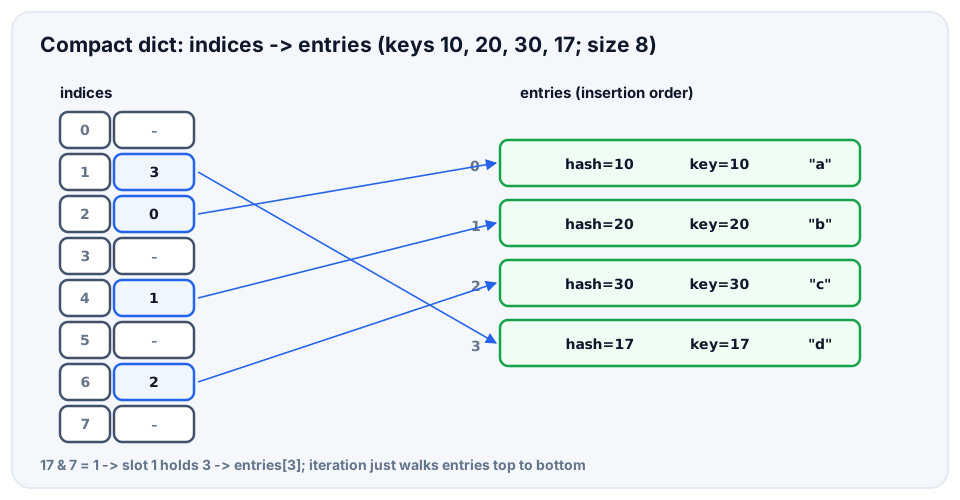
dict: a small indices array and an entries table in insertion orderThe compact dict
Since Python 3.6 a dict has two parts:
indices: a hash array of small integers (an empty slot, a deleted slot or a position inentries).entries: records(hash, key, value)in insertion order.
A lookup does open addressing in indices and the position found leads to entries. Pros: less memory (the sparse array holds only small indices while the heavy records are packed densely) and a natural order. The order is guaranteed by the language since Python 3.7.
Probing
CPython does not use plain linear probing but a key-dependent perturbation: i = (5*i + perturb + 1) & mask, where perturb is shifted right by 5 bits on every step, so the high bits of the hash influence the sequence too. Keys with equal low bits quickly diverge, and clustering shrinks.
def slots(h, size, n):
    mask = size - 1
    perturb = h & (2**64 - 1)
    i = h & mask
    out = []
    for _ in range(n):
        out.append(i)
        perturb >>= 5
        i = (i * 5 + perturb + 1) & mask
    return out

print(slots(1, 8, 5))
print(slots(1000, 8, 5))[1, 6, 7, 4, 5]
[0, 0, 1, 6, 7]