
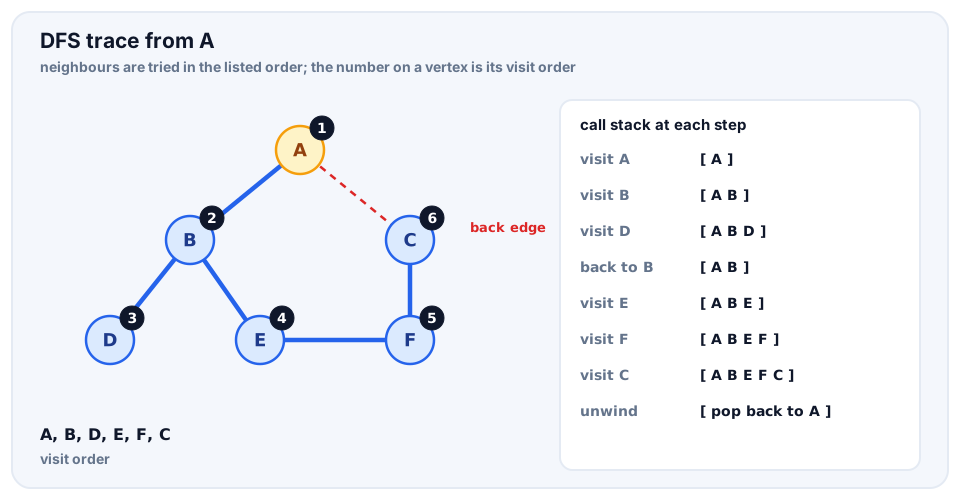
Depth-first search (DFS) explores a graph like a maze: it follows one path as deep as it can and, at a dead end, goes back and tries the next one. It needs two things: the set of visited vertices (otherwise a graph with cycles makes it loop forever) and a stack that remembers where to go back to. Graphs are stored as in Graph Representations; the examples use a dictionary of adjacency lists.
Recursive DFS
visit(u) marks the vertex and then calls itself for every neighbour not yet visited. The order of the neighbours decides the visit order.
graph = {
    "A": ["B", "C"],
    "B": ["A", "D", "E"],
    "C": ["A", "F"],
    "D": ["B"],
    "E": ["B", "F"],
    "F": ["C", "E"],
}

def dfs(graph, start):
    visited = set()
    order = []

    def visit(u):
        visited.add(u)                    # mark on entry
        order.append(u)
        for v in graph[u]:
            if v not in visited:
                visit(v)

    visit(start)
    return order

print(dfs(graph, "A"))['A', 'B', 'D', 'E', 'F', 'C']Here D is a dead end: DFS returns to B and continues with E. Edge A-C is not used: when DFS reaches C from F, the vertex A is already visited (a back edge). The bold edges form the DFS tree.
Iterative DFS with a stack
The recursion stack can be replaced by our own: pop takes the most recently added vertex (LIFO). Pushing the neighbours with reversed gives the same visit order as the recursion.
graph = {
    "A": ["B", "C"],
    "B": ["A", "D", "E"],
    "C": ["A", "F"],
    "D": ["B"],
    "E": ["B", "F"],
    "F": ["C", "E"],
}