
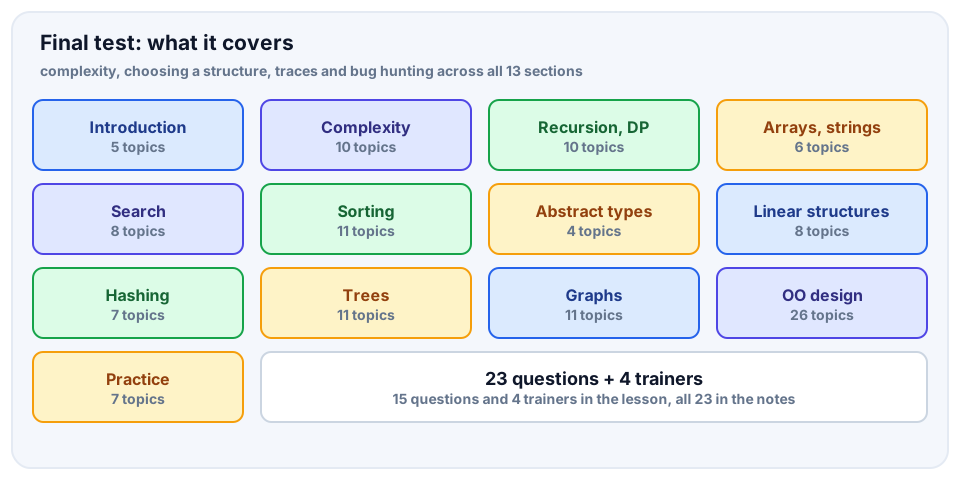
The final test gathers the whole course in one place: complexity estimates, choosing a structure and an algorithm, hand traces and bug hunting. It has 23 questions with three options each and 4 trainers (the interactive lesson has 15 questions and 4 trainers). Answer without running code: in an interview you cannot run it either. Check yourself afterwards in the "Answers" section.
How to take the test
- Set aside 40-50 minutes and do not peek into the notes.
- For a question with code, first write the variable values step by step, then choose an option.
- For complexity questions name
nand the most expensive action. - Compare the answers at the end. Every wrong answer is a pointer to a topic to review.
Questions
Part 1. Complexity
1. What is the complexity?
for i in range(n):
    for j in range(i):
pass- A)
O(n) - B)
O(n^2) - C)
O(n log n)
2. What is the complexity?
while n > 1:
n //= 2- A)
O(log n) - B)
O(n) - C)
O(sqrt n)
3. What is the complexity? (b is a list)
for x in a:          # a and b are lists of length n
    if x in b:
count += 1- A)
O(n) - B)
O(n log n) - C)
O(n^2)
4. Solution of the recurrence T(n) = 2T(n/2) + n?
- A)
O(n) - B)
O(n log n) - C)
O(n^2)
5. list.append called n times: the amortized cost of one append?
- A)
O(1): capacity grows geometrically, rare copies are spread out - B)
O(n) - C)
O(log n)
6. How many times does the body of f run in this code?
from functools import lru_cache

calls = 0

@lru_cache(maxsize=None)
def f(n):
    global calls
    calls += 1
    return 1 if n < 2 else f(n - 1) + f(n - 2)

f(10)
f(10)
print(calls)- A)
177 - B)
21 - C)
11
Part 2. Choosing a structure and algorithm
7. You often need to take items from the front of a queue. What to choose?
- A)
collections.deque - B)
listandpop(0) - C)
heapq
8. Find the k smallest of a stream of a million numbers with O(k) memory.
- A) Store everything and sort
- B) A max-heap of size
k - C) Drop duplicates with a
set
9. The shortest path in a weighted graph with no negative edges?
- A) BFS
- B) DFS
- C) Dijkstra
10. Which structure is the fastest on average for millions of membership checks on fixed data?
- A)
set - B) a sorted list and
bisect - C) a list and
in
11. Which structures give an LRU cache with O(1) get and put?
