
On Monday the seventh Sprint starts at Prowid Shop. Nigar has been on the team for a week and is nervous: what is expected of her in each meeting? Who hands out the tasks? What does “Done” mean? The answers come from the rules of Scrum — the most widespread way to organize the work of an Agile team. In this lesson we look at Scrum the way a developer sees it: who is accountable for what, what happens in a Sprint day by day, and which mistakes are the most common.
What Scrum is and where the rules come from
Scrum is a lightweight framework that helps people, teams and organizations generate value through adaptive solutions for complex problems. That is how the Scrum Guide defines it — a short official document at scrumguides.org. The current edition came out in 2020; it was written by Ken Schwaber and Jeff Sutherland, two of the seventeen authors of the Agile Manifesto.
Two important ideas:
- Scrum is purposefully incomplete. It gives a skeleton — a team, events, artifacts — but does not say how to write tasks, how to estimate them or which tracker to choose. Each team decides that itself.
- It is built on an empirical approach with three pillars: transparency (everyone sees the real state of affairs), inspection (we regularly check the result and the process) and adaptation (we change course based on the check). And there are five values: Commitment, Focus, Openness, Respect and Courage.
💡 A lot of what you hear next to Scrum — user stories, story points, velocity, the Definition of Ready, burndown — is not in the Scrum Guide. These are popular practices that teams add themselves. We look at them in the next lesson; here we stick to what the Scrum Guide actually says.
The Scrum Team: three accountabilities
The 2020 Scrum Guide speaks of “accountabilities” instead of “roles”, but teams and job posts still say “roles”. The whole Scrum Team is one team, typically 10 people or fewer, with no sub-teams or hierarchy.
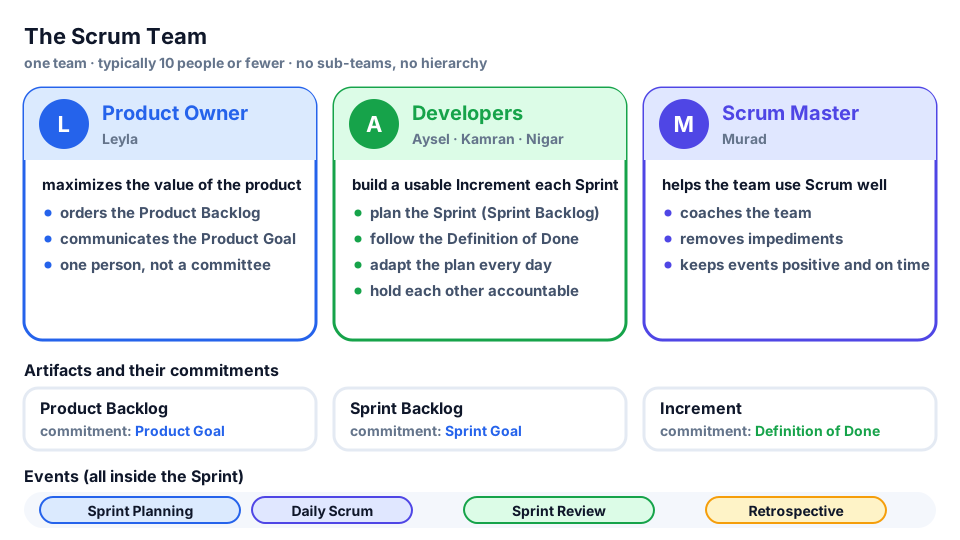
- The Product Owner (Leyla) is accountable for the value of the product: she develops the Product Goal, creates and orders Product Backlog items and makes sure the backlog is transparent and understood. The Product Owner is one person, not a committee.
- The Developers (Aysel, Kamran, Nigar) are everyone who creates any part of a usable Increment in each Sprint. They create the plan for the Sprint (the Sprint Backlog), instill quality by following the Definition of Done, adapt their plan every day and hold each other accountable as professionals.
- The Scrum Master (Murad) is accountable for Scrum being understood and applied, and for the team's effectiveness: he coaches, removes impediments and makes sure the events take place and stay within the timebox.
Scrum has no separate accountability for a “tech lead” or a “junior” — everyone who builds the Increment is a Developer. Job titles in your company may be anything, but inside Scrum you are a full member of the team, and your questions are part of the work.
⚠️ The Scrum Master is neither a boss nor the team's secretary. He does not hand out tasks or collect reports. If Murad tries to do exactly that, you are looking at an anti-pattern (more on those below).
