
At refinement Aysel shows the board: “WIP is three, we take nothing new for now.” Kamran turns to Nigar: “How many points is this?” To a newcomer both phrases sound like a cipher. In fact they stand for simple ideas: how to follow the flow of work (Kanban), how to phrase tasks in the language of the user (user stories and acceptance criteria) and how to agree on the amount of work (estimation). Let's go through it in order.
Kanban: work is pulled, not pushed
Kanban, by the definition of the Kanban Guide (the current edition is May 2025), is a strategy for optimizing the flow of value through a process. The idea of “pulling” work comes from the Toyota Production System: new work is taken when there is spare capacity, not when it is “pushed down from above”.
Kanban has three practices:
- Define and visualize the workflow. Columns are states (To Do, In Progress, Review, Done), cards are work items.
- Actively manage what is already in progress. Limit WIP (work in progress), notice “stuck” cards, help finish what is started.
- Improve the workflow. Look at the metrics and keep asking: where do we get stuck and what should we change?
The difference from Scrum: Kanban has no Sprints and no prescribed roles, work flows continuously and cards are taken when the team is ready. Many teams combine the approaches (“Scrumban”): Sprints plus a board with WIP limits.
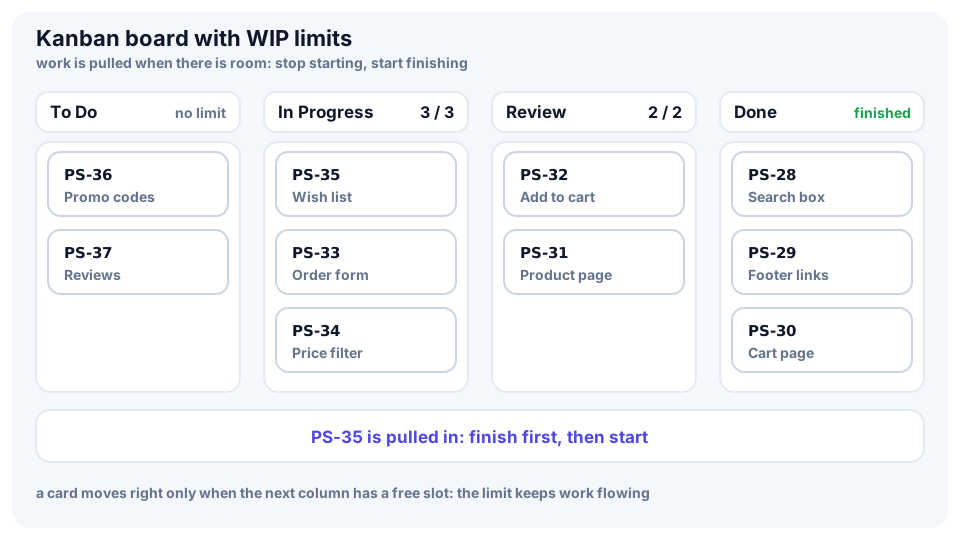
The board and WIP limits
On the board the In Progress and Review columns have limits — the maximum number of cards at one time. A WIP limit does not let you start something new until what is started is finished. Why this matters:
- Less context switching. Five started tasks means zero finished ones: every switch eats time and attention.
- Bottlenecks become visible. If the Review column is always full, reviews are the bottleneck and help is needed exactly there.
- Finish first, then start. The column is full? Do not take new work: help finish what is started — review someone's pull request, pair up, remove a blocker.
How to pick a limit? Start with a number around the head count or lower and tune it by observation: a limit is not a law but an experiment. When WIP drops below the limit, that is a signal to pull new work (the Kanban Guide).
Flow metrics
To improve a process you have to measure it. The Kanban Guide describes four flow metrics; the fifth, lead time, comes from classic practice:
| Metric | Meaning | Example |
|---|---|---|
| WIP | the number of tasks started but not finished | 3 cards in In Progress |
| Throughput | how many tasks are finished per period | 6 tasks per week |
| Cycle time | time from starting work on a task to finishing it | started Wednesday, finished Friday: 2 days |
| Work item age | how long an unfinished task has already been in progress | has been “hanging” for 5 days |
| Lead time | time from a request appearing to it being delivered (the customer's view) | created on Monday, shipped 2 weeks later |
If the start day and the finish day of every task are known, the calculation is easy:
