
For decades, enterprise network management centered around manual interaction with the command-line interface (CLI). Network engineers connected to each switch and router using Telnet or SSH, typed configuration commands, and visually verified the results using show commands. However, as digital infrastructure grew in scale, distributed multi-cloud fabrics emerged, and service availability requirements dramatically tightened, the manual box-by-box management model became the leading cause of outages, downtime, and operational stagnation. Modern network engineering is undergoing a fundamental paradigm shift: moving away from brittle screen scraping scripts toward programmable networks driven by strictly typed YANG data models, controller-led architectures, Infrastructure as Code (IaC) principles, NetDevOps workflows, and autonomous AI agents powered by the Model Context Protocol (FastMCP). This comprehensive technology stack forms the core of the Cisco 300-435 ENAUTO v2.0 (Automating Cisco Enterprise Solutions) certification exam.
Goal and prerequisites
After this lesson, you will be able to:
- articulate the fundamental risks of manual box-by-box CLI management (configuration drift, human error, exponential labor costs);
- distinguish between the 4 evolutionary stages of network automation: manual CLI, screen scraping, model-driven APIs, and NetDevOps with AI agents;
- navigate the Cisco 300-435 ENAUTO v2.0 ecosystem: Cisco IOS XE devices, Catalyst Center, Catalyst SD-WAN Manager, Cisco Meraki, Cisco ISE, ThousandEyes, and Python FastMCP servers;
- calculate automation return on investment (ROI) and mean time to recovery (MTTR) reduction;
- formulate the principles of a single Source of Truth (SoT) and build continuous integration and continuous deployment (CI/CD) pipelines for network changes.
Prerequisites: CCNA-level foundational networking knowledge (OSI/TCP-IP models, IPv4/IPv6 addressing, basic Cisco IOS XE CLI syntax, VLAN switching, and OSPF/BGP routing).
A real-life task
An international logistics enterprise operates a corporate network consisting of 450 routers and switches (Cisco Catalyst 9300, Catalyst 8300, and ISR 4000) deployed across 85 regional distribution centers. Network administration was historically performed manually by six shift engineers using SSH terminal windows.
During an unscheduled emergency maintenance window to isolate a compromised subnet, engineers needed to update Access Control Lists (ACLs) and Native VLAN IDs across trunk uplinks in all remote branches. A shift engineer copied a template command block from a text editor and pasted it into a core router console. Due to an unnoticed whitespace formatting anomaly in the clipboard buffer, the trunk configuration command truncated the management VLAN. The port entered an inconsistent state, the SSH session dropped, and the entire logistics hub was severed from the corporate WAN.
Restoring connectivity required 4.5 hours while an on-call field engineer traveled to the physical site with a console cable. During the outage, warehouse sorting systems halted, resulting in contractual delivery penalties exceeding $180,000. A subsequent audit revealed that 42% of production switches had drifted from standard golden configurations, interface descriptions were outdated, and backups were performed irregularly.
The digital transformation board mandated an immediate migration to the Cisco ENAUTO automation architecture: replacing manual CLI with declarative templates, Git as a Source of Truth, centralized controllers, and pre-deployment automated tests.
The crisis of manual CLI: Box-by-Box and configuration drift
Traditional network management, where human operators configure each device individually in isolation, creates four severe systemic vulnerabilities:
- Configuration Drift: When making emergency hotfixes during incidents, engineers frequently bypass documentation updates. Over time, production device configurations drift significantly from engineering designs and peer devices in adjacent branches.
- Human Error: Industry studies show that 70% to 80% of major network outages stem from manual configuration mistakes (IP typos, missing wildcard masks in ACLs, or incorrect BGP autonomous system numbers).
- Lack of Atomicity and Pre-Validation: Traditional CLI executes commands line-by-line. If a syntax error occurs on line 20 of a 30-line batch, the first 19 commands remain active, leaving the router in a half-configured, broken state.
- Inability to Scale: Deploying a service across 500 switches manually scales linearly (O(N)): if configuring one node takes 20 minutes, manual network-wide deployment requires more than 160 engineering hours.
Network automation evolution: 4 technological stages
The industry's journey from legacy administration to autonomous networks spans four distinct stages.

| Comparison Factor | Stage 1: Manual CLI | Stage 2: Screen Scraping | Stage 3: Model-Driven APIs | Stage 4: NetDevOps & AI |
|---|---|---|---|---|
| Interface | Console / SSH terminal | SSH + Python (Netmiko, Expect) | NETCONF / RESTCONF / REST API | Git CI/CD + FastMCP AI agents |
| Data Format | Unstructured text | Text + regular expressions | Structured JSON / XML | YANG data models + YAML |
| Source of Truth (SoT) | Router NVRAM | Script text files | Controller databases | Git repository (IaC) |
| Validation | Visual engineer inspection | Minimal (CLI exit codes) | YANG schemas (RFC 7950) | pyATS / Genie + Digital Twin |
| Deployment Speed | Hours / days | Minutes / hours | Seconds / minutes | Seconds (automated pipeline) |
| Mean Time to Recovery (MTTR) | 4–8 hours | 1–2 hours | 15–30 minutes | < 3 minutes (auto-revert) |
In the second stage, engineers used SSH libraries to script CLI commands. However, human-oriented CLI text lacks schemas. Any minor Cisco IOS XE release upgrade that modifies column widths breaks regex parsers.
The solution emerged in the third stage: Model-Driven Programmability. Protocols like NETCONF and RESTCONF utilize standardized YANG models (RFC 6020 / RFC 7950) to enforce data typing, client-side validation, and atomic commits. In the fourth stage, DevOps principles unite with networking (NetDevOps): configurations reside in Git, undergo automated validation via pyATS test suites, and are deployed by autonomous agents.
Cisco 300-435 ENAUTO v2.0 ecosystem architecture
The Cisco 300-435 ENAUTO v2.0 blueprint encompasses an enterprise automation ecosystem divided into Device-Level programmability and Controller-Level orchestration.
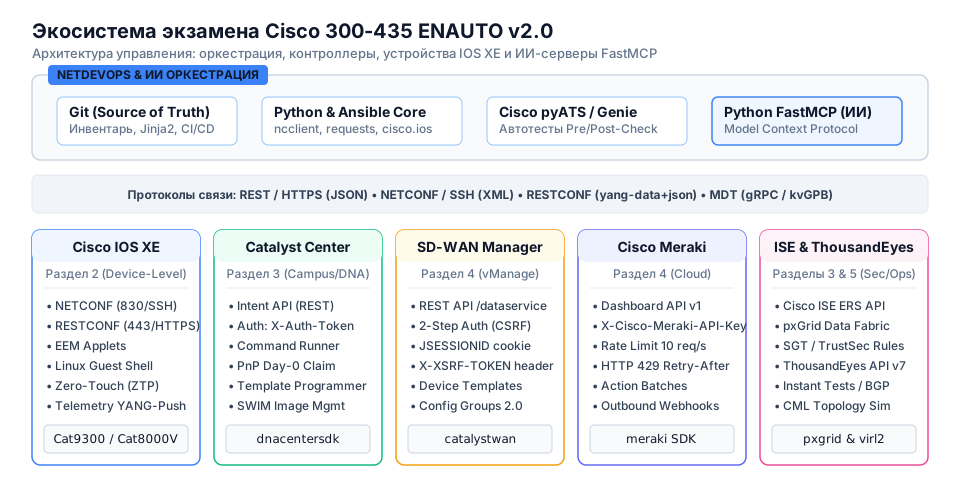
The ecosystem integrates six key pillars:
- Device-Level Programmability (Cisco IOS XE): Direct programmatic control of Catalyst 9000 switches and Catalyst 8000V routers via NETCONF (TCP port 830) and RESTCONF (TCP port 443), on-box Embedded Event Manager (EEM) applets, and the containerized Python Guest Shell environment.
- Campus Controller (Cisco Catalyst Center): Centralized campus LAN management providing the Intent API (REST), Day-0 Plug-and-Play (PnP) onboarding, Software Image Management (SWIM), Command Runner diagnostics, and Ansible automation via
cisco.dnac. - Security and Access Control (Cisco ISE): TrustSec policy automation, programmatic Scalable Group Tag (SGT) creation, and adaptive network containment via ERS REST APIs and the pxGrid data bus.
- Enterprise SD-WAN (Cisco Catalyst SD-WAN Manager): Distributed WAN fabric automation through vManage REST APIs, two-step session authentication using
JSESSIONIDcookies andX-XSRF-TOKENheaders, and thecatalystwanSDK. - Cloud-Managed Networking (Cisco Meraki Dashboard): Cloud automation via Dashboard API v1, with strict rate limiting handling (10 requests/sec limit) and
Retry-Afterheader processing on HTTP 429 responses. - Observability, Validation, and AI (ThousandEyes, pyATS, FastMCP): End-to-end synthetic path testing, automated state verification (Pre/Post Change Testing), Model-Driven Telemetry (MDT) streaming, and LLM orchestration via FastMCP servers.
Worked example: brittle CLI script vs. Model-Driven API call
Consider checking the operational state of GigabitEthernet1. In the legacy approach, the engineer relies on Python and regex:
# Brittle Screen Scraping approach (parsing raw CLI text output)
import re
from netmiko import ConnectHandler

device_params = {
    "device_type": "cisco_ios",
    "host": "192.168.10.1",
    "username": "admin",
    "password": "SecretPassword123!",
}

with ConnectHandler(**device_params) as net_connect:
    output = net_connect.send_command("show ip interface brief")

# Regular expression is tightly coupled to spaces and string positions
match = re.search(r"^GigabitEthernet1\s+(\S+)\s+\w+\s+\w+\s+(up|down)", output, re.M)
if match:
    ip_address, status = match.groups()
    print(f"Interface Gi1: IP={ip_address}, Status={status}")
else:
    # A minor Cisco IOS XE release change will crash execution here
    raise ValueError("Failed to parse CLI output: format has changed!")
In contrast, Model-Driven Programmability uses RESTCONF with a standardized JSON payload adhering to the ietf-interfaces YANG schema:
# Reliable Model-Driven Programmability approach (RESTCONF + YANG)
import requests
from requests.auth import HTTPBasicAuth

url = "https://192.168.10.1/restconf/data/ietf-interfaces:interfaces/interface=GigabitEthernet1"
headers = {
    "Accept": "application/yang-data+json",
}

response = requests.get(
    url,
    auth=HTTPBasicAuth("admin", "SecretPassword123!"),
    headers=headers,
    verify=False,
    timeout=5,
)

if response.status_code == 200:
    data = response.json()
    interface_data = data["ietf-interfaces:interface"]
    name = interface_data["name"]
    enabled = interface_data["enabled"]
    print(f"Interface {name}: Administratively Enabled = {enabled}")
This second approach guarantees structural integrity regardless of software version, terminal geometry, or language localization.
Worked example: NetDevOps declarative verification pipeline
In a NetDevOps architecture, engineers express intent in declarative YAML files stored in Git:
# hosts_vars/core-rtr-01.yml - Declarative target state description
hostname: "core-rtr-01"
interfaces:
  - name: "GigabitEthernet1"
    description: "Uplink to ISP-1 Primary"
    ipv4_address: "198.51.100.2"
    ipv4_mask: "255.255.255.252"
    enabled: true
  - name: "GigabitEthernet2"
    description: "Trunk to Distribution Switch SW-01"
    ipv4_address: "10.100.1.1"
    ipv4_mask: "255.255.255.0"
    enabled: true
The CI/CD pipeline validates syntax, spins up digital twin topologies in Cisco Modeling Labs (CML), runs pyATS testbed suites, and only pushes changes to production when all checks pass.
Automation economics: calculating ROI and MTTR reduction
Adopting network automation requires initial investments in tooling, compute resources, and engineering training. To justify the initiative, network architects calculate Return on Investment (ROI) and Mean Time to Recovery (MTTR) improvements.
Enterprise Network Baseline Parameters («Given»):
- Managed network devices:
450 units(routers and switches); - Engineering staff:
6 engineers; - Blended engineer hourly rate (including overhead):
$50/hour; - Annual planned change windows:
1,200 procedures; - Labor time per manual change (prep, approvals, CLI, validation):
2.5 hours; - Labor time per automated change via NetDevOps (Git commit + CI/CD):
0.2 hours(12 minutes); - Annual outages caused by manual CLI human error:
18 incidents; - Hourly cost of business downtime:
$25,000/hour; - Manual MTTR for CLI troubleshooting and rollback:
3.5 hours; - Automated MTTR via Git revert and CI/CD redeployment:
0.1 hours(6 minutes); - Upfront automation platform investment (licenses, compute, tooling):
$95,000.
The annual economic impact is calculated below:
# Annual economic impact analysis for NetDevOps migration
labor_cost_reduction:
  manual_hours_total: 1200 * 2.5           # 3,000 engineering hours/year
  automated_hours_total: 1200 * 0.2        # 240 engineering hours/year
  hours_saved: 3000 - 240                  # 2,760 engineering hours saved
  financial_savings_labor: 2760 * 50       # $138,000 direct payroll savings

downtime_cost_reduction:
  manual_annual_downtime_hours: 18 * 3.5   # 63 hours of business downtime/year
  automated_annual_downtime_hours: 18 * 0.1 # 1.8 hours of business downtime/year
  downtime_hours_saved: 63.0 - 1.8         # 61.2 downtime hours eliminated
  prevented_downtime_losses: 61.2 * 25000  # $1,530,000 in prevented losses

total_economic_benefit:
  direct_annual_savings: 138000 + 1530000  # $1,668,000 total Year 1 gross benefit
  initial_investment: 95000                # $95,000 project startup cost
  net_present_value_year1: 1668000 - 95000 # $1,573,000 net first-year benefit
  roi_percentage: (1573000 / 95000) * 100  # 1,655.8% first-year ROI
  payback_period_months: (95000 / (1668000 / 12)) # 0.68 months (< 3 weeks)
💡 Engineering verdict: Transitioning from manual CLI to NetDevOps repays its infrastructure investment in less than 3 weeks. The overwhelming driver of financial return is not reduced engineering hours, but the elimination of catastrophic business downtime (a 97% reduction in MTTR combined with the prevention of human configuration errors).
What can go wrong and how to find it
Migrating to programmatic interfaces introduces distinct operational challenges:
| Symptom / Error Code | Root Cause | Isolation and Remediation |
|---|---|---|
SSH Timeout / ConnectionRefused when launching Netmiko scripts | VTY access unconfigured, TCP port 22 closed, or blocked by control plane ACL | Inspect show ip access-lists on management interface, verify line vty 0 4 and transport input ssh |
HTTP 401 Unauthorized during RESTCONF or Catalyst Center requests | Expired X-Auth-Token or invalid local/AAA credentials | Verify AAA server reachability; implement automatic token renewal logic in Python upon receiving 401 |
HTTP 429 Too Many Requests with header Retry-After: 30 | Meraki Dashboard API rate limit exceeded (10 req/s limit) | Implement exponential backoff with mandatory pause: time.sleep(int(response.headers['Retry-After'])) |
<rpc-error> <error-tag>data-missing</error-tag> in NETCONF reply | Attempting to configure a nested leaf without creating parent container | Check RFC 8340 tree via pyang -f tree; verify required parent containers and list key [name] leaves |
State desynchronization: script reports Success but traffic fails | Configuration updated in candidate datastore without issuing <commit> | Inspect active sessions with show netconf-yang sessions; verify m.commit() call in ncclient script |
⚠️ Common pitfall: Attempting network automation by blindly blasting raw CLI configuration strings via Python scripts without validation or automated rollback. If a script severs connectivity halfway through a rollout, the network is left in an inconsistent state requiring physical console recovery.
Practice
- Predict: What happens if a single-threaded Python script sequentially polls 450 network devices via SSH, assuming each device takes 2.5 seconds to establish and answer? What is the total execution time?
- Verify: Calculate the theoretical execution time when using a thread pool
ThreadPoolExecutor(max_workers=50)versus an asynchronous framework (asyncio+ HTTPX with 50 ms latency). - Explain: Why does using Git as a single Source of Truth (SoT) inherently prevent configuration drift across geographically distributed network nodes?
- Modify: In the RESTCONF script above, update the request URI to retrieve the entire list of router interfaces as a JSON array instead of a single interface.
- Configure on your own ⭐: Construct a Cisco IOS XE configuration snippet that concurrently enables the secure HTTPS server, the RESTCONF service, and NETCONF sessions on TCP port 830.
Self-check
Question 1: What is the fundamental architectural difference between Model-Driven APIs (NETCONF/RESTCONF) and legacy CLI screen scraping?
Answer explanation: CLI produces unstructured text intended for human operators, lacking machine-readable schemas and data typing. Any software update may alter text layouts, breaking regular expression parsers. In contrast, YANG data models (RFC 6020 / RFC 7950) provide formal, strictly typed schemas with contract validation (integer, string, boolean) and atomic transaction support, ensuring deterministic XML/JSON data exchange regardless of software release.
Question 2: Why is making manual configuration changes directly in CLI (configure terminal) strictly prohibited in a NetDevOps environment, even during critical incidents?
Answer explanation: Direct manual modifications bypass Git, violating the single Source of Truth principle and generating configuration drift. During the next automated CI/CD pipeline run, the automation platform will overwrite manual fixes with the Git baseline, potentially re-triggering the outage. Emergency fixes must be committed to a hotfix branch and deployed through automated testing pipelines.
Practice exercise solutions
- Solution 1: Sequential single-threaded polling takes
450 * 2.5 = 1,125 seconds(18 minutes and 45 seconds), which is unacceptable for real-time telemetry. - Solution 2: With 50 concurrent worker threads, total duration drops to
(450 / 50) * 2.5 ≈ 22.5 seconds. Usingasynciowith RESTCONF reduces the entire poll to1.5–3 seconds. - Solution 3: Under Git as SoT, routers do not generate their own configurations; they consume rendered artifacts from code. Any out-of-band discrepancy is detected by automated diff audits (e.g., pyATS) and automatically remediated to match
main. - Solution 4: Target URI:
"https://192.168.10.1/restconf/data/ietf-interfaces:interfaces". The response returns the root interfaces container:data["ietf-interfaces:interfaces"]["interface"]. - Solution 5:
! Enable programmatic management interfaces on Cisco IOS XE
ip http secure-server
restconf
netconf-yang
Review and the criterion for moving on
Without looking at notes, you can:
- articulate the operational differences between Screen Scraping, RESTCONF, and NetDevOps;
- list the 5 controller platforms in the Cisco 300-435 ENAUTO v2.0 exam syllabus;
- justify the financial ROI of automation based on MTTR reduction and prevented downtime;
- enable
netconf-yangandrestconfservices on Cisco IOS XE devices.
Check question: An engineer plans to parse show cdp neighbors detail using Python regular expressions to map the network topology. What modern alternative from the ENAUTO v2.0 stack should be used and why?
(Readiness criterion: Recommend using RESTCONF/NETCONF with Cisco Native or OpenConfig models, or utilizing Cisco Genie/pyATS parsers via device.parse('show cdp neighbors detail') to immediately obtain structured Python dictionaries).
Standards and sources
- RFC 6020 / RFC 7950: YANG — A Data Modeling Language for the Network Configuration Protocol (NETCONF).
- RFC 6241: Network Configuration Protocol (NETCONF).
- RFC 8040: RESTCONF Protocol.
- RFC 8340: YANG Tree Diagrams.
- Cisco Certified DevNet Professional / CCNP Enterprise: Official Cert Guide 300-435 ENAUTO (Cisco Press).
- Cisco DevNet Learning Labs: Network Programmability Basics & Model-Driven Programmability.
