NGN: Softswitch, H.248, SIGTRAN and TDM Interworking

The NGN: Softswitch, H.248, SIGTRAN and TDM Interworking course — MGC/MGW, MEGACO, M3UA, BICC, SIP-I and Huawei MSOFTX3000/UMG8900
72 lessons · 5 labs · project
6 practicums · 16 troubleshooting cases
After the SIP and SDP: Complete Guide course
Individual
Per month 250 AZN
Group
Per month 170 AZN
Paying for the full course in a group
15% discount
Installments
50/50
Subscription
from 60 AZN a month
Next Generation Networks (NGN) form the architectural bridge connecting legacy TDM exchanges (E1 trunks, ISDN PRI, SS7/ISUP) with packet-switched IP cores and the SIP ecosystem. This course examines how the monolithic telephone exchange was decomposed into a call-control softswitch (MGC — Media Gateway Controller), a media gateway (MGW: TDM ↔ RTP conversion, DSP farms, transcoding, G.168 echo cancellation) and a signaling gateway (SG), along with circuit emulation over IP (CES, SAToP, CESoPSN). You will dissect the H.248 (MEGACO, ITU-T H.248.1) gateway control protocol: physical (TDM) and ephemeral (RTP) terminations, contexts and the Null Context, all 8 commands (Add, Modify, Subtract, Move, AuditValue, AuditCapabilities, Notify, ServiceChange), descriptors (Media, Local/Remote SDP, Events, Signals, DigitMap), transactions and MGW digit collection. You will master the SIGTRAN suite (RFC 2719): SG/SGP and AS/ASP/IPSP architecture, M2PA, M2UA, M3UA (ASPUP/ASPAC/NTFY states, Routing Context, DATA transfer and SSNM DUNA/DAVA), SUA, IUA (PRA over IP) and SCTP multi-homing redundancy. Finally, you will cover carrier interworking (BICC, SIP-I/SIP-T with encapsulated ISUP bodies, ITU-T Q.1912.5 ISUP ↔ SIP and Q.850 ↔ SIP mapping, H.323 and MGCP overview) and hands-on Huawei MSOFTX3000 and UMG8900 MML configuration.

Enrollment for a new group is open — send a request to reserve your seat

Lessons are taught live in Azerbaijani and Russian.

Or study on your own in your personal account → with a subscription from 60 AZN a month

Before you start

Complete ISDN: BRI and PRI, Q.921 and Q.931, SS7 Signalling: MTP, ISUP, SCCP, TCAP, IP Networks for Telecom Engineers, Voice over IP: Codecs, RTP, DTMF and Quality, and SIP and SDP: Complete Guide first: E1 framing, Q.931/Q.850, MTP2/MTP3, ISUP (IAM/ACM/ANM/REL/RLC, CIC, OPC/DPC), SCTP, RTP/RTCP, audio codecs, SIP/SDP dialogs and Huawei MML fundamentals are used here without repeating the basics.

How the course works

One topic, one lesson: interactive slides, call-flow ladder diagrams and process animations, exercises with automated answer checking, and study notes in three languages (az, ru, en). Every lesson includes a worked example, a “What can go wrong and how to find it” section, practice tasks and a self-check. Hands-on labs cover H.248 trace dissection, M3UA setup with OsmoSTP, M3UA/ISUP and SIP-I packet analysis in Wireshark, and building a complete Huawei MSOFTX3000/UMG8900 MML interconnection script.

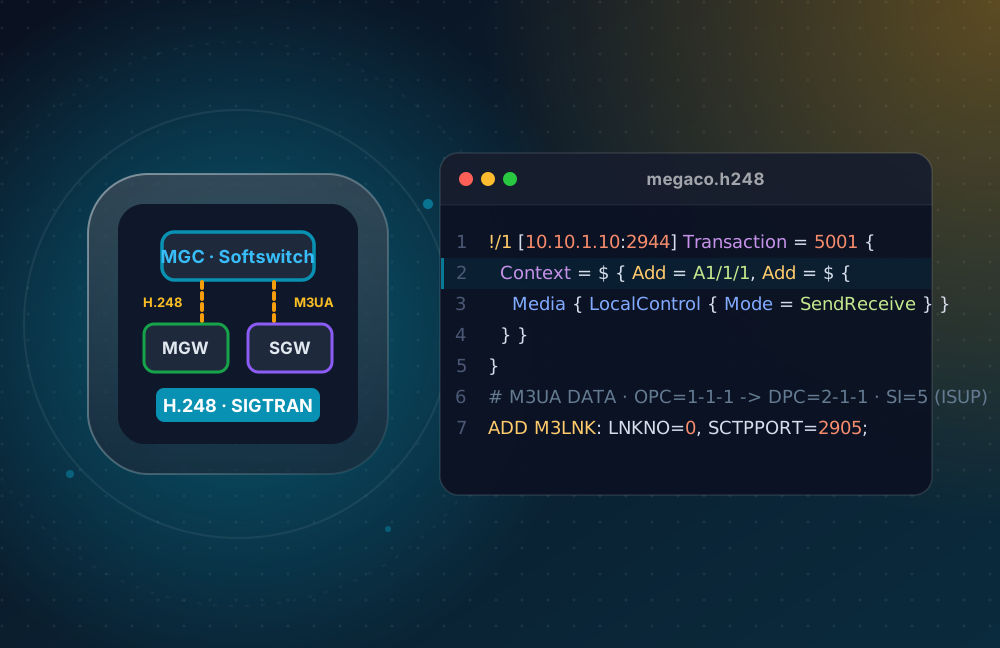
Course outline

01

From TDM to NGN

  • why operators migrated to NGN (economics, unified IP transport, value-added services)
  • the 4-layer NGN architecture (access, transport, control, service)
  • softswitch (MGC) call control without a switching matrix
  • media gateway (MGW: TDM ↔ RTP, DSPs, echo cancellation)
  • signaling gateway (SG)
  • E1 over IP (CES, SAToP, CESoPSN) and Huawei MSOFTX3000 / UMG8900 roles
02

H.248 (MEGACO)

  • master (MGC) and slave (MGW) model
  • physical (TDM) and ephemeral (RTP) terminations
  • contexts and the Null Context
  • the 8 commands (Add, Modify, Subtract, Move, AuditValue, AuditCapabilities, Notify, ServiceChange)
  • descriptors (Media, Local/Remote SDP, Events, Signals, DigitMap)
  • transactions (Transaction, Reply, Pending)
  • UDP/SCTP transport, H.248 packages
  • MGW DTMF collection via DigitMap
  • TDM ↔ IP call flow and MGW registration ladders
  • DSP resources, trace lab and practicum
03

SIGTRAN suite

  • purpose and RFC 2719 architecture (SG, SGP, AS, ASP, IPSP)
  • M2PA (RFC 4165), M2UA (RFC 3331) and M3UA (RFC 4666) comparison
  • ASP state machine (ASPUP, ASPAC, NTFY)
  • Routing Key and Routing Context (Override vs Loadshare modes)
  • DATA transfer and SSNM (DUNA, DAVA)
  • SUA (RFC 3868) and IUA (RFC 4233 — PRA over IP)
  • SIGTRAN redundancy and SCTP multi-homing
  • OsmoSTP and Wireshark capture labs, and practicum
04

Carrier interworking

  • BICC (ITU-T Q.1902), encapsulating ISUP inside SIP bodies (SIP-I and SIP-T)
  • ISUP ↔ SIP mapping (ITU-T Q.1912.5)
  • Q.850 cause ↔ SIP response code mapping
  • number normalization at interconnects
  • historical overview of H.323 (H.225, H.245) and MGCP
  • carrier interconnect design and acceptance testing
  • SIP-I trace lab and practicum
05

Huawei practice and operations

  • number analysis and routing objects in the MSOFTX3000 (office direction, route, trunk group)
  • SCTP and M3UA configuration
  • connecting the UMG8900 over H.248
  • SIP trunk provisioning
  • softswitch CDR charging and billing fields
  • O&M with LMT and U2000 (alarms, performance statistics, backups) and a complete MML interconnection script lab
06

Problems, solutions and final project

  • 16 real-world troubleshooting cases (MGW ServiceChange rejection, H.248 timeouts, busy-hour DSP exhaustion, M3UA Routing Context mismatch, SCTP association failure, Loadshare/Override message loss, rejected SIP-I body, all errors mapped to 500 / Cause 127, MGW one-way audio, echo, lost DTMF, codec mismatch, interconnect number format error, IUA D-channel down, trunk overload, CES clock slips)
  • systematic NGN troubleshooting methodology and the NGN node capstone project

The Telecom track

The eighth course of the 14-course Telecom track, from the telephone line to 5G.

How do we teach?

Learning stages

01

Webinar

Students join the lesson live. At the end of each lesson, students are sent a video recording of the class.

02

Homework

Every assignment is based on the topic covered in the webinar. Homework helps you reinforce the material and understand it better.

03

Working with a mentor

The teacher stays in touch with the group both during the course and outside class. Any questions get answered right away.

04

Portfolio

During the course you'll complete several projects on different topics — they'll show employers what you can do.

Self-paced learning

The full curriculum in your personal account

3 topics with theory, examples and practice. The first 1 are free, the rest come with a subscription. Interactive lessons with slides and coding trainers: 3.

Group and individual classes include a teacher, homework review and a certificate. The subscription gives you materials, exercises and progress tracking at your own pace, without teacher feedback.

NGN: Softswitch, H.248, SIGTRAN and TDM Interworking: how to enroll

Fill in the form and we will tell you the start date of the next group, the schedule and payment terms. Or come to a free trial lesson first.

WhatsApp