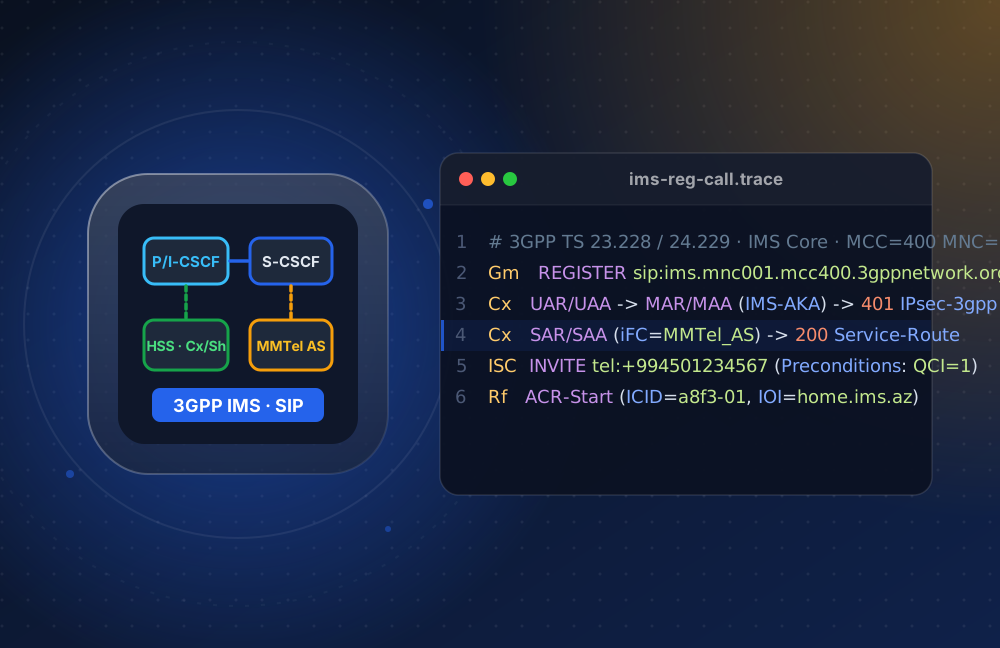
IMS: Multimedia Core Network

The IMS: Multimedia Core Network course — P-CSCF, I-CSCF, S-CSCF, HSS, MMTel AS, MRFC/MRFP, MGCF/BGCF, IBCF, SIP (3GPP TS 24.229), Diameter Cx/Dx/Sh/Rx/Ro/Rf, IMS-AKA, IPsec, iFC and Kamailio IMS + pyHSS
136 lessons · 12 labs · project
4 practicums · 30 troubleshooting cases
After SIP & SDP: Complete Guide, NGN: Softswitch, H.248, SIGTRAN, and LTE/4G and the EPC Core
Individual
Per month 200 AZN
Group
Per month 150 AZN
Paying for the full course in a group
15% discount
Installments
50/50
Subscription
from 30 AZN a month
Why do 4G LTE, 5G NR, Wi-Fi and fixed fiber GPON networks rely on a single unified control core — the IP Multimedia Subsystem (IMS) — to deliver carrier-grade voice (VoLTE, VoNR, VoWiFi), video calling and enterprise telephony? This course provides an exhaustive, standard-by-standard breakdown of IMS architecture, subscriber data models, protocols and call flows per 3GPP TS 23.228 and TS 24.229: why IMS was created (access-network independence, end-to-end QoS enforcement and decoupled service logic), the evolution of 3GPP Releases 5/6/7 (ETSI TISPAN, Common IMS) and 3GPP2 MMD, the three-layer architecture (access/transport, session control, application services), CSCF roles (P-CSCF, I-CSCF, S-CSCF, plus emergency E-CSCF and LRF), the HSS and SLF, Application Servers (MMTel AS, SCC AS, IP-SM-GW, IM-SSF), Media Resource Functions (MRFC and MRFP), PSTN and inter-carrier interworking elements (BGCF, MGCF, IM-MGW, IBCF, TrGW), fixed broadband access (SBC + P-CSCF, PSTN emulation via AGCF/MSAN, enterprise SIP trunks) and Huawei IMS product mapping (CSC3300, ATS9900, CloudSE2980, UGC3200/MSOFTX3000, UMG8900, MRP6600, HSS9860, SPG2800, iCG9815). Identities and subscriber profiles: Private User Identity (IMPI) and Public User Identities (IMPU: SIP URI and tel URI), ISIM vs USIM derived identities, Implicit Registration Sets, Service Profiles and Initial Filter Criteria (iFC: TriggerPoint, SPT, ApplicationServer, DefaultHandling), PSI and GRUU, the HSS data model and Northbound provisioning via SPG. Reference points and protocols: Gm, Mw, Mi, Mj, Mk, Mg, Mr, Mp, Mn, ISC and Ici/Izi interfaces, Diameter Cx/Dx (UAR/UAA, MAR/MAA, SAR/SAA, LIR/LIA, RTR/RTA, PPR/PPA), Sh (UDR, PUR, SNR, PNR), Rx (AAR/AAA, RAR/RAA, STR/STA, ASR/ASA), Ro and Rf, 3GPP SIP extensions (Path, Service-Route, Security-Client/Server/Verify), IMS P-headers (P-Visited-Network-ID, P-Called-Party-ID, P-Served-User, P-Charging-Vector, P-Charging-Function-Addresses) and network domain security (NDS/IP, Za/Zb, TLS). Registration and session flows: P-CSCF discovery (PCO, DHCP, DNS), initial REGISTER and UAR/UAA, S-CSCF selection by capabilities, MAR/MAA and 401 challenge, IMS-AKA mutual authentication, SQN resynchronization via AUTS, IPsec SA establishment between UE and P-CSCF, SAR/SAA and 200 OK, Third-Party Registration to AS, reg-event subscription, MO and MT session legs, iFC evaluation and AS chaining over ISC, number normalization (tel URI, phone-context), ENUM/DNS routing, LIR/LIA, resource reservation Preconditions (curr, des, conf), PSTN breakout and ingress (BGCF, MGCF SIP ↔ ISUP, IM-MGW H.248 Mn), MMTel supplementary services (CDIV, OIP/OIR, TIP/TIR, Hold/CW/ECT, Ut/XCAP self-care), offline/online charging (ICID, IOI, Rf ACR/ACA, CDR, Ro CCR/CCA), Huawei IMS operations, 12 hands-on labs on Kamailio IMS + pyHSS + rtpengine + Asterisk and 30 real-world outage investigations.

Enrollment for a new group is open — send a request to reserve your seat

Lessons are taught live in Azerbaijani and Russian.

Or study on your own in your personal account → with a subscription from 30 AZN a month

Before you start

Complete SIP and SDP: Complete Guide, NGN: Softswitch, H.248, SIGTRAN and TDM Interworking, and LTE/4G and the EPC Core first: SIP methods, headers, transactions and dialogs (RFC 3261), the SDP Offer/Answer model (RFC 3264), H.248 (MEGACO) contexts and ISUP ↔ SIP interworking (Q.1912.5 / Q.850), as well as EPC core architecture (P-GW, PCRF, HSS), EPS bearers (QCI 5 for SIP signaling and QCI 1 for voice), the Diameter base protocol (RFC 6733) and AKA authentication are used here without repeating the basics.

How the course works

One topic, one lesson: interactive slides, SIP and Diameter signaling ladder diagrams, iFC trigger and session-routing animations, exercises with automated answer checking, and study notes in three languages (az, ru, en). Every lesson includes a worked example, a “What can go wrong and how to find it” section, practice tasks and a self-check. Hands-on labs run on the track Docker testbed: Kamailio IMS (P-CSCF, I-CSCF, S-CSCF) + pyHSS + rtpengine + DNS (NAPTR/SRV/ENUM) + Asterisk (as AS and PSTN gateway) + Wireshark.

Course outline

01

IMS architecture

  • why IMS is needed (one unified multimedia core across any access network and service)
  • history of 3GPP Releases 5/6/7 (ETSI TISPAN, Common IMS) and 3GPP2 MMD
  • the three-plane architecture (access/transport, session control, application services)
  • P-CSCF, I-CSCF, S-CSCF
  • emergency E-CSCF and LRF
  • HSS and SLF, Application Servers (MMTel AS, SCC AS, IP-SM-GW, IM-SSF)
  • MRFC and MRFP, BGCF/MGCF/IM-MGW
  • IBCF and TrGW, Huawei IMS product mapping (CSC3300, ATS9900, CloudSE2980, UGC3200/MSOFTX3000, UMG8900, MRP6600, HSS9860, SPG2800, iCG9815)
  • fixed VoIP access (SBC + P-CSCF)
  • PSTN emulation via AGCF/MSAN (UAC3000, UA5000) and enterprise SIP trunks
02

Subscriber identities and data model

  • Private User Identity (IMPI)
  • Public User Identity (IMPU: SIP URI and tel URI)
  • ISIM vs USIM smart-card applications and IMSI-derived identities
  • Implicit Registration Sets
  • Service Profiles, Initial Filter Criteria (iFC structure: TriggerPoint, SPT, ApplicationServer, DefaultHandling) and real-world iFC examples
  • PSI and GRUU overview, the HSS data model and subscriber provisioning from billing via the SPG gateway
03

IMS reference points and protocols

  • complete reference-point map (Gm, Mw, Mi, Mj, Mk, Mg, Mr, Mp, Mn, ISC, Ici/Izi)
  • Diameter Cx/Dx commands (UAR, MAR, SAR, LIR, RTR, PPR)
  • Diameter Sh interface for Application Servers (UDR, PUR, SNR, PNR)
  • Diameter Rx interface toward PCRF (AAR, RAR, STR, ASR)
  • Ro and Rf charging interfaces
  • 3GPP SIP extensions in TS 24.229 (Path, Service-Route, Security-Client/Server/Verify)
  • IMS P-headers (P-Visited-Network-ID, P-Called-Party-ID, P-Served-User, P-Charging-Function-Addresses) and inter-node Network Domain Security (NDS/IP, Za/Zb, TLS)
04

IMS registration

  • end-to-end registration overview
  • how the UE discovers the P-CSCF (PCO, DHCP, static config)
  • initial REGISTER (P-CSCF → I-CSCF and Diameter UAR/UAA)
  • S-CSCF selection via mandatory/optional capabilities and server name
  • MAR/MAA authentication vectors and 401 Unauthorized
  • IMS-AKA mutual authentication (RES, XRES, AUTN)
  • SQN desynchronization and resynchronization via AUTS
  • IPsec SA pair setup between UE and P-CSCF (Security-Client/Server/Verify)
  • SAR/SAA profile download and 200 OK (Path and Service-Route)
  • Third-Party Registration to Application Servers
  • subscribing to the reg-event package (SUBSCRIBE/NOTIFY)
  • re-registration and network-initiated de-registration (RTR)
  • P-CSCF/S-CSCF failure recovery (IMS Restoration) and a registration trace practicum
05

IMS session control

  • splitting calls into Originating (MO) and Terminating (MT) session halves
  • MO call progression (UE → P-CSCF → S-CSCF)
  • step-by-step iFC evaluation in the S-CSCF and invoking Application Servers over ISC
  • the four AS operating modes (Proxy, B2BUA, Terminating UA, Originating UA) and multi-AS chaining
  • number normalization (tel URI, phone-context and user=phone)
  • routing lookup via ENUM and DNS
  • provisioning ENUM zones and records
  • MT call ingress at the I-CSCF (Diameter LIR/LIA)
  • terminating S-CSCF → P-CSCF → UE delivery
  • QoS Preconditions negotiation (SDP curr, des, conf attributes)
  • session release, access-edge media handling (P-CSCF/SBC and IMS-AGW)
  • complete end-to-end IMS–IMS call flow and a session-path practicum
06

IMS laboratory with Kamailio, pyHSS and rtpengine

  • testbed architecture (what Kamailio P/I/S-CSCF, pyHSS, rtpengine, DNS and Asterisk model)
  • bringing up the IMS core on the Docker testbed
  • provisioning a subscriber in pyHSS (IMPI, IMPU, keys, iFC)
  • capturing correlated SIP and Diameter Cx registration flows in Wireshark
  • reproducing SQN desynchronization and AUTS resync
  • capturing a full IMS–IMS call across all CSCFs
  • triggering an iFC to route calls through Asterisk as an Application Server
  • verifying Third-Party Registration on the AS
  • and configuring E.164 ENUM records in the testbed DNS
07

Interworking with the PSTN and external networks

  • breakout point selection by the BGCF
  • SIP ↔ ISUP signaling conversion on the MGCF
  • controlling the IM-MGW over H.248 on the Mn reference point
  • PSTN-to-IMS incoming call flow
  • inter-operator IMS ↔ IMS interconnect via IBCF and TrGW
  • IPX carrier exchange and IMS roaming overview
  • a hands-on PSTN gateway breakout lab on the testbed and an interworking practicum
08

Media resources and MMTel supplementary services

  • playing announcements and early media via MRFC/MRFP
  • multi-party audio conferencing on the MRF
  • a hands-on MRF announcement lab
  • overview of the Multimedia Telephony (MMTel) service suite (3GPP TS 24.173)
  • Call Diversion (CDIV), identity presentation and restriction services (OIP, OIR, TIP, TIR)
  • Call Hold, Call Waiting (CW) and Explicit Call Transfer (ECT)
  • subscriber self-service configuration over Ut/XCAP
  • video calling and video conferencing
  • IP Centrex and RCS overview (Huawei ATS9900 and RCS9880)
  • and detailed emergency call architecture in IMS (Emergency Registration, E-CSCF, LRF and PSAP routing)
09

IMS charging architecture

  • offline and online charging entities (CTF, CDF, CGF and OCS per 3GPP TS 32.260)
  • billing correlation identifiers ICID
  • IOI and the P-Charging-Vector header
  • offline charging over Diameter Rf (ACR/ACA messages and CDR generation)
  • ACR record types (Start, Interim, Stop, Event)
  • dissecting IMS CDR fields
  • real-time online charging over Diameter Ro (CCR/CCA credit control)
  • a hands-on call accounting lab on the IMS testbed and a charging practicum
10

Huawei IMS practice and operations

  • Huawei IMS O&M fundamentals (OMU architecture, LMT terminal and end-to-end signaling trace per documentation)
  • IMS capacity dimensioning (simultaneous registrations, BHCA, session licensing)
  • correlating SIP and Diameter in a single Wireshark capture
  • IMS SIP failure codes reference (403, 404, 480, 488, 500, 503, 580) and a fault-injection and recovery lab on the testbed
11

Problems, solutions and final project

  • 30 real-world outage investigations (403 Forbidden on mismatched IMPI/IMPU with Diameter 5002 and 5001 User Unknown; infinite 401 Unauthorized loops due to SQN desync and wrong ISIM/HSS keys; IPsec SA setup failure; unreachable P-CSCF in PCO/DNS; I-CSCF failing to select an S-CSCF; registration drops due to short Expires and NAT timeouts; failed Third-Party Registration to AS, iFC not triggering, and AS timeouts with DefaultHandling; 404 routing/ENUM failures, 480 Not Registered, 488 codec mismatch and 580 Precondition Failure; BGCF PSTN breakout failure and MGCF cause mapping errors; one-way audio across the SBC and silent announcements due to P-Early-Media; CDIV forwarding loops, hidden caller ID due to PAI/Privacy and Ut/XCAP 403 errors; missing Rf CDRs and calls blocked by OCS over Ro; HSS overload during mass re-registrations and P-CSCF failure recovery; broken DNS NAPTR/SRV records, IBCF TLS handshake failures, AS ↔ S-CSCF routing loops and misrouted emergency calls to PSAP)
  • systematic IMS troubleshooting workflow and the operator IMS core design capstone project
How do we teach?

Learning stages

01

Webinar

Students join the lesson live. At the end of each lesson, students are sent a video recording of the class.

02

Homework

Every assignment is based on the topic covered in the webinar. Homework helps you reinforce the material and understand it better.

03

Working with a mentor

The teacher stays in touch with the group both during the course and outside class. Any questions get answered right away.

04

Portfolio

During the course you'll complete several projects on different topics — they'll show employers what you can do.

Self-paced learning

The full curriculum in your personal account

137 topics with theory, examples and practice. The first 4 are free, the rest come with a subscription. Interactive lessons with slides and coding trainers: 136.

Section 1. IMS Architecture16 topics
  1. Why IMS Is Needed: One Unified Core for Any Access Network and Service
  2. IMS History and Releases: 3GPP Rel-5, 6, 7 (TISPAN, Common IMS) and 3GPP2 MMD
  3. IMS Architectural Planes: Access/Transport, Session Control, and Application Services
  4. P-CSCF: The First Point of Contact into the IMS Core
  5. I-CSCF: Entry Point into the Home Network
  6. S-CSCF: The Brain of Registration and Session Control
  7. E-CSCF and LRF: Emergency Call Processing in IMS
  8. HSS and SLF: Master Subscriber Database and Diameter Locator
  9. Application Servers (AS): MMTel AS, SCC AS, IP-SM-GW, and IM-SSF
  10. MRFC and MRFP: Media Resource Functions in IMS
  11. BGCF, MGCF, and IM-MGW: Interworking with PSTN and CS Networks
  12. IBCF and TrGW: Border Control with External IMS and IP Networks
  13. IMS Functions in Huawei Products: CSC3300, ATS9900, CloudSE2980, UGC3200, UMG8900, MRP6600, HSS9860
  14. Fixed Broadband Access to IMS: SBC and P-CSCF for VoIP Subscribers
  15. PSTN Emulation: AGCF and Analog Subscribers via MSAN (Huawei UAC3000, UA5000)
  16. Enterprise SIP Trunks in IMS
Section 2. Subscriber Identities and Data10 topics
  1. IMPI: IP Multimedia Private Identity
  2. IMPU: IP Multimedia Public Identity (SIP URI and tel URI)
  3. ISIM and USIM: IMSI-Derived Identities
  4. Implicit Registration Set: Registering Multiple IMPUs with One Request
  5. Service Profile: The Subscriber's IMS Service Blueprint
  6. iFC Structure: TriggerPoint, SPT, ApplicationServer, and DefaultHandling
  7. Real-World iFC Examples for MMTel, IP-SM-GW, and SCC AS
  8. PSI and GRUU: Addressing Application Services and Specific Terminals
  9. HSS Data Model: IMPI, IMPU, Service Profiles, iFC, and Charging Addresses
  10. Subscriber Provisioning in IMS: BSS/Billing → SPG → HSS and AS
Section 3. Reference Points and Protocols8 topics
  1. IMS Reference Points: Gm, Mw, Mi, Mj, Mk, Mg, Mr, Mp, Mn, ISC, Ici/Izi
  2. Diameter Cx and Dx Interfaces: UAR, MAR, SAR, LIR, RTR, and PPR
  3. Diameter Sh Interface: UDR, PUR, SNR, and PNR (AS ↔ HSS)
  4. Diameter Rx Interface: AAR, RAR, STR, and ASR (P-CSCF ↔ PCRF)
  5. Ro and Rf Charging Interfaces (Diameter Credit-Control and Accounting)
  6. SIP Extensions in IMS (TS 24.229): Path, Service-Route, and Security-* Headers
  7. IMS P-Headers: P-Visited-Network-ID, P-Called-Party-ID, P-Served-User, and P-Charging-*
  8. Inter-Node Security: NDS/IP, Za/Zb Interfaces, IPsec, and TLS
Section 4. Registration14 topics
  1. IMS Registration: End-to-End Overview
  2. How the UE Discovers the P-CSCF: PCO, DHCP, and Configuration
  3. Initial REGISTER: P-CSCF → I-CSCF and Diameter UAR/UAA
  4. S-CSCF Selection: Capabilities and Server Name
  5. MAR/MAA Exchange, Authentication Vectors, and the 401 Unauthorized Challenge
  6. IMS-AKA Mutual Authentication: RAND, AUTN, RES, and XRES Verification
  7. SQN Desynchronization and Recovery via AUTS
  8. IPsec SA Between UE and P-CSCF: Security-Client, Security-Server, and Security-Verify
  9. SAR/SAA, Service Profile Download, 200 OK, Path, and Service-Route
  10. Third-Party Registration to Application Servers
  11. Subscribing to the Registration Event Package (reg-event)
  12. Re-Registration and De-Registration (UE-Initiated and Network-Initiated RTR)
  13. IMS Restoration Procedures on P-CSCF and S-CSCF Failure
  14. Practicum: Dissecting a Full IMS Registration Trace
Section 5. Sessions15 topics
  1. IMS Session Architecture: Originating (MO) and Terminating (MT) Half-Call Model
  2. Mobile-Originated (MO) Call: UE → P-CSCF → S-CSCF Routing
  3. iFC Evaluation in the S-CSCF and Invoking the AS over ISC
  4. The Four AS Operating Modes: Proxy, B2BUA, Terminating UA, and Originating UA
  5. Chaining Multiple Application Servers (AS Chaining)
  6. Number Normalization: tel URI, phone-context, and user=phone
  7. Routing Lookups in the S-CSCF: ENUM and DNS
  8. ENUM Provisioning: Record Structure, Number Portability, and Operations
  9. Mobile-Terminated (MT) Call Ingress: I-CSCF and Diameter LIR/LIA
  10. Terminating Call Delivery: S-CSCF → P-CSCF → UE
  11. QoS Preconditions (RFC 3312): SDP curr, des, and conf Attributes
  12. IMS Session Release: UE-, P-CSCF-, S-CSCF-, and AS-Initiated Clearing
  13. P-CSCF/SBC and the Media Plane: IMS-AGW, NAT Traversal, SRTP, and Transcoding
  14. Complete End-to-End IMS–IMS Call Flow
  15. Practicum: Reconstructing the Full Session Path from a Signaling Trace
Section 6. IMS Laboratory10 topics
  1. Track testbeds: how they work, how to start them, where to capture container traffic
  2. The IMS Lab Testbed: Kamailio IMS, pyHSS, rtpengine, DNS, and Asterisk
  3. Lab 1: Bringing Up and Verifying the IMS Core on the Testbed
  4. Lab 2: Provisioning a Subscriber in the HSS (IMPI, IMPU, Keys, and iFC)
  5. Lab 3: IMS Registration — Capturing SIP and Diameter Cx in One Trace
  6. Lab 4: Reproducing SQN Desynchronization and AUTS Resynchronization
  7. Lab 5: Capturing an End-to-End IMS–IMS Call Across All CSCFs
  8. Lab 6: Triggering iFC to an Application Server (Asterisk as AS)
  9. Lab 7: Configuring and Verifying Third-Party Registration to an AS
  10. Lab 8: Configuring E.164 ENUM Zones in the Testbed DNS
Section 7. Interworking with PSTN and External Networks8 topics
  1. BGCF: Selecting the PSTN/CS Breakout Point
  2. MGCF: SIP ↔ ISUP/BICC Signaling Interworking
  3. IM-MGW and H.248 Control over the Mn Interface
  4. Incoming Call Flow from the PSTN to IMS
  5. Inter-Operator IMS ↔ IMS Interconnect via IBCF and TrGW
  6. Inter-Carrier Exchange: IPX Transport and IMS Roaming Overview
  7. Lab 9: IMS-to-PSTN Breakout via a Media Gateway on the Testbed
  8. Practicum: Segment-by-Segment Analysis of IMS ↔ PSTN and IBCF Calls
Section 8. Media Resources and Supplementary Services11 topics
  1. Playing Announcements and Early Media via the MRF
  2. Multi-Party Conferencing on the MRF
  3. Lab 10: Playing an Audio Announcement via the Media Server on the Testbed
  4. MMTel Overview: The Standardized Multimedia Telephony Service Suite
  5. Call Diversion (CDIV: CFU, CFB, CFNR, CFNL) and History-Info
  6. Identity Presentation and Restriction Services: OIP, OIR, TIP, and TIR
  7. Call Hold, Call Waiting (CW), and Explicit Call Transfer (ECT)
  8. Subscriber Self-Service Configuration: The Ut Interface and XCAP Protocol
  9. Video Calling (ViLTE) and Video Conferencing in IMS
  10. IP Centrex and RCS Overview (Huawei ATS9900 and RCS9880)
  11. Emergency Calls in IMS: Emergency Registration, E-CSCF, LRF, and PSAP Routing
Section 9. Charging and Billing8 topics
  1. IMS Charging Architecture: CTF, CDF, CGF, and OCS
  2. ICID, IOI, and the P-Charging-Vector Header: Correlating Call Records
  3. Offline Charging: Diameter Rf, ACR/ACA Exchange, and CDR Generation
  4. ACR Accounting Record Types: Start, Interim, Stop, and Event
  5. Anatomy of IMS CDR Fields (3GPP TS 32.298)
  6. Online Charging: Diameter Ro, CCR/CCA, and Real-Time Credit Control
  7. Lab 11: Call Accounting and CDR Analysis on the IMS Testbed
  8. Practicum: From SIP Call Flow to CDR Generation and Ro Quota Calculation
Section 10. Huawei Practice and Network Operations5 topics
  1. Huawei IMS Operations: OMU, LMT, and Signaling Trace (per Documentation)
  2. IMS Capacity Dimensioning: Registrations, BHCA, and Concurrent Sessions
  3. Wireshark for IMS: Correlating SIP and Diameter in a Single Capture
  4. IMS Failure Codes Reference: What 403, 404, 480, 488, 500, 503, and 580 Mean
  5. Lab 12: Fault Injection and Recovery on the IMS Testbed
Section 11. Troubleshooting Cases and Capstone Project32 topics
  1. Case 1: 403 Forbidden — IMPI and IMPU Do Not Match (Diameter 5002)
  2. Case 2: 403 Forbidden — User Unknown in HSS (Diameter 5001)
  3. Case 3: Infinite 401 Unauthorized Loop — SQN Desynchronization Failure
  4. Case 4: Mismatched Ki/OPc Keys on ISIM or in the HSS
  5. Case 5: IPsec SA Establishment Fails Between UE and P-CSCF
  6. Case 6: P-CSCF Unreachable — PCO, DNS, or SGi Routing Misconfiguration
  7. Case 7: I-CSCF Cannot Select an S-CSCF (Capabilities Mismatch / 500 Error)
  8. Case 8: Registration Drops Periodically — Expires Timer and NAT/UDP Pinholes
  9. Case 9: AS Does Not Receive Third-Party Registration — Supplementary Services Fail
  10. Case 10: iFC Does Not Trigger — Call Bypasses the Application Server
  11. Case 11: Application Server Timeout — DefaultHandling Drops All Calls
  12. Case 12: 404 Not Found on Call Setup — Number Normalization or ENUM Failure
  13. Case 13: 480 Temporarily Unavailable — Called Party Not Registered
  14. Case 14: 488 Not Acceptable Here — Codec and SDP Parameter Mismatch
  15. Case 15: 580 Precondition Failure — Dedicated QCI 1 Bearer Setup Fails
  16. Case 16: Call to PSTN Fails to Break Out — BGCF Routing Error
  17. Case 17: Incorrect ISUP ↔ SIP Cause Code Mapping on the MGCF
  18. Case 18: One-Way Audio Across the SBC / IMS-AGW
  19. Case 19: Announcements Not Heard — P-Early-Media Header Blocking at the SBC
  20. Case 20: Call Diversion Loop (CDIV Loop — 483 Too Many Hops)
  21. Case 21: Caller ID Not Displayed — PAI, From, and Privacy Header Mismatch
  22. Case 22: Supplementary Services Cannot Be Configured via Ut/XCAP (HTTP 403/409)
  23. Case 23: Missing CDRs in Billing — Diameter Rf and CDF Failure
  24. Case 24: Outgoing Calls Blocked for All Prepaid Subscribers — OCS and Ro Failure
  25. Case 25: HSS Overload During a Mass Re-Registration Storm
  26. Case 26: P-CSCF Node Outage — Subscriber Recovery and IMS Restoration
  27. Case 27: Misconfigured NAPTR and SRV Records in IMS DNS
  28. Case 28: IMS Interconnect via IBCF — TLS Handshake and Topology Hiding Failure
  29. Case 29: Infinite Signaling Loop Between the AS and S-CSCF
  30. Case 30: Emergency Call Routed to the Wrong PSAP
  31. Systematic IMS Troubleshooting Methodology
  32. Capstone Project: Operator IMS Core Design — Nodes, iFC, Registration, Calls, and Charging

Group and individual classes include a teacher, homework review and a certificate. The subscription gives you materials, exercises and progress tracking at your own pace, without teacher feedback.

IMS: Multimedia Core Network: how to enroll

Fill in the form and we will tell you the start date of the next group, the schedule and payment terms. Or come to a free trial lesson first.

WhatsApp