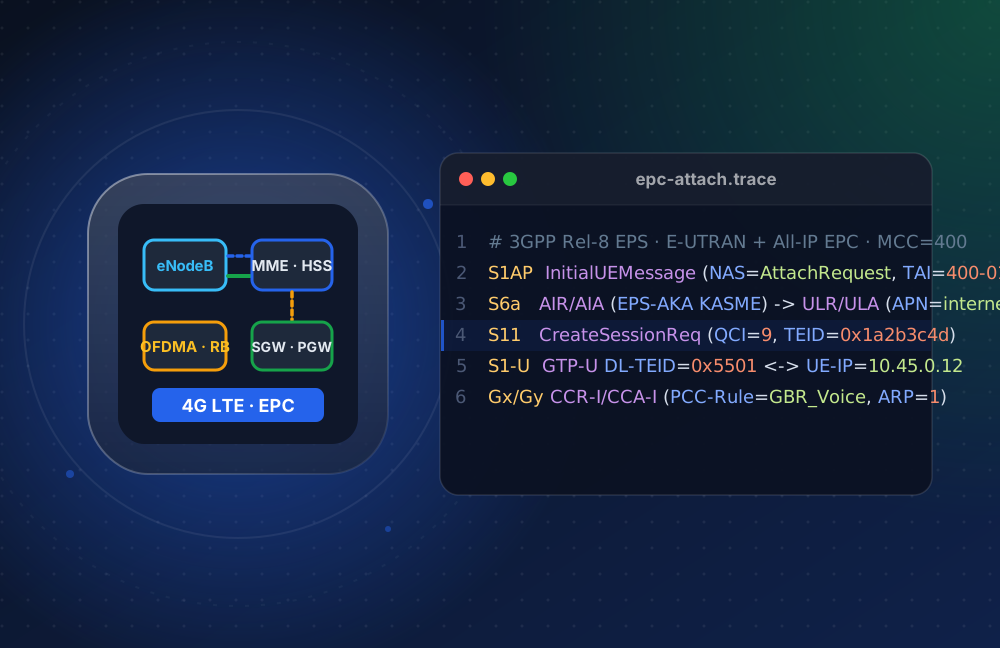
Complete IP Networks for Telecom Engineers and 2G/3G Mobile Networks: GSM, UMTS, MAP and SMS first: VLAN tagging, IPv4/IPv6 addressing, UDP/TCP/SCTP, DNS NAPTR/SRV records, DSCP/QoS marking, Wireshark packet analysis, as well as IMSI/IMEI/MSISDN identities, USIM AKA mutual authentication, and 2G/3G packet core fundamentals (SGSN, GGSN, PDP context and GTPv1) are used here without repeating the basics.
One topic, one lesson: interactive slides, signaling ladder diagrams, radio/GTP tunnel animations, exercises with automated answer checking, and study notes in three languages (az, ru, en). Every lesson includes a worked example, a “What can go wrong and how to find it” section, practice tasks and a self-check. Hands-on labs run on the track Docker testbed: Open5GS (EPC) + srsRAN 4G (in ZMQ virtual radio mode, no SDR hardware required) + Wireshark.
Course outline
01
Introduction to LTE and EPS
- why LTE was created (throughput, latency and cost-per-MB targets)
- comparing LTE, LTE-Advanced
- LTE-Advanced Pro and IMT-Advanced
- EPS = E-UTRAN + EPC overview (All-IP, no CS domain)
- EPC core nodes (MME, S-GW, P-GW, HSS, PCRF)
- EPC interface map (S1-MME, S1-U, S11, S5/S8, S6a, Gx, SGi, X2, S10, S13, SGs) and Huawei EPC product mapping (USN9810, UGW9811, UPCC, plus UNC and UDG in the convergent core)
02
LTE air interface
- OFDM fundamentals (orthogonal subcarriers and cyclic prefix)
- OFDMA in the downlink vs SC-FDMA in the uplink
- frame structure (10 ms frame, 1 ms subframe, slot)
- resource grid (Resource Block = 12 × 15 kHz and Resource Elements)
- 1.4–20 MHz channel bandwidths and frequency bands (Bands 3, 7, 20, etc.)
- physical channels (PDSCH, PDCCH, PUSCH, PUCCH, PBCH, PRACH) and reference signals
- MIMO spatial multiplexing and transmit diversity
- Carrier Aggregation (CA)
- cell search (PSS/SSS) and Random Access (RACH)
- basic eNodeB parameters (PLMN, TAC, Cell ID, frequency, power)
- cell reselection in idle and measurements in connected mode
- DRX battery saving and practicum
03
E-UTRAN and EPC protocols
- Control Plane and User Plane protocol stacks
- RRC states and messages
- RRC Connection Reconfiguration and Measurement Reports
- PDCP (ROHC header compression and ciphering)
- RLC (TM/UM/AM modes) and the MAC scheduler
- NAS signaling (EMM and ESM)
- S1AP procedures and S1 Setup
- X2AP, SCTP transport on S1-MME and Diameter
- GTPv2-C control messages
- GTP-U user plane tunneling and TEIDs
- GTP path management (Echo Request/Response and Recovery counter)
- GTP tunnel MTU math and TCP MSS clamping
- Diameter base protocol (CER/CEA, DWR/DWA, AVP format)
- Diameter realm and host routing
- Diameter result codes (2xxx–5xxx)
- Diameter agents (DRA, DEA and Huawei USC)
- S6a interface (AIR/AIA, ULR/ULA, CLR, IDR, PUR) and Gx/Gy interfaces (CCR/CCA, RAR)
04
Identities and node selection
- temporary identities GUTI
- S-TMSI and M-TMSI, tracking area identities TAI and TAC and global cell ID ECGI
- APN structure (Network Identifier and Operator Identifier)
- selecting MME, S-GW and P-GW via DNS S-NAPTR (3GPP TS 29.303)
- MME Pool architecture (S1-flex, MMEGI and MMEC)
- PDN Connection and IPv4 address allocation
- IPv6 in LTE (PDN type IPv4v6, /64 prefix allocation, Router Advertisement) and an identity trace decoding practicum
05
EPS Bearers and QoS
- the end-to-end EPS Bearer concept (Radio + S1 + S5/S8 bearers)
- Default vs Dedicated Bearers
- the standardized QCI table (GBR and non-GBR classes, delay and loss budgets)
- Allocation and Retention Priority (ARP)
- APN-AMBR and UE-AMBR rate limits
- Traffic Flow Templates (TFT) and packet filters
- mapping QCI to transport-layer DSCP markings
- APN subscription profiles in the HSS and a bearer design practicum
06
LTE/EPC signaling procedures
- overview of the 6 phases of Initial Attach
- Phase 1 (RRC Connection and Attach Request)
- Phase 2 (identification and mutual authentication via AIR/AIA and EPS-AKA)
- Phase 3 (NAS Security Mode Command)
- Phase 4 (location update ULR/ULA over S6a)
- Phase 5 (Create Session Request/Response over S11 and S5/S8)
- Phase 6 (Initial Context Setup, RRC Reconfiguration, Attach Complete and Modify Bearer)
- UE-requested additional PDN connectivity
- Detach initiated by UE
- MME or HSS, EMM and ECM state machines
- S1 Release and transition to ECM-IDLE
- Service Request and Paging
- Tracking Area Update (TAU)
- X2-based and S1-based handovers
- Dedicated Bearer activation and a call-flow trace practicum
07
EPC laboratory with Open5GS and srsRAN
- testbed architecture (Open5GS EPC + srsRAN 4G in ZMQ virtual radio mode)
- bringing up the EPC, eNodeB and UE containers
- provisioning a subscriber in the HSS (IMSI, secret key K, OPc, APN, QoS profile)
- capturing a full Attach flow (S1AP, NAS, GTPv2-C, Diameter) in Wireshark
- inspecting cleartext NAS with EEA0 ciphering
- verifying UE user-plane traffic inside GTP-U tunnels
- establishing a second PDN connection to a separate APN
- modifying AMBR and QCI dynamically
- dissecting Diameter S6a exchanges
- testing GTP Echo path failure when stopping the S-GW
- diagnosing and fixing GTP tunnel MTU blackholes
- and reproducing Attach Reject scenarios (wrong K, unknown IMSI, unsubscribed APN)
08
Policy and Charging Control (PCC)
- PCC architecture (PCRF, PCEF, AF, OCS online charging and OFCS offline charging)
- predefined vs dynamic PCC rules
- commercial policy use cases (Fair Usage tiering, Zero-Rating, bandwidth throttling)
- online charging over Diameter Gy
- quota management (CCR-Initial/Update/Termination and Final Unit Indication FUI)
- offline charging over Gz/Rf (S-GW/P-GW CDR generation and CGF)
- a hands-on Open5GS PCRF rule lab and a tariff design practicum
09
Pre-VoLTE voice, inter-RAT mobility and roaming
- Circuit Switched Fallback (CSFB) architecture (the SGs interface between MME and MSC/VLR)
- end-to-end MO and MT voice call flows via CSFB
- SMS over SGs without leaving LTE radio
- inter-RAT mobility (LTE ↔ 3G UMTS / 2G GSM handovers and reselection)
- LTE international roaming architecture (S8 Home Routed vs Local Breakout) and inter-carrier IPX transport
- Diameter Edge Agents (DEA) and S6a roaming
10
EPC evolution
Control and User Plane Separation (CUPS) in the EPC (SGW-C/SGW-U and PGW-C/PGW-U split, PFCP over the Sx interface) and Cellular IoT in the EPC (NB-IoT and LTE-M / Cat-M1, Data over NAS, PSM and eDRX power saving)
11
Huawei practice and network operations
- core MME configuration objects on Huawei USN9810
- configuring APNs and IP address pools on Huawei UGW9811
- handling alarms and subscriber signaling traces in Huawei EPC
- Wireshark display filters for LTE/EPC (s1ap, nas-eps, gtpv2, diameter and NAS decryption)
- comprehensive reference to EMM and ESM Cause Codes
- and calculating key LTE/EPC KPIs (Attach Success Rate, E-RAB Setup SR, Drop Rate and Throughput)
12
Problems, solutions and final project
- 31 real-world outage investigations (Attach Reject #3 Illegal UE, #7 EPS services not allowed, #8, #11 PLMN not allowed, #12 Tracking area not allowed, #13 Roaming not allowed in this TA, #15 No suitable cells, #19 ESM failure, #22 Congestion and #111 Protocol error; ESM rejects #26 Insufficient resources, #27 Missing or unknown APN and #33 Service option not subscribed; EPS-AKA Synch failure on SQN/AUTS desynchronization and MAC failure on mismatched K/OPc; S1 Setup Failure and SCTP association down; Diameter peer down on CER/CEA and S6a errors 5001 User Unknown and 5420 Unknown EPS Subscription; Create Session Reject, GTP path failure mass drops, P-GW IP pool exhaustion, websites stalling due to GTP tunnel MTU, DNS APN resolution failure, Dedicated Bearer creation failure on TFT/QCI/ARP mismatch, X2 handover failure at Path Switch, roaming TAU reject, CSFB call failure when SGs is down, paging no-response, and low throughput due to AMBR/QCI/radio)
- systematic EPC troubleshooting workflow and the end-to-end capstone project from handset power-on to loading the first web page
The tenth course of the 14-course Telecom track, from the telephone line to 5G.