VoLTE, VoWiFi and SRVCC

The VoLTE, VoWiFi and SRVCC course — GSMA IR.92, IMS APN, QCI 1 / QCI 5, P-CSCF and PCO, VoPS, T-ADS, Diameter Rx/Gx, dedicated bearer, AMR-WB and EVS, SRVCC/eSRVCC (Sv, ATCF), S8HR, ePDG, SWu IKEv2, S2b and Open5GS + Kamailio IMS
94 lessons · 7 labs · project
3 practicums · 25 troubleshooting cases
After LTE/4G and the EPC Core and IMS: Multimedia Core Network
Individual
Per month 200 AZN
Group
Per month 150 AZN
Paying for the full course in a group
15% discount
Installments
50/50
Subscription
from 30 AZN a month
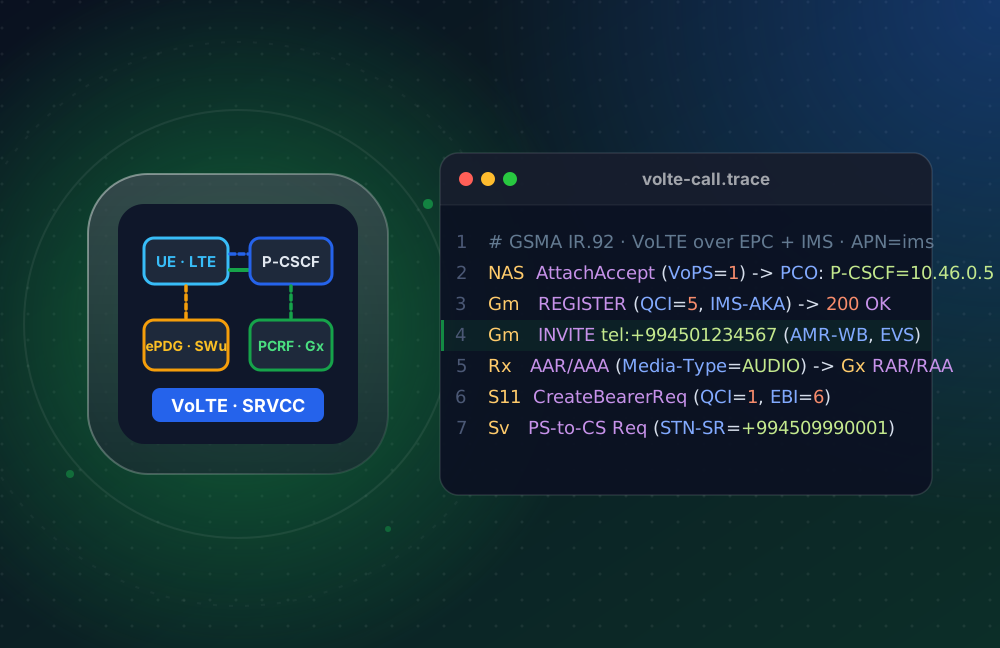
Why does a smartphone on a 4G network no longer fall back to 2G/3G to place a call, how does a conversation survive leaving LTE coverage without dropping, and how does the very same call travel over a home Wi-Fi network? This course walks step by step, message by message, through carrier-grade voice over packet networks — VoLTE, VoWiFi and Single Radio Voice Call Continuity (SRVCC) — per the GSMA IR.92, IR.51 and IR.65 profiles and 3GPP TS 23.228, TS 24.229, TS 29.214, TS 29.212, TS 23.216, TS 23.237, TS 23.402, TS 24.302 and TS 23.167. Architecture: why VoLTE replaces CSFB, how the LTE/EPC network and the IMS core combine into one solution (eNodeB, MME, S-GW, P-GW, PCRF, HSS, P-CSCF, S-CSCF, MMTel AS, SCC AS), what the handset and the network must support under the IR.92 profile, the IMS APN and its two bearers — a QCI 5 default bearer for SIP signaling and a QCI 1 dedicated bearer for voice, P-CSCF address delivery in PCO, the “IMS voice over PS supported” (VoPS) indication in Attach Accept and TAU Accept, voice domain selection on the handset, VoLTE settings on the device and the ISIM, and the role split in the Huawei VoLTE solution (per the VoLTE V500R020C10 documentation). Registration and related services: attach and the IMS PDN, REGISTER over LTE, GBA and BSF for the Ut interface, SMS over IP and the choice between SGs and IMS, USSD over IMS (USSI), and the causes of registration failures. Calls: MO and MT calls with T-ADS domain selection, the Rx session (AAR/AAA) from the P-CSCF to the PCRF, the voice PCC rule over Gx (RAR/RAA) and QCI 1 dedicated bearer creation, preconditions in VoLTE, call release and bearer deletion, AMR-WB and EVS codecs (modes, ptime), radio features for voice (SPS, TTI bundling, DRX, RoHC), DTMF as telephone-event alongside AMR and AMR-WB, MMTel supplementary services over Ut, conferencing, VoLTE calls to 2G/3G subscribers and ViLTE video calls. Call continuity: SRVCC over the Sv interface and an SRVCC-enhanced MSC Server, the STN-SR number, eSRVCC with anchoring in the ATCF and ATGW, transfer in the alerting phase and mid-call, an overview of vSRVCC and rSRVCC, and the SCC AS. Emergency calls (emergency attach and emergency bearer, E-CSCF), VoLTE roaming with S8HR and LBO, and VoLTE inter-operator interconnect. VoWiFi: the ePDG and its DNS-based discovery, the SWu tunnel (IKEv2 and IPsec) with EAP-AKA inside IKE_AUTH, the S2b interface to the P-GW (GTP), registration over Wi-Fi, Wi-Fi vs cellular preferences, Wi-Fi ↔ LTE handover, emergency calls and location. Operations: VoLTE KPIs (registration and call setup success, call drops, SRVCC success) and their calculation from counters, finding problem cells and nodes, test calls, handset logs and drive tests, S1AP, GTPv2, Diameter and SIP traces in a single picture, and Huawei VoLTE operations. Hands-on work — 7 labs (registration, call and SRVCC trace analysis, an Open5GS + Kamailio IMS testbed, the Rx → PCRF → Gx chain, IKEv2/IPsec on strongSwan, KPI calculation), 3 practicums, 25 real-world troubleshooting cases and a final project.

Enrollment for a new group is open — send a request to reserve your seat

Lessons are taught live in Azerbaijani and Russian.

Or study on your own in your personal account → with a subscription from 30 AZN a month

Before you start

Complete LTE/4G and the EPC Core and IMS: Multimedia Core Network first: from the former, EPS architecture (eNodeB, MME, S-GW, P-GW, HSS, PCRF), the Attach, TAU, handover and CSFB (SGs) procedures, S1AP, NAS and GTPv2-C signaling, EPS bearers with QCI, ARP and TFT, PCC policy and Diameter S6a/Gx; from the latter, the P-CSCF, I-CSCF, S-CSCF, HSS and MMTel AS, IMPI/IMPU identities and the ISIM, IMS-AKA registration with IPsec, iFC, session routing, Preconditions and Diameter Cx/Rx are used here without repeating the basics.

How the course works

One topic, one lesson: interactive slides, signaling ladder diagrams spanning S1AP, GTPv2, Diameter and SIP at once, animations of voice domain selection and SRVCC call transfer, KPI calculations, exercises with automated answer checking, and study notes in three languages (az, ru, en). Every lesson includes a worked example, a “What can go wrong and how to find it” section, practice tasks and a self-check. Labs combine real trace analysis in Wireshark with a Docker testbed: Open5GS (EPC with PCRF) + Kamailio IMS (P/I/S-CSCF) + pyHSS + rtpengine, plus strongSwan as a model of the SWu interface for VoWiFi.

Course outline

01

VoLTE architecture

  • why VoLTE instead of CSFB
  • LTE + IMS together (nodes and interfaces)
  • the GSMA IR.92 profile and its mandatory features
  • the IMS APN and EPS bearers (QCI 5 for SIP signaling and QCI 1 for voice)
  • P-CSCF address via PCO
  • the “IMS voice over PS supported” (VoPS) indication in network responses
  • voice domain selection on the handset
  • VoLTE settings on the device and the card (operator profile, ISIM) and the Huawei VoLTE solution: nodes and roles (per the VoLTE V500R020C10 documentation)
02

Registration and related services

  • attach and IMS PDN activation
  • REGISTER over LTE, GBA and BSF for Ut authentication
  • SMS over IP and choosing the SMS delivery path (SGs or IMS)
  • USSD over IMS (USSI), registration failures and their causes
  • a lab on a full registration trace (S1AP, GTPv2, Diameter, SIP) and a practicum
03

VoLTE calls

  • MO and MT calls with T-ADS domain selection
  • Diameter Rx (AAR/AAA) and Gx (RAR/RAA) with voice PCC rules
  • QCI 1 dedicated bearer creation
  • preconditions in VoLTE
  • call release and bearer deletion
  • AMR-WB and EVS codecs (modes, ptime)
  • radio features for voice (SPS, TTI bundling, DRX, RoHC)
  • DTMF as telephone-event alongside AMR and AMR-WB
  • MMTel supplementary services over Ut
  • conferencing, VoLTE ↔ 2G/3G subscriber calls
  • ViLTE video calls (codecs and bearers)
  • labs (a call trace with a dedicated bearer, an Open5GS + Kamailio IMS testbed with IMS registration over the EPC, the Rx → PCRF → Gx chain) and a practicum
04

Call continuity — SRVCC

  • why calls are moved to 2G/3G
  • the Sv interface and the SRVCC-enhanced MSC Server
  • the SRVCC call flow (3GPP TS 23.216)
  • eSRVCC with ATCF and ATGW (3GPP TS 23.237)
  • SRVCC in the alerting phase and mid-call
  • vSRVCC and rSRVCC overview
  • the SCC AS and T-ADS, an SRVCC trace lab and a practicum
05

Emergency calls and roaming

  • emergency attach and emergency bearer
  • the E-CSCF (3GPP TS 23.167)
  • VoLTE roaming with S8HR and LBO
  • S8HR in detail (GSMA IR.65) and VoLTE inter-operator interconnect
06

VoWiFi (GSMA IR.51)

  • why calls over Wi-Fi, the ePDG
  • ePDG discovery via DNS
  • the SWu interface (IKEv2 and IPsec)
  • EAP-AKA inside IKE_AUTH
  • S2b and GTP (3GPP TS 23.402, TS 24.302)
  • VoWiFi registration, Wi-Fi vs cellular preferences
  • Wi-Fi ↔ LTE handover, emergency calls and location
  • and an IKEv2/IPsec lab on strongSwan as a model of SWu
07

Operations

  • VoLTE KPIs (registration, call setup, drops, SRVCC) and how they are calculated
  • reading KPIs to find problem cells and nodes
  • a lab on calculating KPIs from counters
  • VoLTE testing (test calls, handset logs, drive tests)
  • Huawei VoLTE operations (per documentation)
  • S1AP, GTPv2, Diameter and SIP traces in a single picture
  • and where to look for one-way audio and call drops
08

Problems, solutions and final project

  • 25 real-world troubleshooting cases (no VoLTE icon: settings, subscription, VoPS; IMS PDN rejected because the APN is not subscribed; no P-CSCF address in PCO; 403 on VoLTE registration; IPsec failing on some handsets; dedicated bearer rejected and Rx AAR rejected by the PCRF; long call setup due to preconditions and paging; one-way audio and drops caused by bearer loss; SRVCC not triggering (Sv, STN-SR) and drops after SRVCC (ATCF); MT calls delivered to CS instead of LTE (T-ADS); EVS and AMR-WB failing to negotiate; DTMF not working with an IVR; undelivered SMS (SMSoIP vs SGs); VoLTE not working while roaming; failing emergency calls; call forwarding that cannot be configured (Ut and GBA); USSD not working (USSI or CSFB); ePDG not found in DNS; IKEv2 failing at EAP-AKA; drops on Wi-Fi ↔ LTE handover; VoWiFi dropping behind NAT; low MOS in a cell due to RoHC and radio conditions)
  • a systematic VoLTE and VoWiFi troubleshooting workflow and the final project — VoLTE and VoWiFi for an operator (registration, call, SRVCC, emergency call; ladder, KPIs, checklist)
How do we teach?

Learning stages

01

Webinar

Students join the lesson live. At the end of each lesson, students are sent a video recording of the class.

02

Homework

Every assignment is based on the topic covered in the webinar. Homework helps you reinforce the material and understand it better.

03

Working with a mentor

The teacher stays in touch with the group both during the course and outside class. Any questions get answered right away.

04

Portfolio

During the course you'll complete several projects on different topics — they'll show employers what you can do.

Self-paced learning

The full curriculum in your personal account

97 topics with theory, examples and practice. The first 4 are free, the rest come with a subscription. Interactive lessons with slides and coding trainers: 96.

Section 1. VoLTE Architecture9 topics
  1. Why VoLTE: Voice over IMS Instead of Circuit Switched Fallback (CSFB)
  2. VoLTE Architecture: LTE + IMS — Nodes, Interfaces, and Signaling and Voice Paths
  3. The GSMA IR.92 Profile: Mandatory Requirements for VoLTE Devices and Networks
  4. The IMS APN and VoLTE Bearers: QCI 5 Default Bearer for SIP and QCI 1 Dedicated Bearer for Voice
  5. P-CSCF Address Discovery via PCO: The Request in PDN Connectivity and the Network Response
  6. The IMS VoPS Indicator: “IMS Voice over PS Session Supported” in Attach Accept and TAU Accept
  7. Voice Domain Selection: Voice Domain Preference, UE Usage Setting, and VoPS
  8. VoLTE Settings on the Device and SIM: Operator Profile, ISIM, and IMS Parameters
  9. The Huawei VoLTE Solution: Network Elements and Their Roles (VoLTE V500R020C10)
Section 2. Registration and Related Services9 topics
  1. Attach and the IMS PDN: From Power-On to an IP Address on the IMS APN
  2. IMS Registration over LTE: REGISTER on the QCI 5 Bearer, IMS-AKA, and IPsec
  3. GBA and BSF: Bootstrapping Authentication for Ut (Ub, Ua, Zh, Zn)
  4. SMS over IP: SIP MESSAGE, IP-SM-GW, and Delivery Reports
  5. SMS in a VoLTE Network: SGs or IMS — Who Chooses and How
  6. USSI: USSD over IMS (SIP INVITE/INFO and USSD XML)
  7. VoLTE Registration Failures: From IMS PDN Reject to 403 and 494 — Where and Why
  8. Lab: A Full VoLTE Registration Trace — S1AP, NAS, GTPv2, Diameter, and SIP
  9. Practicum: VoLTE Registration from a Trace
Section 3. VoLTE Calls20 topics
  1. VoLTE Mobile-Originated Call: INVITE from the Device to the Terminating Network
  2. VoLTE Mobile-Terminated Call: Paging, INVITE Delivery, and T-ADS Domain Selection
  3. Rx in a VoLTE Call: AAR/AAA — Media Description from SDP to the PCRF
  4. Gx in a VoLTE Call: RAR/RAA and the PCC Rule for QCI 1 Voice
  5. Setting Up the QCI 1 Dedicated Bearer: Create Bearer, E-RAB Setup, and RRC Reconfiguration
  6. Preconditions in VoLTE: No Ringing Until the QCI 1 Bearer Is Up
  7. VoLTE Call Release: BYE, STR, and QCI 1 Bearer Deletion
  8. VoLTE Codecs: AMR-WB and EVS — Modes, ptime, and SDP Negotiation
  9. LTE Radio Features for Voice: SPS, TTI Bundling, C-DRX, and RoHC
  10. DTMF in VoLTE: telephone-event Alongside AMR and AMR-WB (RFC 4733)
  11. Supplementary Services in VoLTE: MMTel Services and Ut Configuration
  12. Conference Calls in VoLTE: Conference Factory URI, REFER, and MRF
  13. VoLTE ↔ 2G/3G Subscriber Calls: BGCF, MGCF, and IM-MGW
  14. ViLTE Video Calls: The GSMA IR.94 Profile, Video Codecs, and the QCI 2 Bearer
  15. Lab: A VoLTE Call Trace with a Dedicated Bearer
  16. Open5GS and srsRAN 4G (ZMQ Mode): Lab Testbed Architecture and Capabilities
  17. The IMS Lab Testbed: Kamailio IMS, pyHSS, rtpengine, DNS, and Asterisk
  18. Lab: An Open5GS + Kamailio IMS Testbed — IMS Registration over the EPC
  19. Lab: Rx → PCRF → Gx on the Testbed — The Voice Rule and Bearer
  20. Practicum: A VoLTE Call from a Trace
Section 4. Call Continuity: SRVCC9 topics
  1. SRVCC: Why and How a VoLTE Call Is Handed Over to 2G/3G
  2. The Sv Interface and the SRVCC-Enhanced MSC Server: STN-SR and C-MSISDN
  3. The SRVCC Call Flow: From Measurement Report to a CS Domain Call
  4. eSRVCC: Anchoring in the ATCF and ATGW for a Shorter Voice Gap
  5. SRVCC in the Alerting Phase (aSRVCC, bSRVCC) and Mid-Call SRVCC
  6. vSRVCC and rSRVCC: Video Call Handover and Reverse Handover to LTE — Overview
  7. SCC AS and T-ADS: Call Anchoring and Terminating Domain Selection
  8. Lab: Analyzing an SRVCC Trace — S1AP, Sv, and SIP
  9. Practicum: SRVCC Call Transfer from a Trace
Section 5. Emergency Calls and Roaming4 topics
  1. VoLTE Emergency Calls: Emergency Attach, Emergency Bearers, and the E-CSCF
  2. VoLTE Roaming: S8HR and LBO Architectures
  3. S8HR in Depth: Signaling and Voice Paths, QoS, and Emergency Calls (GSMA IR.65)
  4. VoLTE Operator Interconnect: IBCF/TrGW, IPX, and the NNI Profile
Section 6. VoWiFi12 topics
  1. Why VoWiFi: Calling over Wi-Fi Where LTE Falls Short (GSMA IR.51)
  2. The ePDG: Untrusted Wi-Fi Access Gateway to the EPC and Its Interfaces
  3. ePDG Discovery via DNS: Operator FQDN, NAPTR, and Address Selection
  4. SWu: The IKEv2/IPsec Tunnel Between the Device and the ePDG
  5. EAP-AKA Inside IKE_AUTH: SIM-Based Authentication via SWm and AAA
  6. S2b and GTPv2: The Session from the ePDG to the P-GW and the IMS APN
  7. VoWiFi Registration: REGISTER Inside the SWu Tunnel and WLAN Access Indications
  8. VoWiFi Preferences: Wi-Fi or Cellular — Modes and Thresholds
  9. Wi-Fi ↔ LTE Handover: Preserving the IP Address and the Call
  10. VoWiFi Emergency Calls and Caller Location
  11. Lab: building an IPsec tunnel with strongSwan (IKEv2 + ESP)
  12. Lab: IKEv2/IPsec on strongSwan as a Model of SWu
Section 7. Operations7 topics
  1. VoLTE KPIs: Registration, Setup, Drops, and SRVCC — Formulas and Calculation
  2. VoLTE KPI Analysis: Finding Problem Cells and Nodes
  3. Lab: Calculating VoLTE KPIs from Counters
  4. VoLTE Testing: Test Calls, Device Logs, and Drive Tests
  5. Huawei VoLTE Operations: Monitoring, Tracing, and KPIs (per Documentation)
  6. VoLTE Traces in Wireshark: S1AP, GTPv2, Diameter, and SIP in One Picture
  7. One-Way Audio and Call Drops in VoLTE: Where to Look
Section 8. Troubleshooting Cases and Capstone Project27 topics
  1. Case Study: No VoLTE Icon — Settings, Subscription, or VoPS
  2. Case Study: IMS PDN Rejected — The IMS APN Is Not Subscribed
  3. Case Study: No P-CSCF Address in the PCO
  4. Case Study: 403 Forbidden During VoLTE Registration
  5. Case Study: IPsec Fails on Some Device Models
  6. Case Study: Call Setup Fails — Dedicated Bearer Rejected
  7. Case Study: Rx AAR Rejected by the PCRF
  8. Case Study: Long Call Setup Time — Preconditions and Paging
  9. Case Study: One-Way Audio in VoLTE
  10. Case Study: Call Drop Due to Bearer Loss
  11. Case Study: SRVCC Fails — Sv and STN-SR
  12. Case Study: Call Drop After SRVCC — ATCF
  13. Case Study: Incoming Calls Go to CS Instead of LTE — T-ADS
  14. Case Study: EVS and AMR-WB Fail to Negotiate
  15. Case Study: DTMF Fails in an IVR over VoLTE
  16. Case Study: SMS Not Delivered — SMS over IP vs SGs
  17. Case Study: VoLTE Does Not Work in Roaming
  18. Case Study: VoLTE Emergency Call Fails
  19. Case Study: Call Forwarding Cannot Be Configured — Ut and GBA
  20. Case Study: USSD Not Working — USSI or CSFB
  21. Case Study: ePDG Not Found — DNS
  22. Case Study: IKEv2 Fails — EAP-AKA
  23. Case Study: Call Drop on Wi-Fi ↔ LTE Handover
  24. Case Study: VoWiFi Drops Behind NAT — Keepalives
  25. Case Study: Low MOS in a Cell — RoHC and Radio
  26. A Troubleshooting Method for VoLTE and VoWiFi
  27. Capstone Project: VoLTE and VoWiFi for an Operator — Registration, Calls, SRVCC, Emergency Calls; Ladders, KPIs, and a Checklist

Group and individual classes include a teacher, homework review and a certificate. The subscription gives you materials, exercises and progress tracking at your own pace, without teacher feedback.

VoLTE, VoWiFi and SRVCC: how to enroll

Fill in the form and we will tell you the start date of the next group, the schedule and payment terms. Or come to a free trial lesson first.

WhatsApp