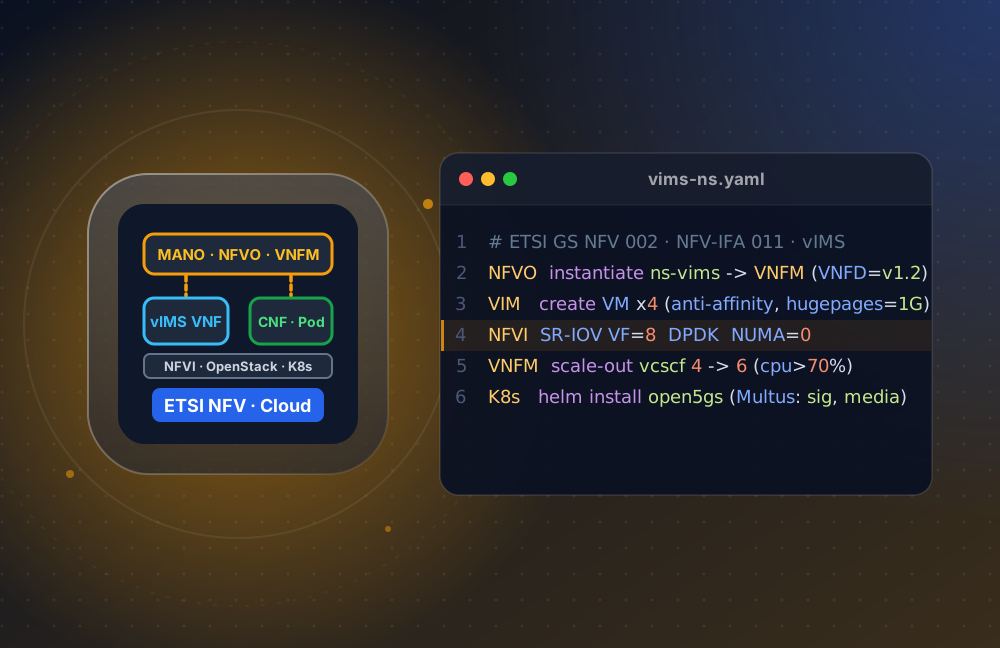
vIMS and Cloud Core: NFV, MANO, Containers

The vIMS and Cloud Core: NFV, MANO, Containers course — OpenStack, Open vSwitch, Ceph, SR-IOV, DPDK, NUMA, ETSI NFV (NFVI, VNF, MANO: NFVO, VNFM, VIM), VNFD and NSD, Huawei FusionSphere and FusionStage, vIMS, CNFs, Kubernetes, Multus, Helm, Prometheus and Grafana
63 lessons · 9 labs · project
12 troubleshooting cases
After the IP Networks for Telecom Engineers, LTE/4G and EPC Core, and IMS: Multimedia Core Network courses
Individual
Per month 200 AZN
Group
Per month 150 AZN
Paying for the full course in a group
15% discount
Installments
50/50
Subscription
from 30 AZN a month
Why do operators move IMS and the mobile core from dedicated cabinets onto ordinary servers, how do calls survive when a virtual machine fails, and why does the same CSCF run today as a container in Kubernetes? This course walks step by step through the operator cloud core — Network Functions Virtualisation (NFV), management and orchestration (MANO) and the cloud-native approach — following ETSI GS NFV 002, NFV-MAN 001, NFV-IFA 011 and NFV-IFA 014, NFV-SOL 001 and NFV-SOL 004. Infrastructure: why operators move away from dedicated hardware, the data centre (servers, storage systems, networking), the hypervisor and the virtual machine, OpenStack (Nova, Neutron, Cinder, Glance), Neutron and Open vSwitch networking, provider networks, Ceph distributed storage, affinity and anti-affinity rules, availability zones. Performance for telecom: direct access to the network card with SR-IOV, user-space packet processing with DPDK, NUMA, CPU pinning and hugepages. ETSI NFV: NFVI, VNF and MANO, the NFVO, VNFM and VIM roles, VNFD and NSD descriptors, the VNF package and onboarding, the instantiate, scale, heal and terminate workflows, Huawei FusionSphere, FusionStage, FusionClusterManager and Telco Cloud (from the product documentation). vIMS: IMS functions as VNFs, vIMS VM and module types (from the IMS V500R019C10 documentation), deployment stages, scaling, redundancy and geo-redundancy, signalling, media and management networks, operations. Cloud-native: microservices, Kubernetes networking (Pod, Service, CNI), extra interfaces with Multus for signalling and media, what a telecom cluster adds, Helm packages, CNFs versus VNFs, the CNF lifecycle, bare-metal containers, service mesh. Operations: monitoring with Prometheus and Grafana, logs and request tracing, rolling, canary and ISSU upgrades, backup and restore, capacity planning, cloud core security. Practice: 9 Kubernetes labs (a cluster, the Open5GS EPC via Helm, scaling, self-healing, Multus, Prometheus and Grafana, zero-downtime upgrades, resource limits, a VM versus a container), 12 real-world troubleshooting investigations and a final project.

Enrollment for a new group is open — send a request to reserve your seat

Lessons are taught live in Azerbaijani and Russian.

Or study on your own in your personal account → with a subscription from 30 AZN a month

Before you start

Complete the IP Networks for Telecom Engineers, LTE/4G and EPC Core, and IMS: Multimedia Core Network courses first. From the first: VLANs and trunks, IP addressing and routing, MTU, DNS, NTP, load balancers, TLS and certificates, Active/Standby and geo-redundancy, Wireshark and the track’s Docker labs. From the second: the EPC architecture (MME, S-GW, P-GW, HSS, PCRF) and the Open5GS lab. From the third: the IMS nodes (P-CSCF, I-CSCF, S-CSCF, HSS, AS, MRF, BGCF, MGCF), registration and sessions, and the basics of Huawei IMS operations. These are used here without being explained again. Container and Kubernetes basics are covered inside the course through linked topics from the Docker course.

How the course works

One topic, one lesson: interactive slides, NFV and MANO architecture diagrams, ladder diagrams of the instantiate, scale and heal workflows, animations of the VNF and CNF lifecycle, scaling and geo-redundancy, capacity calculations, exercises with automated answer checking, and study notes in three languages (az, ru, en). Every lesson has a worked example, a “What can go wrong and how to find it” block, practice and a self-check. The labs use Kubernetes (kind or k3s), Helm, Multus, Prometheus and Grafana on the track’s lab environment; the Huawei FusionSphere, FusionStage and vIMS topics follow the official product documentation.

Course outline

01

Virtualization and cloud infrastructure

  • why operators move away from dedicated hardware
  • the data centre (servers, storage systems, networking)
  • the hypervisor and the virtual machine
  • OpenStack (Nova, Neutron, Cinder, Glance)
  • OpenStack networking (Neutron, Open vSwitch, provider networks)
  • Ceph distributed storage
  • fault tolerance: affinity and anti-affinity, availability zones
02

Performance for telecom

  • SR-IOV — direct access from a virtual machine to the network card
  • DPDK — packet processing in user space
  • NUMA, CPU pinning and hugepages
03

ETSI NFV

  • the NFVI, VNF and MANO architecture (ETSI GS NFV 002)
  • the NFVO, VNFM and VIM roles (NFV-MAN 001)
  • VNFD and NSD descriptors and the VNF lifecycle
  • VNF onboarding (package, images, descriptors)
  • MANO workflows: instantiate
  • scale, heal, terminate; Huawei FusionSphere as the NFVI/VIM
  • FusionStage and FusionClusterManager
  • Huawei Telco Cloud and CloudCore — an overview (from the product documentation)
04

vIMS

  • IMS functions as VNFs, vIMS VM and module types (from the IMS V500R019C10 documentation)
  • vIMS deployment stages
  • scaling, redundancy and geo-redundancy
  • vIMS networking (planes, VLANs, external and internal networks)
  • operations: OMU, LMT, alarms
05

Cloud-native

  • cloud-native design and microservices
  • Kubernetes networking (Pod, Service, CNI)
  • several Pod interfaces for signalling and media networks (Multus)
  • Kubernetes in telecom, Helm packages
  • CNFs versus VNFs, the CNF lifecycle
  • Huawei bare-metal containers
  • service mesh in the core — an overview
06

Cloud core operations

  • monitoring with Prometheus and Grafana
  • logs and request tracing
  • upgrades (rolling, canary, ISSU)
  • backup and restore, capacity planning, cloud core security
07

Kubernetes lab

  • a training cluster, the Open5GS EPC in Kubernetes via Helm
  • scaling a component, self-healing
  • a second Pod interface with Multus
  • monitoring the core with Prometheus and Grafana
  • a zero-downtime upgrade
  • Pod resources and QoS classes
  • a VM versus a container: start-up and resource comparison
08

Problems, solutions and final project

  • 12 real-world troubleshooting cases (a VM cannot be scheduled — resources or anti-affinity; SR-IOV virtual functions missing; packet drops on the virtual switch; performance loss caused by NUMA; storage latency; CrashLoopBackOff; a Pod without its second interface; scaling cannot keep up with a signalling storm; split-brain in a redundant pair; a failed upgrade and rollback; expired cluster certificates; time drift in the cluster)
  • a systematic cloud core troubleshooting workflow and the final project — a vIMS deployment plan (resources, networks, redundancy, monitoring, work and rollback sequence)
How do we teach?

Learning stages

01

Webinar

Students join the lesson live. At the end of each lesson, students are sent a video recording of the class.

02

Homework

Every assignment is based on the topic covered in the webinar. Homework helps you reinforce the material and understand it better.

03

Working with a mentor

The teacher stays in touch with the group both during the course and outside class. Any questions get answered right away.

04

Portfolio

During the course you'll complete several projects on different topics — they'll show employers what you can do.

Self-paced learning

The full curriculum in your personal account

69 topics with theory, examples and practice. The first 4 are free, the rest come with a subscription. Interactive lessons with slides and coding trainers: 68.

Section 1. Virtualization and Cloud Infrastructure7 topics
  1. Why Operators Virtualize: From Dedicated Cabinets to Standard Servers
  2. The Data Centre: Servers, Storage, and Networking
  3. The Hypervisor and the Virtual Machine
  4. OpenStack: Nova, Neutron, Cinder, and Glance
  5. OpenStack Networking: Neutron, Open vSwitch, and Provider Networks
  6. Distributed Storage: Ceph
  7. High Availability: Affinity, Anti-Affinity, and Availability Zones
Section 2. Performance for Telecom3 topics
  1. SR-IOV: Direct Access from a VM to the Network Card
  2. DPDK: Packet Processing in User Space
  3. NUMA, CPU Pinning, and Hugepages
Section 3. ETSI NFV6 topics
  1. The ETSI NFV Architecture: NFVI, VNF, and MANO
  2. MANO: NFVO, VNFM, and VIM
  3. VNFD and NSD; the VNF Lifecycle: Instantiate, Scale, Heal
  4. VNF Onboarding: Package, Images, Descriptors
  5. MANO Workflows: Instantiate, Scale, Heal, Terminate
  6. Huawei FusionSphere as the NFVI/VIM (Product Documentation)
Section 4. vIMS7 topics
  1. vIMS Architecture: IMS Functions as VNFs
  2. vIMS VM and Module Types (IMS V500R019C10 Documentation)
  3. vIMS Deployment Stages (Product Documentation)
  4. Scaling vIMS
  5. vIMS Redundancy and Geo-Redundancy
  6. vIMS Networking: Planes, VLANs, External and Internal Networks
  7. vIMS Operations: OMU, LMT, Alarms
Section 5. Cloud-Native16 topics
  1. Containers vs Virtual Machines: Namespaces, cgroups, Images
  2. Why Kubernetes: Orchestration and Cluster Architecture
  3. Pods: Your First Manifest and kubectl apply
  4. Deployments: Replicas, Rolling Updates, Probes and Rollback
  5. Services: Reaching Pods Inside and Outside the Cluster
  6. Cloud-Native Design and Microservices
  7. Kubernetes Networking: Pod, Service, CNI
  8. Multiple Pod Interfaces with Multus for Signalling and Media Networks
  9. Kubernetes in Telecom: What a Regular Cluster Needs
  10. Helm: Application Packages
  11. CNFs versus VNFs
  12. The CNF Lifecycle
  13. Bare-Metal Containers at Huawei (Product Documentation)
  14. Huawei FusionStage and FusionClusterManager (Product Documentation)
  15. Huawei Telco Cloud and CloudCore: An Overview (Product Documentation)
  16. Service Mesh in the Core: An Overview
Section 6. Cloud Core Operations6 topics
  1. Monitoring: Prometheus and Grafana
  2. Logs and Request Tracing
  3. Upgrades: Rolling, Canary, ISSU
  4. Backup and Restore
  5. Capacity Planning
  6. Cloud Core Security
Section 7. Kubernetes Lab10 topics
  1. Track testbeds: how they work, how to start them, where to capture container traffic
  2. Lab: Building a Training Kubernetes Cluster
  3. Lab: Deploying the Open5GS EPC in Kubernetes with Helm
  4. Lab: Scaling a Component and Verifying It
  5. Lab: Self-Healing — Delete a Pod and Watch the Reaction
  6. Lab: A Second Pod Network Interface with Multus
  7. Lab: Monitoring the Core with Prometheus and Grafana
  8. Lab: A Zero-Downtime Upgrade
  9. Lab: Pod Resources and QoS Classes
  10. Lab: VM versus Container — Comparing Start-Up and Resources
Section 8. Problems and Solutions14 topics
  1. Case Study: A VM Cannot Be Scheduled — Resources or Anti-Affinity
  2. Case Study: SR-IOV Virtual Functions Are Missing
  3. Case Study: Packet Drops on the Virtual Switch
  4. Case Study: Performance Loss Caused by NUMA
  5. Case Study: Storage Latency
  6. Case Study: CrashLoopBackOff
  7. Case Study: A Pod Without Its Second Interface
  8. Case Study: Scaling Cannot Keep Up with a Signalling Storm
  9. Case Study: Split-Brain in a Redundant Pair
  10. Case Study: A Failed Upgrade and Rollback
  11. Case Study: Expired Cluster Certificates
  12. Case Study: Time Drift in the Cluster
  13. A Systematic Cloud Core Troubleshooting Workflow
  14. Capstone Project: A vIMS Deployment Plan — Resources, Networks, Redundancy, Monitoring, Work and Rollback Sequence

Group and individual classes include a teacher, homework review and a certificate. The subscription gives you materials, exercises and progress tracking at your own pace, without teacher feedback.

vIMS and Cloud Core: NFV, MANO, Containers: how to enroll

Fill in the form and we will tell you the start date of the next group, the schedule and payment terms. Or come to a free trial lesson first.

WhatsApp