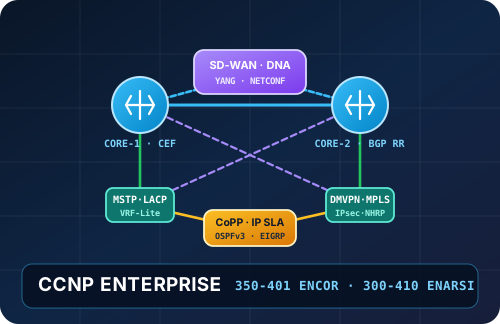
CCNP Enterprise: 350-401 ENCOR v1.2 + 300-410 ENARSI v1.2

CCNP Enterprise course: advanced routing, architecture, VPN, security and troubleshooting
Curriculum: 160 lessons · 16 sections · 10 free
Direct continuation of CCNA · network engineering level
AZ · RU · EN · EVE-NG / GNS3 / CML · Wireshark · DevNet
Individual
Per month 200 AZN
Group
Per month 150 AZN
Paying for the full course in a group
15% discount
Installments
50/50
Subscription
from 60 AZN a month
How do CEF hardware forwarding tables, the EIGRP DUAL state machine, OSPFv2/v3 LSA Types 1–9, and MP-BGP Best Path Selection with Route Reflectors work under the hood? How do you build a single-hub DMVPN Phase 3 cloud, an MPLS L3VPN core, VRF-Lite multi-tenancy, a VXLAN/LISP/SD-Access fabric, and isolate faults in complex troubleshooting tickets? Step up from CCNA to the full CCNP Enterprise (ENCOR + ENARSI) engineering curriculum.

Enrollment for a new group is open — send a request to reserve your seat

Lessons are taught live in Azerbaijani and Russian.

Or study on your own in your personal account → with a subscription from 60 AZN a month

What you need to start

This course builds directly on our 143-lesson CCNA curriculum: familiarity with OSI/TCP-IP, IPv4/IPv6 subnetting, foundational Cisco IOS CLI, VLANs, RSTP, single-area OSPF, and ACLs is expected. Hands-on labs use EVE-NG, GNS3, or Cisco Modeling Labs (CML) with real Cisco IOS XE / IOSv / IOSvL2 images, Wireshark packet captures, and the free Cisco DevNet Sandbox.

CCNA-level foundationEVE-NG / GNS3 / Cisco CMLWireshark + Cisco DevNet Sandbox12 hands-on ENARSI troubleshooting tickets

How you will learn

Every protocol is dissected down to its internal memory tables (RIB, FIB, Adjacency, LSDB, DUAL Topology, Adj-RIB-In/Loc-RIB/Adj-RIB-Out, LIB/LFIB, NHRP), packet headers, and state machines. Lessons combine interactive topology diagrams, step-by-step animations, real Cisco IOS XE CLI configurations, line-by-line show/debug output analysis, and structured "symptom → verification → root cause → fix" troubleshooting tickets.

The golden rule (R1)

Every CCNP-level concept, protocol header, LSA type, BGP attribute, and Cisco IOS XE CLI command is introduced in strict dependency order: no term or command appears in labs or troubleshooting tickets before the lesson that defines and explains it from the inside out. Term order and 100% blueprint coverage are verified automatically.

Full 16-section curriculum (160 lessons)

01

Enterprise Network Architecture and Hardware Forwarding

lessons 1–10
  • Tier 2/Tier 3 and Routed Access design
  • oversubscription, Cisco Express Forwarding (CEF: FIB and Adjacency tables)
  • SSO, NSF, ISSU, and StackWise Virtual HA
  • HSRP v1/v2, VRRP, and GLBP with Object Tracking
  • cloud models, and Cisco Catalyst SD-WAN (vManage, vSmart, vBond, WAN Edge, OMP, and TLOCs)
02

Advanced Switching: Trunking, EtherChannel, RSTP, and MSTP

lessons 11–20
  • 802.1Q and DTP troubleshooting
  • L2/L3 EtherChannel deep dive (LACP and PAgP, load-balancing hashes)
  • RSTP (802.1w) Proposal/Agreement synchronization
  • Multiple Spanning Tree (MSTP, 802.1s, IST/CST/CIST) regions and configuration
  • Root Guard, BPDU Guard
  • Loop Guard, UDLD, and VTP v3
03

Routing Architecture, Policies, and Path Control

lessons 21–30
  • route selection logic (Longest Prefix Match, Administrative Distance, metric)
  • prefix filtering with ip prefix-list (ge/le)
  • policy programming with route-maps and route tags
  • loop prevention mechanisms
  • one-way and mutual multi-point route redistribution (Route Feedback)
  • Policy-Based Routing (PBR), and BFD
04

EIGRP Deep Dive: IPv4, IPv6, and Named Mode

lessons 31–40
  • RTP transport, Classic vs. EIGRP Named Mode hierarchy
  • MD5 key-chain and HMAC-SHA-256 authentication
  • Classic and 64-bit Wide Metrics
  • DUAL state machine (RD, FD, Successor, Feasibility Condition RD < FD, Feasible Successor)
  • Unequal-Cost load balancing with variance
  • Queries, Stuck-in-Active (SIA)
  • EIGRP Stub (with leak-map), IPv6, and VRF
05

OSPF v2 and v3 Deep Dive

lessons 41–54
  • neighbor FSM and MTU verification in DBD
  • OSPF network types (broadcast, non-broadcast, point-to-point, point-to-multipoint)
  • LSA Types 1–5 and Forwarding Address
  • Stub, Totally Stubby, NSSA
  • and Totally NSSA areas (LSA Type 7 → Type 5)
  • path preference O > O IA > E1/N1 > E2/N2
  • summarization and 4 filtering methods
  • Virtual Links, OSPFv3 architecture (LSA Types 8 & 9)
  • OSPFv3 Address Families
  • SPF tuning, and LFA FRR
06

BGP: Architecture, Attributes, Policies, and Scaling

lessons 55–68
  • 2/4-byte and private ASNs
  • ISP multihoming topologies
  • BGP FSM and messages over TCP 179
  • eBGP vs. iBGP rules (iBGP Split Horizon, next-hop-self, update-source, ebgp-multihop, ttl-security)
  • Adj-RIB-In/Loc-RIB/Adj-RIB-Out tables
  • aggregation with as-set
  • 13-step BGP Best Path Selection
  • traffic engineering (Weight, LOCAL_PREF, AS_PATH prepend, MED)
  • AS_PATH regex, BGP Communities
  • Peer Groups, Route Reflectors
  • and MP-BGP for IPv6 and VRF
07

Multicast and Network Virtualization: VRF, LISP, VXLAN, SD-Access

lessons 69–78
  • IP Multicast addressing and 32:1 MAC overlap
  • IGMPv1/v2/v3 and IGMP Snooping
  • PIM Dense/Sparse Mode and SSM
  • RPF check, Rendezvous Point (Static, Auto-RP, BSR) and SPT Switchover
  • Type 1/2 hypervisors and vSwitch
  • VRF-Lite isolation, LISP architecture (EID, RLOC, xTR, MS/MR)
  • VXLAN (VNI, VTEP) with MP-BGP EVPN
  • and Cisco SD-Access fabric
08

Tunneling, MPLS, L3VPN, and DMVPN

lessons 79–88
  • GRE tunnels (MTU/MSS calculation and recursive routing)
  • IPsec VPN architecture (ESP/AH, Tunnel/Transport Mode, IKEv1 vs. IKEv2, IPsec profiles, and Static VTI)
  • MPLS operations (CE, PE, P, Push/Swap/Pop, PHP, LDP, LIB, and LFIB)
  • MPLS Layer 3 VPN (VRF, RD, RT, VPNv4, and two-label stack)
  • and Enterprise DMVPN (Phase 1, 2, and Phase 3 with mGRE, NHRP redirect/shortcut, and IPsec)
09

Enterprise Wireless Networks (WLAN)

lessons 89–98
  • RF engineering math (dBm, dBi, EIRP, RSSI, Noise Floor, SNR, rules of 3 and 10 dB)
  • 2.4/5 (DFS)/6 GHz bands and antenna patterns
  • WLAN deployment models (Centralized, FlexConnect, Embedded, Cloud) and AP modes
  • CAPWAP discovery and join (DHCP Option 43, DNS, WLC selection, DTLS)
  • Layer 2 and Layer 3 roaming (Foreign/Anchor WLC)
  • Location services (RSSI, AoA HyperLocation)
  • 802.1X EAP security (EAP-TLS, PEAP, EAP-FAST, EAP-TEAP)
  • WPA3-SAE, WebAuth, and WLC GUI troubleshooting
10

Infrastructure Security and Access Control

lessons 99–108
  • Console/VTY hardening (SSHv2, access-class with vrf-also, Role-Based CLI Views)
  • IOS XE AAA deep dive (TACACS+ vs. RADIUS, command authorization, local fallback)
  • advanced and time-based IPv4 ACLs in TCAM
  • IPv6 traffic filters and the Neighbor Discovery trap
  • Unicast RPF anti-spoofing (Strict vs. Loose)
  • Control Plane Policing (CoPP)
  • IPv6 First Hop Security (RA Guard, DHCP Guard, ND Inspection, Source Guard)
  • and Cisco TrustSec (802.1X, MAB, SGT)
11

Network Services, QoS, and IP SLA

lessons 109–116
  • DHCPv4 deep dive (ip helper-address, giaddr, Options 43/150, and Option 82 drop issue)
  • IPv6 addressing (SLAAC, Stateless and Stateful DHCPv6, relay, and Prefix Delegation)
  • authenticated NTP and PTP (IEEE 1588) overview
  • end-to-end QoS (DiffServ, CoS, DSCP EF and AFxy, Trust Boundary, CBWFQ, LLQ, WRED, Policing vs. Shaping)
  • active monitoring with IP SLA (icmp-echo, udp-jitter with responder)
  • and Enhanced Object Tracking
12

Network Assurance, Monitoring, and Diagnostics

lessons 117–126
  • Syslog with millisecond timestamps
  • safe production debugging with Conditional Debugging
  • SNMPv2c and SNMPv3 security and troubleshooting (view, group, user in authPriv SHA + AES-128)
  • Local SPAN, RSPAN, and GRE-routed ERSPAN packet mirroring
  • NetFlow v5, v9, IPFIX, and Flexible NetFlow
  • Cisco Catalyst Center workflows and Assurance diagnostics (Health Scores, Time Travel, Path Trace)
  • and Embedded Packet Capture (EPC)
13

Programmability, YANG, NETCONF/RESTCONF, and Automation

lessons 127–138
  • JSON validation vs. YAML and XML
  • Python scripts (json, requests, ncclient)
  • REST API security (HTTPS, Token/Bearer, X-Auth-Token, X-XSRF-TOKEN, OAuth 2.0, Rate Limiting)
  • YANG data models (IETF, OpenConfig, Cisco Native)
  • NETCONF (SSH 830, XML RPC, candidate/running) and RESTCONF (HTTPS, yang-data+json, HTTP methods and status codes)
  • Catalyst Center and SD-WAN vManage APIs
  • reactive EEM applets, Ansible vs. Puppet
  • Chef, and SaltStack, and Model-Driven Telemetry (MDT)
14

Comprehensive ENARSI Troubleshooting Tickets — Part 1: L2, IGP, and Redistribution

lessons 139–146
  • ENARSI troubleshooting methodology
  • 6 hands-on tickets (#1 HSRP/MSTP misalignment and LACP suspension, #2 dual-stack EIGRP Named Mode branch outage, #3 missing OSPF NSSA external routes due to Forwarding Address, #4 OSPFv3 Address Families and Virtual Link failure, #5 route feedback loop in mutual EIGRP ↔ OSPF redistribution, #6 blackhole in PBR with IP SLA)
  • and IGP troubleshooting lab marathon
15

Comprehensive ENARSI Troubleshooting Tickets — Part 2: BGP, VPN, VRF, and Security

lessons 147–154
  • 6 advanced ENARSI tickets (#7 iBGP Route Reflector prefixes missing ">" and MED failure, #8 ISP transit leak and dropped BGP Communities, #9 broken end-to-end VRF-Lite and MP-BGP chain, #10 IPsec failure and broken Spoke-to-Spoke shortcuts in DMVPN Phase 3, #11 flapping BGP/OSPF and blocked SSH due to CoPP and Strict uRPF, #12 AAA command lockout and DHCPv4 Option 82 / DHCPv6 relay failure)
  • second lab marathon, and 10-ticket mock exam
16

350-401 ENCOR & 300-410 ENARSI Exam Strategy and Capstone Project

lessons 155–160
  • exam strategies for 350-401 ENCOR v1.2 (120 min) and 300-410 ENARSI v1.2 (90 min)
  • Performance-Based Labs tactics
  • master CCNP protocol and CLI reference
  • and 3-part Enterprise Capstone Project (designing, building, securing, automating, and defending a multi-site enterprise network with HQ + DC + DMVPN branches + dual ISPs)

What you can do after the course

Design, deploy, secure, and troubleshoot large-scale enterprise campus and WAN infrastructures on Cisco IOS XE: featuring MSTP/LACP switched cores, resilient HSRP/VRRP/GLBP gateways, multi-area OSPFv2/v3 and EIGRP Named Mode, inter-domain MP-BGP with Route Reflectors and traffic engineering policies, loop-free mutual redistribution, VRF-Lite segmentation, VXLAN/LISP/SD-Access and SD-WAN fabrics, encrypted DMVPN Phase 3 and MPLS L3VPN networks, CoPP/uRPF/AAA/QoS enforcement, IP SLA/NetFlow/ERSPAN/Catalyst Center telemetry, and Python, YANG, NETCONF, RESTCONF, and EEM automation.

Cisco CCNP Enterprise Track Structure & Subsections Covered in This Course

The complete Cisco CCNP Enterprise certification track consists of the mandatory 350-401 ENCOR core exam plus 6 optional concentration exams. This course covers 100% of the two primary exams — the 350-401 ENCOR v1.2 core (which also serves as the qualifying exam for the CCIE Enterprise Infrastructure lab) and the flagship 300-410 ENARSI v1.2 routing concentration — while also covering the foundational ENCOR topics of the remaining concentrations:

✔ 350-401 ENCOR (Core — 100% covered): enterprise architecture, CEF, virtualization (VRF, LISP, VXLAN, SD-Access), MSTP/LACP switching, OSPF/EIGRP/BGP routing, enterprise WLAN, security, QoS, assurance, and automation.
✔ 300-410 ENARSI (Concentration — 100% covered): advanced IPv4/IPv6 routing and troubleshooting (OSPFv2/v3, EIGRP Named Mode, MP-BGP, redistribution, PBR, BFD), MPLS L3VPN, DMVPN Phase 3, infrastructure security, and services.
◐ 300-415 ENSDWI (Cisco Catalyst SD-WAN): our course covers SD-WAN control/data planes (vManage, vSmart, vBond, WAN Edge), OMP, TLOCs (Section 1), and vManage REST APIs (Section 13); deep SD-WAN template/policy deployment is a separate concentration.
◐ 300-420 ENSLD (Designing Cisco Enterprise Networks): our course covers Tier 2/Tier 3 and Routed Access campus design, FHRP HA, BGP multihoming, OSPF area design, and VPN topologies (Sections 1, 5, 6, 8); the dedicated design exam is a separate concentration.
◐ 300-435 ENAUTO (Automating Cisco Enterprise Solutions): our course covers Python, JSON/YAML/XML, YANG models, NETCONF/RESTCONF, Catalyst Center / SD-WAN APIs, EEM, and MDT telemetry (Section 13); advanced software automation is a separate concentration.
○ 300-440 ENCC (Cloud Connectivity) & 300-445 ENNA (Enterprise Network Assurance): specialized tracks on multi-cloud connectivity (AWS/Azure/GCP) and ThousandEyes assurance.
How do we teach?

Learning stages

01

Webinar

Students join the lesson live. At the end of each lesson, students are sent a video recording of the class.

02

Homework

Every assignment is based on the topic covered in the webinar. Homework helps you reinforce the material and understand it better.

03

Working with a mentor

The teacher stays in touch with the group both during the course and outside class. Any questions get answered right away.

04

Portfolio

During the course you'll complete several projects on different topics — they'll show employers what you can do.

Self-paced learning

The full curriculum in your personal account

160 topics with theory, examples and practice. The first 10 are free, the rest come with a subscription. Interactive lessons with slides and coding trainers: 157.

Section 1. Enterprise Network Architecture and Hardware Forwarding10 topics
  1. Hierarchical Campus Design: Access, Distribution, Core, and Oversubscription Sizing
  2. The L2/L3 Boundary in the Campus: Traditional Layer 2 Access vs. Routed Access
  3. Control, Data, and Management Planes: CEF Architecture, FIB, and Adjacency Tables
  4. Chassis High Availability: SSO, NSF, ISSU, StackWise Virtual, and MTBF/MTTR Availability Math
  5. HSRP Deep Dive: v1 vs. v2, State Machine, Object Tracking, and MHSRP
  6. VRRP and GLBP Protocols: Master/Backup Roles, AVG/AVF Load Balancing, and Configuration
  7. WAN and Cloud Deployment Models: On-Premises, IaaS/PaaS/SaaS, MPLS, and Hybrid Interconnects
  8. Cisco Catalyst SD-WAN Architecture: 4 Planes, vBond/vManage/vSmart Controllers, and WAN Edge
  9. OMP Protocol, TLOC Locators, and Application-Aware Routing Policies in Cisco SD-WAN
  10. Practicum: Campus Capacity and Availability Sizing, CEF Analysis, FHRP, and SD-WAN Selection
Section 2. Advanced Switching: Trunking, EtherChannel, RSTP, and MSTP10 topics
  1. 802.1Q Trunking and DTP Troubleshooting: Modes, Native VLAN, and VLAN Filtering
  2. Layer 2 and Layer 3 EtherChannel Deep Dive: LACP, PAgP, Priorities, and Load-Balancing Hashes
  3. Engineering Case Study: Troubleshooting EtherChannel Loops and Aggregation Failures (LACP/PAgP)
  4. RSTP (IEEE 802.1w) Internals: Port Roles, BPDU Flags, and Proposal/Agreement Synchronization
  5. MSTP (IEEE 802.1s) Architecture: MST Regions, MSTI Instances, IST/CST/CIST Trees, and PVST+ Simulation
  6. MSTP Configuration and Verification on Cisco IOS XE: Region Setup, Root Bridge Load Sharing, and Port Tuning
  7. STP Topology Protection Mechanisms: PortFast, BPDU Guard, BPDU Filter, Root Guard, Loop Guard, and UDLD
  8. VTP v3 and VLAN Pruning: Database Overwrite Protection, Extended VLANs, and MST Synchronization
  9. Lab: Building a Resilient Campus with LACP EtherChannel, MSTP, VTP v3, and STP Guards
  10. Engineering Case Study: 3 Layer 2 Campus Troubleshooting Tickets (MSTP, Root Guard, Loop Guard)
Section 3. Routing Architecture, Policies, and Path Control10 topics
  1. Route Selection Logic in RIB and FIB: Longest Prefix Match, Administrative Distance, and Metric
  2. Prefix Filtering with IP Prefix-Lists: Bitwise ge/le Operators and distribute-list Binding
  3. Route-Maps and Route Tagging: Boolean match/set Logic and Policy Filtering
  4. Routing Loop Prevention Mechanisms: Split Horizon, Route Poisoning, Null0 Discard Routes, and Tags
  5. Route Redistribution Fundamentals: RIB Extraction Rules and Seed Metrics (OSPF, EIGRP, BGP)
  6. Two-Point Mutual Redistribution: Route Feedback, the AD 170 vs. 110 Trap, and Loop Mitigation
  7. Policy-Based Routing (PBR): Traffic Interception, Default Next-Hop, and Availability Tracking
  8. BFD Protocol (RFC 5880): Sub-Second Data-Plane Failure Detection and Echo Mode
  9. Lab: Two-Point EIGRP/OSPF Redistribution with Route-Map Tagging, PBR, and BFD
  10. Engineering Case Study: Troubleshooting Route Feedback Loops, Missing OSPF Subnets, and PBR Blackholes
Section 4. EIGRP Deep Dive (IPv4, IPv6, Named Mode)10 topics
  1. EIGRP Architecture (RFC 7868): RTP Transport, Packet Types, and Named Mode vs. Classic Hierarchy
  2. EIGRP Adjacency and Authentication: Peering Requirements, MD5 Key-Chain Rotation, and HMAC-SHA-256
  3. EIGRP Metric Mathematics: 32-Bit Classic K1–K5 Composite Formula and 64-Bit Wide Metrics
  4. EIGRP DUAL Algorithm: FD/RD Metrics, Successor Selection, and the Feasibility Condition (FC)
  5. EIGRP Load Balancing: Equal-Cost (ECMP) and Unequal-Cost Multi-Path (UCMP, variance Multiplier)
  6. EIGRP Queries, Stuck-in-Active (SIA) Failures, and Bounding the Query Scope with EIGRP Stub
  7. EIGRP Route Summarization and Filtering: summary-address, leak-map, distribute-list, and offset-list
  8. EIGRP for IPv6 and VRF Environments: Link-Local FE80::/10 Peering and Isolated Address Families
  9. Lab: Enterprise EIGRP Named Mode Network (IPv4/IPv6/VRF) with SHA-256, UCMP, Stub, and leak-map
  10. Engineering Case Study: 4 EIGRP Troubleshooting Tickets (K-Values, FC with variance, DUAL-3-SIA, and Stub)
Section 5. OSPF v2 and v3 Deep Dive14 topics
  1. OSPF Link-State Architecture: 5 Packet Types, 7 FSM States, Master/Slave Election, and MTU Check
  2. OSPF Network Types and DR/BDR Elections: Broadcast, Non-Broadcast, Point-to-Point, and Point-to-Multipoint
  3. OSPF Area Hierarchy, ABR/ASBR Roles, and Detailed Anatomy of LSA Types 1–5 (Router, Network, Summary, External)
  4. OSPF Special Area Types: Stub, Totally Stubby, NSSA (LSA Type 7 and P-Bit Translation), and Totally NSSA
  5. OSPF Path Selection Algorithm and Cost Calculation: O > O IA > E1/N1 > E2/N2 Priority and reference-bandwidth
  6. OSPF Summarization and Filtering: area range, summary-address, filter-list, and distribute-list in
  7. Area 0 Backbone Continuity: OSPF Virtual Links vs. GRE Tunnels
  8. OSPFv2 Authentication and Security: Clear Text, MD5, HMAC-SHA-256 (Key-Chain), and TTL Security
  9. OSPFv3 Architecture (RFC 5340): Link-Local FE80::/10 Operation and Topology/Prefix Separation in LSA Types 8 and 9
  10. OSPFv3 Address Families (RFC 5838): Unified IPv6/IPv4 Routing Process and IPsec AH/ESP & HMAC-SHA Security
  11. OSPF Convergence Optimization: SPF/LSA Throttling, Prefix Suppression, and Loop-Free Alternate (LFA FRR)
  12. Lab: Multi-Area OSPFv2 Network (Stub, Totally NSSA, Virtual Link) with Summarization and HMAC-SHA-256
  13. Lab: Deploying Unified OSPFv3 Address Families for IPv4/IPv6 with Stub/NSSA Areas and IPsec Authentication
  14. Engineering Case Study: 5 OSPF v2/v3 Troubleshooting Tickets (MTU ExStart, 2-Way, Network Type, Forwarding Address, Virtual Link)
Section 6. BGP: Architecture, Attributes, Policies, and Scaling14 topics
  1. BGP-4 Protocol Architecture (RFC 4271): Autonomous Systems (2/4-Byte ASNs) and ISP Homing Topologies
  2. BGP Finite State Machine (FSM), 5 Message Types over TCP/179, and Troubleshooting Idle & Active States
  3. eBGP vs. iBGP Fundamentals: iBGP Split Horizon Rule, Loopback Peering, and next-hop-self
  4. Special eBGP Peering Modes: ebgp-multihop, disable-connected-check, GTSM (ttl-security), MD5, and Private ASNs
  5. BGP Prefix Origination and Aggregation: network, aggregate-address (as-set), and Adj-RIB-In / Loc-RIB / Adj-RIB-Out
  6. BGP Path Attributes Deep Dive: 4 RFC 4271 Categories (ORIGIN, AS_PATH, NEXT_HOP, LOCAL_PREF, MED) and Cisco Weight
  7. BGP Best Path Selection Algorithm (13 Tie-Breaker Steps) and Status Codes in show ip bgp
  8. BGP Outbound Traffic Engineering: Router-Local Weight vs. AS-Wide LOCAL_PREF and Soft Route Refresh
  9. BGP Inbound Traffic Engineering: AS_PATH Prepending, the MED Attribute, and deterministic-med
  10. BGP Route Filtering: AS_PATH Regular Expressions (filter-list) and Well-Known & Custom BGP Communities
  11. Scaling iBGP: Peer Groups, Peer Templates, and Route Reflectors (RR Rules, ORIGINATOR_ID, and CLUSTER_LIST)
  12. Multiprotocol BGP Architecture (MP-BGP, RFC 4760): AFI/SAFI, MP_REACH_NLRI Attributes, and IPv6/VRF Routing
  13. Lab: Dual-ISP Enterprise eBGP Multihoming with iBGP Route Reflectors, LOCAL_PREF, AS_PATH Prepend, and Communities
  14. Engineering Case Study: 5 BGP Troubleshooting Tickets (Active Loopback, NEXT_HOP, iBGP Split Horizon, AS_PATH, and Transit)
Section 7. Multicast and Network Virtualization (VRF, LISP, VXLAN, EVPN)10 topics
  1. IP Multicast Architecture and IGMP (v1/v2/v3): Class D Addressing, 01:00:5e MAC Mapping, and IGMP Snooping
  2. PIM Multicast Routing (Dense, Sparse, SSM): Reverse Path Forwarding (RPF) Check, (*,G)/(S,G) Trees, and RP Discovery
  3. Device and Server Virtualization: Type 1 & Type 2 Hypervisors, VMs, VNFs, Virtual Switches (EST/VST/VGT), and SR-IOV
  4. VRF-Lite Data Path Virtualization: RIB/FIB Table Isolation, Multitopology vrf definition, and VRF-Aware Verification
  5. LISP Protocol Architecture (RFC 6830): EID-to-RLOC Separation, ITR/ETR Roles, and Map-Server / Map-Resolver Control Plane
  6. VXLAN Overlay Networks (RFC 7348) and MP-BGP EVPN Control Plane: 24-Bit VNI, VTEP, BUM Traffic, and Type 2/5 Routes
  7. Cisco SD-Access Fabric Architecture: Synergy of LISP (Control Plane), VXLAN (Data Plane), and TrustSec SGT (Policy Plane)
  8. Lab: End-to-End Multi-Tenant VRF-Lite Deployment over 802.1Q Trunks with OSPF, EIGRP Named Mode, and MP-BGP
  9. Lab: Deploying PIM Sparse Mode with BSR, IGMPv2/v3 Subscriptions, SPT Switchover, and RPF Failure Troubleshooting
  10. Practicum: VXLAN/LISP Overlay MTU Calculation, Cisco SD-Access Packet Walk, and Analyzing show ip mroute
Section 8. Tunneling, MPLS, L3VPN, and DMVPN10 topics
  1. Point-to-Point GRE Tunnels (RFC 2784): 24-Byte Overhead, ip mtu / ip tcp adjust-mss Calculation, and %TUN-5-RECURDOWN
  2. IPsec VPN Cryptographic Architecture: ESP vs AH, Tunnel/Transport Modes, IKEv1 vs IKEv2 (RFC 7296), and Static VTI
  3. MPLS Operations (RFC 3031): CE/PE/P (LER & LSR) Roles, 32-Bit Label Header, Push/Swap/Pop (PHP), LDP, and LIB/LFIB Tables
  4. MPLS Layer 3 VPN Architecture (RFC 4364): PE VRFs, Route Distinguisher (RD), Route Target (RT), MP-BGP VPNv4, and Two-Label Stack
  5. Dynamic Multipoint VPN (DMVPN) Architecture: mGRE Interfaces, Next Hop Resolution Protocol (NHRP, NHS/NHC), and IPsec Profiles
  6. DMVPN Phases (Phase 1, 2, 3) and Overlay Routing: ip nhrp redirect / shortcut, CEF Override, EIGRP, OSPF, and BGP
  7. Step-by-Step Configuration and Verification of Secure DMVPN Phase 3 (Single Hub over IPsec) on Cisco IOS XE
  8. Lab: Building a DMVPN Phase 3 over IPsec Network (Hub + 2 Spokes) with EIGRP/OSPF and Dynamic Spoke-to-Spoke Tunnels
  9. Engineering Case Study: 4 DMVPN & IPsec Troubleshooting Tickets (%TUN-5-RECURDOWN, UP-NO-IKE, NHRP Auth, and Missing Shortcut)
  10. Practicum: Two-Label MPLS L3VPN Packet Walk, IPsec + GRE MTU Calculation, and Analyzing LFIB / VPNv4 / DMVPN Tables
Section 9. Enterprise Wireless Networks (WLAN)10 topics
  1. RF Engineering Math: mW and dBm, Rules of 3 and 10, Antenna Gain (dBi/dBd), EIRP, FSPL, RSSI, and SNR
  2. 2.4 / 5 / 6 GHz Bands, Channels (UNII, DFS, Channel Bonding), CCI/ACI Interference, Antenna Types, and Spatial Streams
  3. Enterprise WLAN Deployment Models (Centralized, FlexConnect, EWC, Cloud) and Access Point Operational Modes
  4. CAPWAP Protocol (RFC 5415, UDP 5246/5247): AP State Machine, WLC Discovery Methods (Option 43, DNS), and Selection Order
  5. Wireless Roaming Architecture: Intra- vs Inter-Controller, Layer 2 vs Layer 3 Roaming (Anchor/Foreign WLC), and 802.11r/k/v
  6. WLAN Location Services: Cell of Origin, RSSI Trilateration, Angle of Arrival (AoA / HyperLocation), and Perimeter AP Design
  7. Enterprise Wi-Fi Security (WPA2/WPA3-Enterprise): IEEE 802.1X / RADIUS Architecture and LEAP, EAP-FAST, PEAP, EAP-TLS, EAP-TEAP
  8. Pre-Shared Key and Guest Portals: WPA2-PSK vs WPA3-SAE (Dragonfly, 802.11w PMF), Cisco iPSK, and Local/Central WebAuth (CoA)
  9. WLAN Configuration and Troubleshooting on Cisco Catalyst 9800 (WLAN/Policy/Site/RF Profiles & Tags) and Client Diagnostics
  10. Engineering Case Study: 3 Enterprise Wi-Fi Troubleshooting Tickets (DHCP Option 43 & AP Cert, 802.1X PEAP Failure, and L3 Roaming Drop)
Section 10. Infrastructure Security and Access Control10 topics
  1. Management Plane Hardening: Console/VTY Lines, SSHv2, access-class vrf-also, scrypt/sha256 Password Hashing, and RBAC CLI Views
  2. Centralized AAA on Cisco IOS XE: TACACS+ (TCP 49) vs RADIUS (UDP 1812/1813), aaa new-model, Per-Command Authorization, and Fallback Local
  3. Advanced IPv4 Packet Filtering: TCAM Processing, TCP Flags (established/syn/ack), Fragments, Time-Based ACLs (time-range), and Resequence
  4. IPv6 Traffic Filtering (ipv6 traffic-filter): Implicit ICMPv6 Neighbor Discovery Rules (nd-ns / nd-na) and the Explicit deny ipv6 any any log Trap
  5. Anti-Spoofing with Unicast Reverse Path Forwarding (uRPF): CEF (FIB) Lookup, Strict Mode (rx) vs Loose Mode (any), and Asymmetric Routing
  6. Protecting the Router CPU with Control Plane Policing (CoPP): MQC Architecture (class-map / policy-map) on the control-plane Interface
  7. IPv6 First Hop Security (FHS): ND Inspection (Binding Table), RA Guard (host/router), DHCPv6 Guard, and IPv6 Source Guard
  8. Wired Campus Access Control (IEEE 802.1X, MAB, dACL) and Cisco TrustSec Microsegmentation (SGT Tags, SXP, and SGACL Matrix)
  9. Lab: Core Router Hardening (AAA TACACS+/RADIUS with Fallback Local, VTY vrf-also, 4-Class CoPP Policy, Strict/Loose uRPF, and IPv4/IPv6 ACLs)
  10. Engineering Case Study: 4 Infrastructure Security Tickets (AAA Lockout, CoPP BGP Drop, IPv6 NDP Blackhole, and Asymmetric Strict uRPF)
Section 11. Network Services, QoS, and IP SLA8 topics
  1. DHCPv4 Deep Dive: Relay DORA Exchange (ip helper-address and giaddr), Options 43/150, and the Option 82 Drop
  2. IPv6 Address Assignment: ICMPv6 RA Flags (A, M, O), SLAAC, Stateless/Stateful DHCPv6 (SARR), and Prefix Delegation
  3. Precision Time Hierarchy: NTPv4 Architecture (Stratum 0–16, Client/Peer/Master Modes, MD5 Auth, ACLs) and PTP (IEEE 1588)
  4. End-to-End QoS Architecture and Marking: IntServ vs DiffServ, L2 CoS (802.1p), L3 DSCP (CS, EF, AFxy), and Trust Boundary
  5. MQC Queuing, Congestion Avoidance, and Traffic Conditioning: CBWFQ, LLQ Strict Priority, WRED, Policing, and Shaping
  6. Active Network Monitoring with Cisco IP SLA: icmp-echo and udp-jitter Probes (MOS/ICPIF), ip sla responder, and Diagnostics
  7. Automated Path Failover (IP SLA + Enhanced Object Tracking): Track Objects, Boolean Lists, and Static Route, FHRP, and PBR Binding
  8. Lab: Enterprise Network Services (DHCPv4 with Option 82, DHCPv6 with PD, Authenticated NTP, and WAN Failover via IP SLA + Track)
Section 12. Network Analytics, Monitoring, and Diagnostics (Network Assurance)10 topics
  1. Syslog Architecture on Cisco IOS XE: 5 Logging Destinations, 8 Severity Levels (0–7), Message Anatomy, and msec Timestamps
  2. Safe Real-Time Debugging (debug and Conditional Debugging): CPU Protection, Buffered Logging, ACLs, and debug condition Filters
  3. SNMP Monitoring and Security (v2c and v3): MIB/OID Tree, Trap vs. Inform, USM/VACM Architecture (authPriv), and Configuration Chain
  4. Traffic Mirroring for Packet Analysis: Local SPAN, Campus RSPAN (remote-span VLAN), and Routed GRE-Encapsulated ERSPAN
  5. Network Flow Telemetry: The 7-Tuple Flow Key, NetFlow v5 -> v9 -> IPFIX Evolution, and Flexible NetFlow (Record, Exporter, Monitor)
  6. Cisco Catalyst Center (DNA Center) Architecture and Workflows: Intent-Based Networking and Design, Policy, Provision, and Assurance
  7. Proactive Diagnostics in Cisco Catalyst Center Assurance: Health Scores, Client 360 / Device 360, Time Travel, and Path Trace
  8. On-Box Packet Capture on Cisco IOS XE (Embedded Packet Capture — EPC): monitor capture Configuration, Filtering, and .pcap Export
  9. Lab: Core Network Observability (SNMPv3 authPriv with View and ACL, Flexible NetFlow Export, Routed ERSPAN, and EPC Packet Capture)
  10. Engineering Case Study: 4 Monitoring Tickets (Missing FNF Export, SNMPv3 AuthorizationError, Silent ERSPAN, and Assurance Trace)
Section 13. Programmability, YANG, NETCONF/RESTCONF, and Automation12 topics
  1. Structured Data Formats for Network APIs and Automation: JSON (RFC 8259), YAML, and XML Syntax
  2. Python Scripting for Network Engineers: Data Structures (list, dict), the json Module (loads/dumps), and requests
  3. REST API Architecture and Security: HTTPS/TLS, Basic Auth, Token Auth (JWT/Bearer, X-Auth-Token), OAuth 2.0, CSRF, and Rate Limiting
  4. YANG Data Modeling Language (RFC 6020 / 7950): Module Syntax (container, list, leaf), pyang Tree, and IETF, OpenConfig, and Native Models
  5. NETCONF Protocol (RFC 6241, SSH Port 830, XML): 4-Layer Architecture, RPC Operations, Datastores, and Python ncclient
  6. RESTCONF Protocol (RFC 8040, HTTPS Port 443): HTTP Methods (GET, POST, PUT, PATCH, DELETE), YANG URIs, yang-data+json/xml, and Status Codes
  7. Controller Northbound REST APIs: Cisco Catalyst Center (X-Auth-Token, Async taskId) and SD-WAN vManage (JSESSIONID + XSRF)
  8. On-Box Event-Driven Automation (Embedded Event Manager — EEM): Event Detectors, CLI Applets, Lexicographical Action Order, and Variables
  9. Configuration Management and Orchestration Tools (Ansible, Puppet, Chef, SaltStack, Terraform): Agentless vs. Agent and Push vs. Pull
  10. Model-Driven Telemetry (MDT / YANG-Push): Periodic and On-Change Subscriptions, kvGPB/JSON, gRPC, and Dial-Out vs. Dial-In
  11. Lab: Programming Cisco IOS XE with Python — Configuring ietf-interfaces via NETCONF (ncclient) and RESTCONF (requests)
  12. Lab: Reactive EEM Applets on Cisco IOS XE (Syslog Recovery, CLI reload Intercept, IP SLA Track) and Controller REST APIs
Section 14. Comprehensive ENARSI Troubleshooting Tickets (Part 1: L2, IGP, and Redistribution)8 topics
  1. CCNP ENARSI Troubleshooting Methodology: Search Strategies and Isolating Control Plane vs. Data Plane Failures
  2. ENARSI Ticket #1: Campus Core Cascade Failure (Suspended LACP Member, HSRP Active vs. MSTP Root Mismatch, and ARP/CAM Flooding)
  3. ENARSI Ticket #2: Branch Isolation in Dual-Stack EIGRP Named Mode (Expired HMAC-SHA-256 Keychain, Broken leak-map, and Transit eigrp stub)
  4. ENARSI Ticket #3: OSPF External Routes in LSDB (Type 7/5) Missing from RIB (Unreachable Forwarding Address and suppress-fa)
  5. ENARSI Ticket #4: OSPFv3 Address Families Outage (Broadcast vs. Point-to-Point SPF, Virtual Link over Stub, and ge/le Filter)
  6. ENARSI Ticket #5: Suboptimal Routing and Feedback Loop at the EIGRP / OSPF Boundary (AD 170 vs. AD 110, Tags, and distance)
  7. ENARSI Ticket #6: Inter-VLAN Blackhole under PBR and IP SLA Probe Timeout (Overly Broad PBR ACL and WAN ICMP Echo-Reply Drop)
  8. Lab: ENARSI Troubleshooting Marathon (Part 1) — Diagnosing and Fixing 6 Multi-Layer Faults Across L2, EIGRP, OSPF, and PBR
Section 15. Comprehensive ENARSI Troubleshooting Tickets (Part 2: BGP, VPN, VRF, and Security)8 topics
  1. ENARSI Ticket #7: iBGP Core Failures with Route Reflector and Dual ISPs (Unreachable Next-Hop, Missing Null0 Anchor, and MED)
  2. ENARSI Ticket #8: Missing Backup ISP Routes and BGP Transit Leak (no-advertise vs. no-export, Missing send-community, and AS_PATH Regex)
  3. ENARSI Ticket #9: Connectivity Loss in Multi-Tenant VRF-Lite (Cleared IP on vrf forwarding, Missing AF VRF Activation, and Return Route)
  4. ENARSI Ticket #10: Branch IPsec Failure and Spoke-to-Spoke Degradation in DMVPN Phase 3 (ESP Blocked by ACL, NHRP ID, and Missing Redirect)
  5. ENARSI Ticket #11: BGP/OSPF Flapping and SSH/SNMP Drop on Edge Router (One-Way BGP ACL in CoPP, match-all Trap, and Strict uRPF)
  6. ENARSI Ticket #12: AAA Command Lockout and Campus DHCPv4/DHCPv6 Failure (Missing local Fallback, DHCP Option 82 Untrusted, and ND O-Flag)
  7. Lab: ENARSI Troubleshooting Marathon (Part 2) — Fixing 6 Faults Across MP-BGP, VRF-Lite, DMVPN Phase 3, CoPP, uRPF, AAA, and DHCP
  8. CCNP ENARSI Full Mock Troubleshooting Practicum: Analyzing 10 Exam Tickets from show running-config, RIB, BGP, DMVPN, and CoPP Outputs
Section 16. 350-401 ENCOR & 300-410 ENARSI Exam Preparation and Capstone Project6 topics
  1. Cisco 350-401 ENCOR v1.2 Exam Strategy: 6 Blueprint Domains, Performance-Based CLI Labs, 120-Minute Pacing, and Readiness Checklist
  2. Cisco 300-410 ENARSI v1.2 Exam Strategy: 4 Blueprint Domains, Rapid Ticket Triage in 90 Minutes, and Time-Saving CLI Output Filters
  3. CCNP Enterprise Master Protocol & CLI Reference: TCP/UDP Ports, IP Numbers, Multicast Addresses, AD Values, Timers, and Verification
  4. CCNP Capstone Project (Part 1 — Campus, Core, VRF & Routing): Building the HQ + DC Network (MSTP, FHRP, VRF-Lite, OSPF/EIGRP, and BGP RR)
  5. CCNP Capstone Project (Part 2 — DMVPN WAN, Security, Services & Automation): IPsec, IP SLA/PBR, AAA, CoPP, NetFlow, and Python/EEM
  6. CCNP Capstone Project (Part 3 — Acceptance Testing & Failure Drills): 25-Point Verification Checklist, Failover Audit, and 5 Live Tickets

Group and individual classes include a teacher, homework review and a certificate. The subscription gives you materials, exercises and progress tracking at your own pace, without teacher feedback.

CCNP Enterprise (ENCOR + ENARSI): 350-401 & 300-410 enterprise networks: how to enroll

Fill in the form and we will tell you the start date of the next group, the schedule and payment terms. Or come to a free trial lesson first.

WhatsApp