IP Networks for Telecom Engineers

The IP Networks for Telecom Engineers course — packet networking for VoIP, IMS, LTE and 5G
95 lessons · 9 labs · project
3 practicums · 16 troubleshooting cases
After the Telecom Fundamentals course
Individual
Per month 200 AZN
Group
Per month 150 AZN
Paying for the full course in a group
15% discount
Installments
50/50
Subscription
from 60 AZN a month
Why voice and signalling moved from E1 links to IP, and how an operator IP core is built. Ethernet, VLANs (802.1Q) and LACP bonding; IPv4/IPv6 addressing, ARP/NDP and MTU; routing, OSPF, BGP, VRF plane separation and ECMP; packet capture with Wireshark and tcpdump; UDP, TCP and carrier-grade SCTP; DNS (SRV, NAPTR), ENUM, NTP/PTP time sync and NAT; QoS for voice (DSCP, EF); IPsec, TLS/mTLS and HTTP/2; VRRP and BFD redundancy. All labs run on Docker testbeds.

Enrollment for a new group is open — send a request to reserve your seat

Lessons are taught live in Azerbaijani and Russian.

Or study on your own in your personal account → with a subscription from 60 AZN a month

Before you start

Complete Telecom Fundamentals first: signals, PCM (64 kbit/s), the E1 stream, circuit and packet switching, delay and synchronization are used here without repeating the explanation.
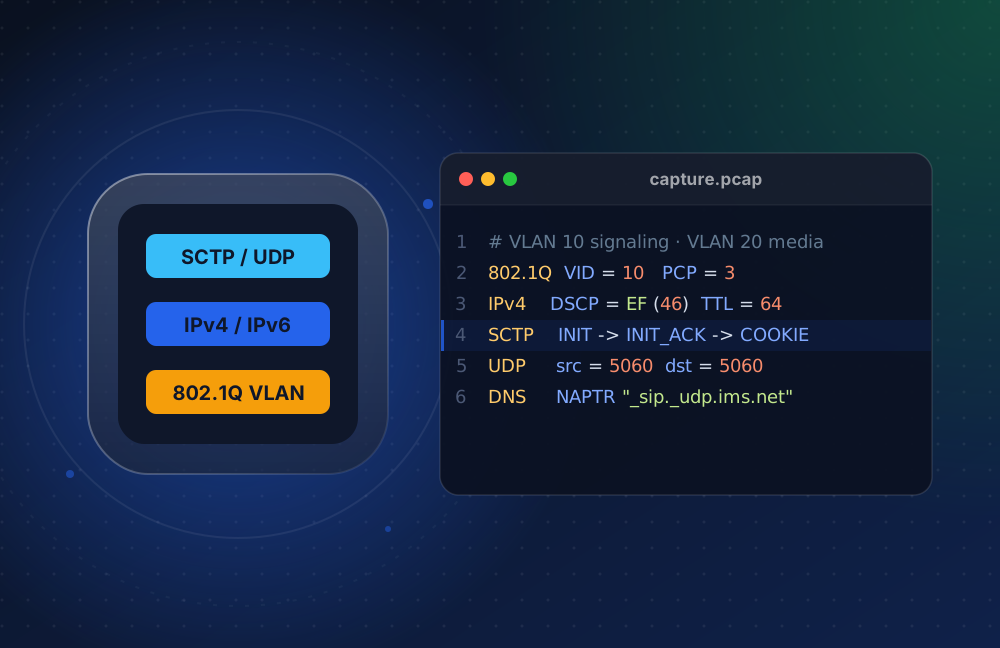
How the course works

One topic, one lesson: interactive slides, animations and message-flow diagrams, exercises with answer checking, and study notes in three languages (az, ru, en). Each lesson has a worked example, a “What can go wrong and how to find it” section, practice and a self-check. Starting from this course, hands-on labs run on the track’s Docker testbeds with live packet capture and analysis in tcpdump and Wireshark.

Course outline

01

Models and Ethernet

  • why voice and signalling moved to IP
  • the OSI and TCP/IP models
  • Ethernet frames and the MAC table
  • VLANs (802.1Q), STP and LACP
02

IP addressing

  • IPv4 and subnetting (CIDR)
  • IPv6 and SLAAC/DHCPv6 autoconfiguration
  • ARP and NDP, the IPv4 header
  • MTU and fragmentation, ICMP, ping and traceroute
03

Routing

  • the routing table, static routes
  • the idea behind OSPF and BGP
  • separating signalling, media and management with VRFs
  • ECMP, core node addressing plans
04

Lab environment and packet capture

  • Docker testbeds, Wireshark and display filters
  • server-side capture with tcpdump and pcap files
05

Transport layer

  • ports and sockets, UDP and TCP
  • choosing a transport for voice
  • SCTP (four-way handshake, chunks, multi-homing, multi-streaming and failure detection)
06

Network services

  • DNS (A/AAAA, SRV, NAPTR) and ENUM
  • DHCP, NTP and PTP time synchronization
  • NAT/PAT, firewalls (ACLs)
  • L4/L7 load balancers, SNMP and syslog monitoring
07

Quality of Service (QoS)

  • delay, jitter and loss
  • DSCP and PHB (EF, AF, BE)
  • queuing and scheduling
  • policing and shaping, end-to-end voice QoS
08

Secure and application protocols

  • IPsec and IKEv2, TLS, certificates (PKI) and mTLS
  • DDoS overview, HTTP/REST/JSON and HTTP/2 binary streams
09

Redundancy and diagnostics

  • active/standby and active/active
  • VRRP, BFD fast failure detection
  • mtr and iperf, advanced Wireshark and multi-point capture
10

Problems and solutions

  • 16 cases, from MTU black holes and asymmetric routing to SCTP association flapping
  • lost DSCP markings and broadcast storms
11

Project

  • a telecom node IP plan — VLANs
  • subnets, VRFs, transport per protocol
  • QoS classes and redundancy
How do we teach?

Learning stages

01

Webinar

Students join the lesson live. At the end of each lesson, students are sent a video recording of the class.

02

Homework

Every assignment is based on the topic covered in the webinar. Homework helps you reinforce the material and understand it better.

03

Working with a mentor

The teacher stays in touch with the group both during the course and outside class. Any questions get answered right away.

04

Portfolio

During the course you'll complete several projects on different topics — they'll show employers what you can do.

Self-paced learning

The full curriculum in your personal account

100 topics with theory, examples and practice. 6 of them are free (marked in the program), the rest come with a subscription. Interactive lessons with slides and coding trainers: 99.

Models and Ethernet8 topics
  1. Why voice and signalling moved to IP
  2. The OSI and TCP/IP models: layers and encapsulation
  3. Ethernet: the frame and the MAC address
  4. The switch: MAC table, broadcast and unknown unicast
  5. VLAN and 802.1Q: separating voice, signalling and management
  6. Access and trunk ports, native VLAN
  7. Layer 2 loops and STP
  8. Link aggregation (LACP) and server port redundancy
IP addressing11 topics
  1. The IPv4 address and binary notation
  2. Subnet mask, prefix (CIDR), network and host addresses
  3. Private and public addresses, special ranges
  4. Practicum: subnetting a network for core nodes
  5. IPv6: notation, abbreviation and address types
  6. IPv6 autoconfiguration: SLAAC and DHCPv6
  7. Dual-stack: IPv4 and IPv6 at the same time
  8. ARP and NDP: finding a MAC address from an IP address
  9. The IPv4 header: TTL, protocol, DSCP, fragmentation
  10. MTU and fragmentation: why it matters for signalling and tunnels
  11. ICMP, ping and traceroute
Routing8 topics
  1. The router, the routing table and the default gateway
  2. Static routes
  3. OSPF: the idea behind a link-state protocol
  4. BGP: routing between networks
  5. VRF: separating signalling, media and management networks
  6. ECMP: equal-cost multipath and load balancing
  7. Core node addressing plan: loopbacks, interfaces, networks
  8. Practicum: routes for a telecom node
Lab environment and packet capture11 topics
  1. Linux for Developers: Ubuntu 24.04, WSL2 and a Practice Machine
  2. Terminal and Navigation: Commands, Paths and Directory Layout
  3. Installing Docker: Docker Desktop and Docker Engine on Ubuntu 24.04
  4. Your First Container: docker run and Its Key Flags
  5. Docker Compose: Your First compose.yaml and Core Commands
  6. Track testbeds: how they work, how to start them, where to capture container traffic
  7. Wireshark: capture, packet list, protocol tree, Follow Stream
  8. Wireshark display filters: addresses, ports, protocols, fields
  9. Server-side packet capture: tcpdump and pcap files
  10. Lab: container network, ping and capture — seeing Ethernet, ARP, IP and ICMP
  11. Lab: routing between subnets in containers
The transport layer11 topics
  1. Ports and sockets
  2. UDP: header and properties
  3. TCP: connection setup, acknowledgements and retransmissions
  4. The TCP window and throughput
  5. Why voice runs over UDP while other traffic uses TCP
  6. SCTP: association and the four-way handshake (INIT, INIT ACK, COOKIE ECHO, COOKIE ACK)
  7. SCTP chunks: DATA, SACK, HEARTBEAT, ABORT, SHUTDOWN
  8. SCTP multi-homing and multi-streaming
  9. SCTP failure detection: RTO, retransmissions and path failure
  10. Lab: TCP, UDP and SCTP with ncat — comparing them in Wireshark
  11. Practicum: choosing a transport and decoding headers
Network services11 topics
  1. DNS: zones, A/AAAA records and recursive lookup
  2. SRV and NAPTR records: discovering service, transport and port
  3. ENUM: phone number → e164.arpa domain → NAPTR → URI
  4. DHCP: automatic address and parameter assignment
  5. Time synchronization: NTP and PTP
  6. NAT and PAT: network address and port translation
  7. Access control lists (ACLs) and firewalls
  8. L4/L7 load balancers and health checks
  9. Monitoring: SNMP, syslog and network counters
  10. Lab: running your own DNS server with SRV, NAPTR and ENUM, testing with dig
  11. Lab: NAT on Linux — what changes inside the packets
Quality of Service (QoS)6 topics
  1. Latency, jitter and packet loss: why QoS matters
  2. Classification, DSCP marking and PHB (EF, AF, CS, BE)
  3. Queues, priority and scheduling (FIFO, PQ, WFQ, LLQ)
  4. Traffic policing and shaping
  5. End-to-end QoS for voice
  6. Lab: latency, jitter, loss and priority queues with Linux tc and netem
Secure and application protocols10 topics
  1. IPsec: AH and ESP, tunnel and transport modes
  2. IKEv2: IKE_SA_INIT and IKE_AUTH exchanges and Child SAs
  3. TLS: handshake and encryption
  4. Certificates, trust chains and certificate authorities (PKI)
  5. Mutual authentication (mTLS)
  6. DDoS: attack types and defenses — an overview
  7. HTTP, REST and JSON: modern APIs for telecom nodes
  8. HTTP/2: streams, multiplexing and binary frames
  9. Lab: building an IPsec tunnel with strongSwan (IKEv2 + ESP)
  10. Lab: TLS, certificates, openssl s_client and curl --http2
Redundancy and high availability4 topics
  1. Active/Standby, Active/Active, N+1 and geo-redundancy
  2. VRRP: the virtual default gateway
  3. BFD: sub-second failure detection
  4. Lab: VRRP with keepalived — failover and what appears on the wire
Diagnostic tools3 topics
  1. mtr and iperf3: path, packet loss and throughput
  2. Advanced Wireshark: Follow Stream, Expert Info, I/O Graphs, Decode As and profiles
  3. Multi-point packet capture and comparing traces (pcap)
Troubleshooting cases and solutions17 topics
  1. Case study: large packets disappear — an MTU black hole
  2. Case study: duplicate IP address conflict
  3. Case study: asymmetric routing and a stateful firewall
  4. Case study: stale ARP cache after failover
  5. Case study: VLAN and native VLAN mismatch
  6. Case study: slow or unresponsive DNS delaying call setup
  7. Case study: NAT forgets the UDP session — why incoming calls stop arriving
  8. Case study: firewall blocks the dynamic UDP port range — calls connect with no audio
  9. Case study: SCTP failed to switch over to the secondary path
  10. Case study: SCTP association keeps flapping — overly aggressive RTO and Path.Max.Retrans
  11. Case study: DSCP marking is bleached to zero in the transport network
  12. Case study: expired TLS certificate or incomplete chain breaking a secure trunk
  13. Case study: clock drift (NTP failure) breaking logs, billing and TLS
  14. Case study: packet reordering caused by per-packet ECMP load balancing
  15. Case study: port speed and duplex mismatch
  16. Case study: L2 loop causing a broadcast storm
  17. Course project: designing and troubleshooting a telecom node IP network

Group and individual classes include a teacher, homework review and a certificate. The subscription gives you materials, exercises and progress tracking at your own pace, without teacher feedback.

IP Networks for Telecom Engineers: how to enroll

Fill in the form and we will tell you the start date of the next group, the schedule and payment terms. Or come to a free trial lesson first.

WhatsApp