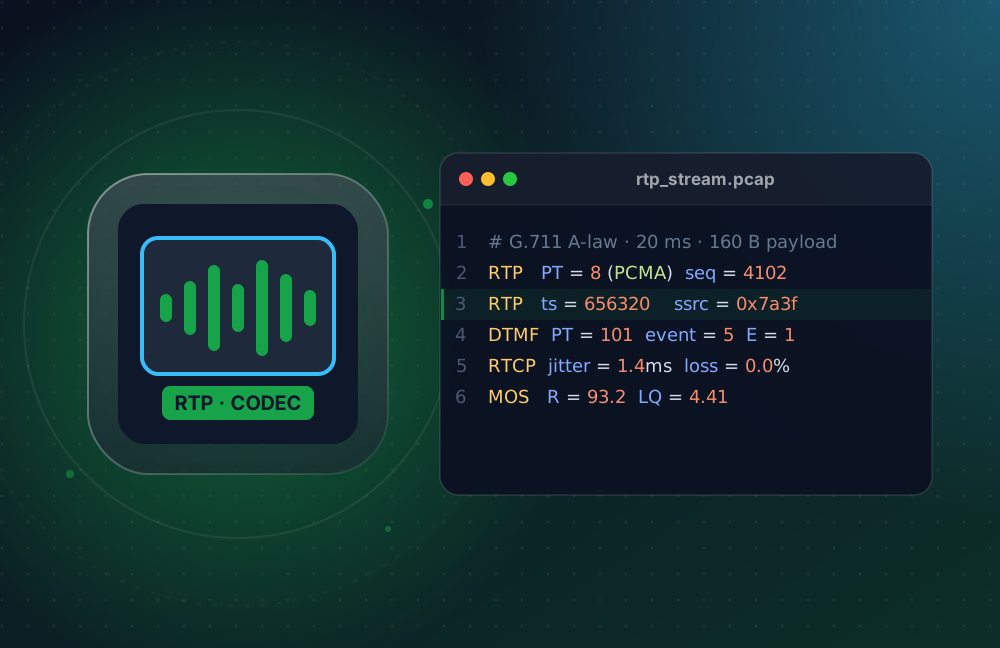
Voice over IP: Codecs, RTP, DTMF and Quality

The Voice over IP: Codecs, RTP, DTMF and Quality course — media streams for VoIP, IMS and VoLTE
90 lessons · 8 labs · project
3 practicums · 21 troubleshooting cases
After the IP Networks for Telecom Engineers course
Individual
Per month 300 AZN
Group
Per month 200 AZN
Paying for the full course in a group
15% discount
Installments
50/50
Subscription
from 100 AZN a month
How voice turns into IP packets and back: packetization (10/20/30 ms), the delay budget (ITU-T G.114), the jitter buffer and packet loss concealment (PLC). Codecs: G.711 (A-law/μ-law), G.729, G.722, mobile AMR (RFC 4867, CMR adaptation), AMR-WB (HD Voice), EVS, Opus and an overview of H.264/H.265 video codecs; silence suppression with VAD, comfort noise CNG (RFC 3389), DTX, transcoding and bandwidth calculation with Ethernet/IP/UDP/RTP/VLAN/IPsec headers. RTP and RTCP (SR/RR, RTCP XR, rtcp-mux, SSRC), symmetric RTP (latching) and media relaying. DTMF in VoIP: in-band audio and RFC 4733 (telephone-event) packets. Voice quality: MOS and the R-factor (E-model, G.107), PESQ/POLQA, echo cancellation (G.168), one-way audio and choppy voice. SRTP media encryption, Fax over IP (G.711 pass-through and T.38) and modems. All labs run on Docker testbeds (GStreamer, ffmpeg, sox, Wireshark, tc netem).

Enrollment for a new group is open — send a request to reserve your seat

Lessons are taught live in Azerbaijani and Russian.

Or study on your own in your personal account → with a subscription from 100 AZN a month

Before you start

Complete Telecom Fundamentals, The PSTN Telephone Network and IP Networks for Telecom Engineers first: PCM (64 kbit/s, A-law/μ-law), the DTMF matrix, Ethernet/IP/UDP headers, NAT, firewalls, QoS (DSCP EF) and Wireshark are used here without repeating the explanation.

How the course works

One topic, one lesson: interactive slides, animations and packet diagrams, exercises with answer checking, and study notes in three languages (az, ru, en). Each lesson has a worked example, a “What can go wrong and how to find it” section, practice and a self-check. Hands-on labs run on Docker testbeds generating and analyzing live RTP streams with GStreamer, ffmpeg, sox, tc netem and Wireshark.

Course outline

01

How voice travels over IP

  • end-to-end chain from microphone to packets
  • packetization (10/20/30 ms)
  • delay budget (ITU-T G.114)
  • static and adaptive jitter buffers, packet loss and PLC
02

Codecs

  • G.711 (A-law and μ-law)
  • G.729, G.722, AMR (RFC 4867 and CMR)
  • AMR-WB, EVS, Opus, H.264/H.265
  • VAD/CNG/DTX (RFC 3389)
  • transcoding, bandwidth and capacity planning, GStreamer/ffmpeg/sox
03

RTP and RTCP

  • RTP header, payload types (PT)
  • sequence number, timestamp and SSRC
  • RTCP (SR, RR, XR) and rtcp-mux
  • symmetric RTP (latching)
  • media relaying, timeouts and RTP analysis in Wireshark
04

DTMF in VoIP

  • in-band DTMF and distortion in compressed codecs
  • RFC 4733 (telephone-event) format and packet sequence
  • duplicate and lost digits
05

Voice quality

  • quality factors, MOS and the R-factor (E-model, G.107)
  • PESQ and POLQA, KPI thresholds
  • echo cancellation (G.168)
  • one-way and robotic audio, quality monitoring
06

Media security, fax and modems

  • SRTP (RFC 3711) encryption and authentication
  • Fax over IP (G.711 pass-through and T.38 IFP/UDPTL)
  • ECM timing and modems over IP
07

Problems and solutions

  • 21 cases, from one-way audio behind NAT and firewalls to jitter
  • loss, echo, VAD clipping
  • duplicate DTMF digits and T.38 fax drops
08

Project

  • a VoIP network media plan — codec selection
  • bandwidth calculation, QoS
  • DTMF, fax, quality metrics and a troubleshooting checklist
How do we teach?

Learning stages

01

Webinar

Students join the lesson live. At the end of each lesson, students are sent a video recording of the class.

02

Homework

Every assignment is based on the topic covered in the webinar. Homework helps you reinforce the material and understand it better.

03

Working with a mentor

The teacher stays in touch with the group both during the course and outside class. Any questions get answered right away.

04

Portfolio

During the course you'll complete several projects on different topics — they'll show employers what you can do.

Self-paced learning

The full curriculum in your personal account

90 topics with theory, examples and practice. The first 4 are free, the rest come with a subscription. Interactive lessons with slides and coding trainers: 89.

How voice travels over IP6 topics
  1. From microphone to IP packets and back: the complete voice transmission chain
  2. Voice packetization: 10, 20 and 30 ms intervals, overhead versus delay
  3. Delay budget in VoIP: ITU-T G.114 standard and delay components
  4. Jitter and the jitter buffer: static and adaptive compensation algorithms
  5. Jitter buffer tuning: size, adaptation limits and the cost of misconfiguration
  6. Packet loss and packet loss concealment (PLC): algorithms and audibility limits
Codecs23 topics
  1. What an audio codec is: compression, bitrate, computational complexity and quality
  2. The ITU-T G.711 codec in VoIP: the quality benchmark, frames and implementation
  3. A-law and μ-law interworking at network boundaries: ITU-T G.711 rules and mismatch effects
  4. The ITU-T G.729 codec and Annex A/B: 8 kbps compression, CS-ACELP, VAD and CNG
  5. The ITU-T G.722 codec: 7 kHz wideband speech and SB-ADPCM sub-band coding
  6. The 3GPP AMR codec: 8 modes from 4.75 to 12.2 kbps and radio channel adaptation
  7. AMR payload format in RTP per RFC 4867: octet-aligned and bandwidth-efficient modes
  8. AMR codec mode adaptation via the CMR field: real-time rate requests
  9. The 3GPP AMR-WB codec (ITU-T G.722.2): HD Voice wideband speech in mobile networks
  10. The 3GPP EVS codec: NB, WB, SWB and FB bands for modern mobile networks
  11. EVS codec operating modes and interoperability: the EVS AMR-WB IO mode
  12. The IETF Opus codec per RFC 6716: use in OTT and WebRTC and comparison with telecom codecs
  13. Video codec basics in telecoms: H.264 and H.265 standards, frame types and bitrate
  14. VAD, CNG and DTX: voice activity detection, comfort noise and silence without extra packets
  15. Comfort noise in RTP per RFC 3389: SID frames, noise level and spectral parameters
  16. Media transcoding: architectural points, delay and audio degradation
  17. Transcoding capacity: codec computational complexity, DSP farms and capacity dimensioning
  18. VoIP call bandwidth: Ethernet, IP, UDP, RTP headers, VLAN tags and IPsec overhead
  19. VoIP capacity planning: calculating concurrent calls on a transmission link
  20. Media stream tools: GStreamer, ffmpeg and sox utilities for telecom engineers
  21. Lab: comparing G.711, G.729, G.722 and Opus codecs — file size, spectrum and sound
  22. Lab: measuring real stream bandwidth in Wireshark and verifying against calculations
  23. Practicum: codec selection and bandwidth calculations for a telecom network
RTP and RTCP18 topics
  1. RTP: purpose, running over UDP and ports
  2. The RTP header: field structure and purpose
  3. RTP payload types: static and dynamic
  4. Sequence number and timestamp: restoring order and timing
  5. RTP header extensions
  6. RTP sessions and SSRC: SSRC changes and collision resolution
  7. RTCP: control protocol, SR, RR, SDES and BYE packets
  8. RTCP XR: extended report metrics (RFC 3611)
  9. rtcp-mux: multiplexing RTP and RTCP on a single port (RFC 5761)
  10. Symmetric RTP and latching
  11. Media anchoring and relay: why RTP is routed through a server
  12. Media timeout: when the network drops a silent call
  13. RTP port ranges and firewalls
  14. RTP analysis in Wireshark: RTP streams, jitter and packet loss
  15. Lab: sending and receiving a G.711 RTP stream with GStreamer
  16. Lab: stream analysis — sequence, timestamp, jitter and loss
  17. Lab: degrading network conditions with tc netem and listening to the result
  18. Practicum: analyzing an RTP stream from a trace and troubleshooting issues
DTMF in VoIP5 topics
  1. In-band DTMF in the audio stream: G.711 vs low-bitrate codecs
  2. RFC 4733 format: telephone-event, event, E, volume and duration fields
  3. RFC 4733 packet sequence: marker bit, duration increase and retransmission
  4. DTMF troubleshooting in VoIP: duplicate digits, lost digits and double transmission
  5. Lab: generating RFC 4733 events and packet analysis
Voice quality10 topics
  1. Voice quality factors: delay, loss, jitter and echo
  2. MOS and the R-factor: the ITU-T G.107 E-model and quality estimation
  3. Voice quality measurement: subjective MOS (P.800), PESQ and POLQA
  4. Voice KPI thresholds: delay, loss and jitter limits for acceptable voice
  5. Echo in VoIP and echo cancellers (ITU-T G.168)
  6. One-way audio: addresses, NAT, firewalls and routing issues
  7. Choppy and robotic voice: jitter, packet loss and CPU load
  8. Voice quality monitoring: RTCP, passive probes and KPI metrics
  9. Lab: estimating R-factor and MOS from measured packet loss and delay
  10. Practicum: finding the root cause of poor voice quality from data and traces
Media security, fax and modems6 topics
  1. SRTP: media stream encryption and message authentication
  2. Lab: analyzing and decrypting an SRTP stream in Wireshark
  3. Fax over IP: facsimile transmission via G.711 Pass-Through
  4. T.38 protocol: fax gateway, IFP stack and UDPTL transport
  5. ECM and T.30 timing: network delay and jitter impact on fax transmission
  6. Modems and POS payment terminals over IP: V.152 standard and MoIP
Problems and solutions22 topics
  1. Case study: one-way audio due to asymmetric NAT and disabled media latching
  2. Case study: firewall blocks reverse RTP stream causing one-way audio
  3. Case study: dead silence on connected call — RTP stream sent to wrong UDP port
  4. Case study: choppy audio and speech stuttering caused by high network jitter
  5. Case study: robotic metallic voice due to packet loss bursts and PLC artifacts
  6. Case study: distinct talker echo on calls with high round-trip delay
  7. Case study: hybrid echo from impedance mismatch on analog 2-wire/4-wire PSTN gateway
  8. Case study: severe audio latency accumulation caused by cascaded transcoding
  9. Case study: loud harsh noise on call — PCM mismatch between A-law and μ-law
  10. Case study: clipped speech onsets and syllables caused by aggressive VAD threshold
  11. Case study: dead silence illusion during speech pauses — missing comfort noise (CNG)
  12. Case study: duplicate DTMF digits in IVR — simultaneous in-band and RFC 4733 transmission
  13. Case study: IVR fails to recognize digits — in-band DTMF over low-bitrate G.729 codec
  14. Case study: DTMF digits dropped due to telephone-event dynamic payload type mismatch
  15. Case study: fax transmission failure — attempting to pass modem tones through G.729 codec
  16. Case study: T.38 fax transmission aborts on lossy link — insufficient UDPTL redundancy
  17. Case study: silence after call transfer or unhold — unannounced RTP SSRC change
  18. Case study: call dropped after 30s on hold — RTP silence triggers media inactivity timeout
  19. Case study: voice degradation and call drops during peak hours — DSP transcoding exhaustion
  20. Case study: severe speech degradation during peak hours — voice traffic lacks LLQ priority queue
  21. Case study: dead silence or noise on mobile call — AMR octet-aligned vs bandwidth-efficient mode mismatch
  22. Course project: comprehensive VoIP media plan and voice quality troubleshooting

Group and individual classes include a teacher, homework review and a certificate. The subscription gives you materials, exercises and progress tracking at your own pace, without teacher feedback.

Voice over IP: Codecs, RTP, DTMF and Quality: how to enroll

Fill in the form and we will tell you the start date of the next group, the schedule and payment terms. Or come to a free trial lesson first.

WhatsApp