
For decades, enterprise wide area networks (Enterprise WANs) were built around the same blueprint: branch offices leased expensive dedicated MPLS L3VPN circuits from service providers, while network engineers manually configured DMVPN or IPsec backup tunnels over secondary internet links. As long as corporate applications resided inside a company's own central data center (DC) and the branch count remained modest, this architecture worked reliably. However, as business workloads shifted to cloud services (Microsoft 365, Webex, Salesforce, AWS, Azure), real-time video collaboration exploded, and branch counts grew into the hundreds, the legacy WAN became a major financial and operational bottleneck. In this opening lesson of the 300-415 ENSDWI course, we examine the four fundamental limitations of traditional WANs from the ground up, explore how Cisco Catalyst SD-WAN (formerly Cisco Viptela) solves each challenge through plane separation, and run our first verification commands on a controller-mode WAN Edge (cEdge) router.
Goal and prerequisites
After completing this lesson, you will be able to:
- explain the 4 architectural and economic limitations of a legacy WAN: high MPLS bandwidth cost, $O(N^2)$ scaling complexity with manual CLI / IKE / IPsec, the cloud Trombone Effect (SaaS Backhauling), and routing protocol blindness (OSPF / BGP) to partial link degradation (Brownout);
- describe the core principles of the Cisco Catalyst SD-WAN fabric: strict separation of the Control Plane and Data Plane, Transport Independence, automated branch onboarding via Zero-Touch Provisioning (ZTP), and real-time path quality enforcement using BFD SLAs;
- calculate the 5-year Total Cost of Ownership (TCO), active branch bandwidth, and brownout failover improvement when migrating from legacy MPLS + Standby Internet to an Active/Active SD-WAN hybrid fabric;
- perform initial health and identity verification on a Cisco Catalyst 8000 / ISR (cEdge) router using
show sdwan system status,show sdwan control local-properties, andshow sdwan bfd summary.
Prerequisites: CCNA-level understanding of IPv4 routing, private (RFC 1918) vs. public IP addressing, and general familiarity with GRE / IPsec tunnels and OSPF / BGP. For an architectural design perspective, you can also reference the ENSLD SD-WAN planes design lesson and the CCNP ENCOR SD-WAN architecture overview.
A real-life task
A retail enterprise with 50 regional branch offices and two central data centers operates a traditional WAN: every branch has a primary 50 Mbps MPLS L3VPN circuit (\$1,200 / month) and a secondary 100 Mbps Business Internet link (\$150 / month) kept in cold Active/Standby mode (used only if MPLS goes completely down). Rolling out Cisco Webex video meetings and Microsoft 365 triggered a wave of complaints from branch employees:
- Data center & MPLS congestion ("Trombone Effect"): all branch internet and cloud traffic follows a default route
0.0.0.0/0over MPLS back to the central DC firewall before reaching the internet. Consequently, round-trip latency (RTT) from the Almaty branch to the cloud is145 msinstead of the local18 ms, and expensive MPLS circuits sit at92%utilization. - Invisible brownouts: last week, a fiber degradation inside the carrier network caused
6%packet loss and45 msjitter. Because eBGPKeepalivepackets (every 20 seconds) still made it through, the BGP session never tore down, and the branch router continued pumping voice and video into the impaired circuit for hours. - Slow branch rollouts: opening a new store takes 4 to 6 weeks because an engineer must hand-craft a
600+ line CLIconfiguration (interfaces, IKEv2 / IPsec crypto profiles, DMVPN NHRP, BGP, QoS, ACLs) and travel on-site.
The CTO has set clear targets: cut recurring WAN operational expenses (OPEX) by at least 45%, utilize all circuits in Active/Active mode, automatically steer voice/video away from any link experiencing > 1% packet loss, and reduce new branch router provisioning time to 15 minutes.
1. The Four Fundamental Ailments of Legacy Enterprise WANs
In a traditional WAN, every branch router is an isolated island: a single hardware chassis tightly couples the Control Plane (calculating OSPF / BGP routes and negotiating IKE cryptographic keys), the Data Plane (encrypting and forwarding packets), and the Management Plane (manual box-by-box SSH / CLI configuration).
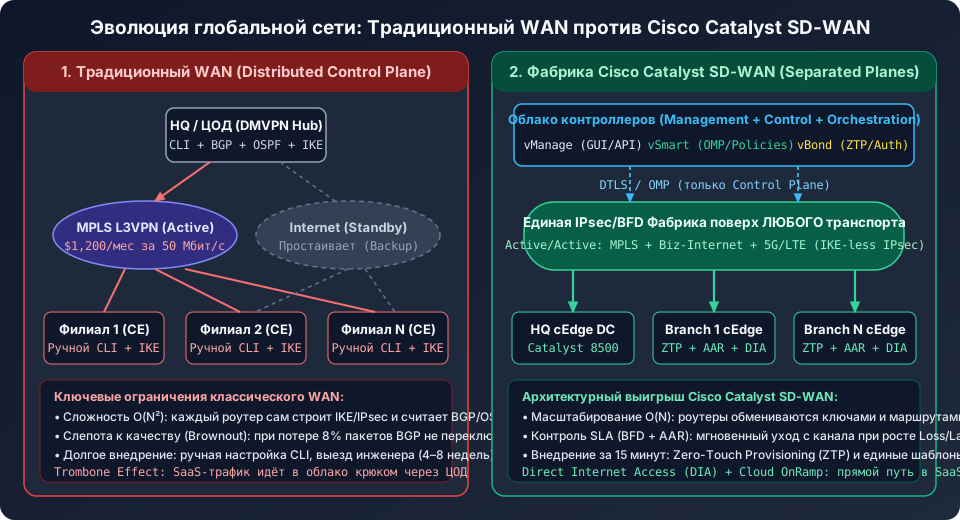
As an enterprise scales to dozens or hundreds of sites, this distributed model hits four severe walls:
- $O(N^2)$ Scaling Complexity and CLI Fragility. Building a full-mesh or partial-mesh VPN across $N$ routers with traditional IPsec requires every router to negotiate pairwise security associations (IKE SA / IPsec SA) and routing adjacencies with its peers:
$$\text{Full-Mesh Pairwise Tunnels} = \frac{N \times (N - 1)}{2}$$
For $N = 100$ routers, that equals $4\,950$ potential tunnels! Even with DMVPN, updating a security policy, ACL, or QoS class requires touching hundreds of routers via SSH. A single typo in a subnet mask orpre-shared-keycan knock a branch offline. - The MPLS Cost Paradox and Idle Backup Bandwidth (Active/Standby). MPLS L3VPN circuits provide predictable intra-provider latency but cost 5 to 10 times more per megabit than Business Internet (DIA / Broadband) or 5G/LTE. Worse yet, in a traditional design the backup internet circuit sits 100% idle during normal operations because BGP / OSPF best-path algorithms prefer a single winning metric per prefix.
- Routing Blindness to Path Quality (The "Brownout" Problem). Legacy routing protocols (OSPF, EIGRP, BGP) only verify whether a neighbor is alive using periodic
Hello/Keepalivepackets. They are completely blind to:
- Packet Loss (%);
- Round-Trip Latency / RTT (ms);
- Jitter (ms).
When a physical interface staysup/up(no Blackout), but provider congestion drops5%of packets (a Brownout), traditional routing considers the link healthy while VoIP calls and video meetings break up. - Inefficient Cloud SaaS/IaaS Hairpinning ("Trombone Effect"). Once
70%of enterprise traffic shifted from internal DCs to cloud platforms (Microsoft 365, Zoom, Salesforce, AWS), backhauling all branch internet traffic through a central HQ firewall created a massive hairpin loop resembling the slide of a trombone.
2. The "Trombone Effect" (SaaS Backhauling) vs. SD-WAN DIA & Cloud OnRamp
Let's trace what happens to a cloud video packet in a legacy network versus a Cisco Catalyst SD-WAN fabric.
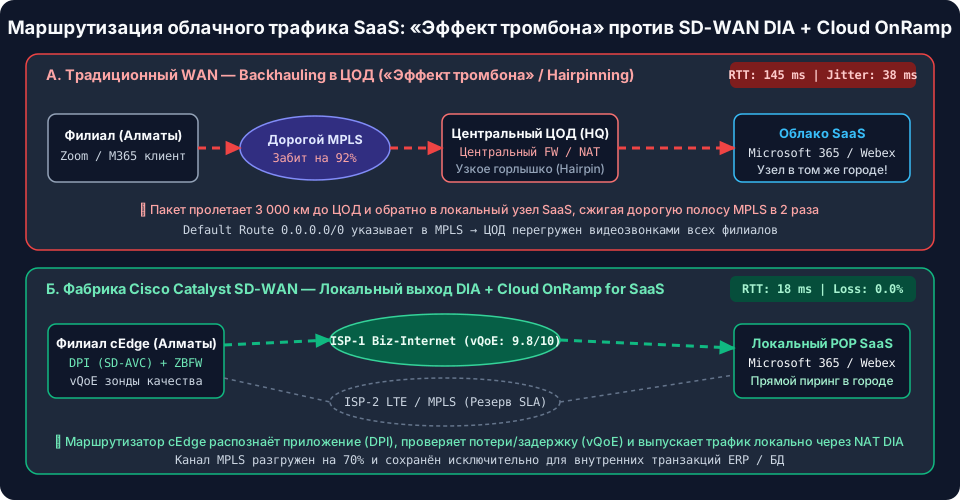
In a legacy WAN, security teams prohibit raw internet breakout at branches because legacy branch routers lack centralized next-generation firewalling and visibility. As a result, a packet from a regional branch:
- enters the expensive MPLS circuit and travels thousands of kilometers to the central DC;
- traverses the congested central firewall and NAT gateway;
- exits to the internet at the DC location and travels to the SaaS cloud (even though a local Microsoft 365 / Webex Point of Presence was located 5 kilometers from the branch!).
In Cisco Catalyst SD-WAN, the branch router (cEdge) includes built-in Deep Packet Inspection DPI (NBAR2 / SD-AVC) and an embedded Zone-Based Firewall (ZBFW). This enables secure Direct Internet Access (DIA)—breaking out trusted cloud traffic locally over the branch internet circuit while bypassing MPLS and the central DC. Furthermore, Cloud OnRamp for SaaS continuously sends lightweight BFD / HTTP probes across all local branch ISP links and computes a real-time vQoE (Virtual Quality of Experience) score (0 to 10), automatically steering Microsoft 365 over whichever local ISP currently delivers the lowest loss and latency.
| Comparison Metric | Traditional Enterprise WAN (MPLS + DMVPN) | Cisco Catalyst SD-WAN Fabric |
|---|---|---|
| Plane Architecture | Distributed: Control and Data Planes coupled inside every router | Centralized: Control Plane on vSmart controllers, management on vManage |
| Transport Dependency | Tied to specific MPLS carriers or complex DMVPN overlay configs | Full Transport Independence: any mix of MPLS, Internet, 5G/LTE, Starlink |
| IPsec Key Exchange | Heavy pairwise IKEv1 / IKEv2 negotiation per tunnel — $O(N^2)$ | IKE-less key distribution via vSmart over OMP — scales linearly at $O(N)$ |
| Brownout Response | None (or fragile manual IP SLA + EEM scripts per router) | Continuous BFD probes on every tunnel + Application-Aware Routing (AAR) |
| Cloud SaaS / IaaS Path | Hairpin via central DC (Backhauling / Trombone Effect), MPLS saturation | Local DIA breakout with Cloud OnRamp for SaaS (vQoE) path selection |
| New Branch Onboarding | Manual box-by-box CLI, truck roll, 3–6 weeks | Automated Zero-Touch Provisioning (ZTP / PnP) in 15 minutes |
3. The Cisco Catalyst SD-WAN Architectural Breakthrough & TCO Math
In 2017, Cisco acquired SD-WAN pioneer Viptela and integrated its cloud-scale fabric architecture into flagship Cisco IOS XE routers (Catalyst 8000, ISR 1000/4000, ASR 1000), creating Cisco Catalyst SD-WAN. The architecture rests on four pillars:
- Complete Plane Separation:
- Management Plane (SD-WAN Manager/vManage) — single-pane-of-glass GUI and REST API for templates, policies, and monitoring. No more manual CLI editing across hundreds of routers!
- Orchestration Plane (SD-WAN Validator/vBond) — the first point of contact that authenticates devices via PKI certificates, facilitates NAT traversal, and distributes the list of activevManageandvSmartcontrollers.
- Control Plane (SD-WAN Controller/vSmart) — the centralized "brain" of the fabric. Branch routers never exchange routing tables or IPsec keys directly with one another; instead, they maintain secure DTLS / TLS control tunnels tovSmartand receive all routes and policies via OMP (Overlay Management Protocol).
- Data Plane (WAN Edge/cEdge) — physical or virtual routers (Catalyst 8200 / 8300 / 8500 / C8000V) that forward user traffic inside automated IPsec tunnels and measure path quality via BFD. - Transport Colors (TLOC Colors) and Active/Active Forwarding. Every WAN transport interface is assigned a logical Color such as
mpls,biz-internet,public-internet, orlte. The router builds encrypted IPsec tunnels across all available transports simultaneously and load-shares traffic (ECMP), turning idle backup links into active capacity. - Centralized SLA Policies (Application-Aware Routing). An administrator defines an SLA class once in
vManage—for example,Voice-SLA:Loss <= 1%,Latency <= 150 ms,Jitter <= 10 ms. If packet loss on the internet link rises to1.5%, the branch router automatically shifts voice traffic to a cleanmplsorltetunnel while leaving bulk file transfers on the internet link.
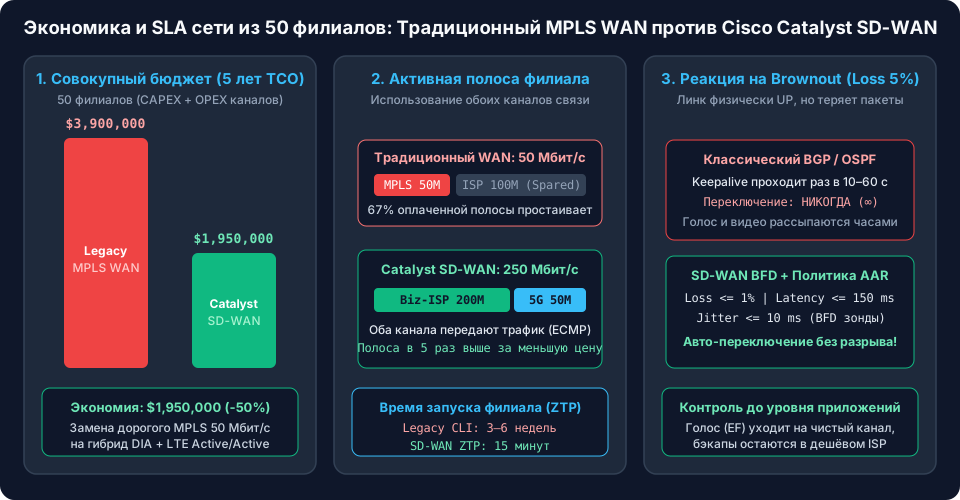
Worked example 1: 5-Year TCO and Active Bandwidth Calculation for 50 Branches
Let's perform the engineering and financial calculation for our real-life scenario (50 branches over a 5-year / 60-month lifecycle).
Given per branch:
- Option A (Legacy WAN):
50 Mbps MPLScircuit at\$1,200 / month(Active) +100 Mbps Business Internetat\$150 / month(Cold Standby). One-time hardware and manual deployment cost (CAPEX):\$300,000total across 50 sites. - Option B (Cisco Catalyst SD-WAN Fabric): decommission expensive MPLS in favor of two Active/Active circuits:
200 Mbps Business Internetat\$250 / month+50 Mbps 5G/LTE Business Unlimitedat\$150 / month. One-time cost forCatalyst 8200routers and 5-year Cisco DNA / SD-WAN cloud subscription (CAPEX + Licenses):\$750,000total.
# Engineering 5-Year TCO & Bandwidth Calculation (50 Branches, 60 Months)
WAN_Modernization_Project:
  Network_Scale:
    Branch_Count: 50
    Planning_Horizon_Months: 60

  Option_A_Legacy_MPLS_WAN:
    Monthly_OPEX_Per_Branch_USD: 1350               # $1,200 (MPLS 50M) + $150 (ISP 100M Standby)
    Total_OPEX_50_Branches_60_Months_USD: 4050000   # 50 * $1,350 * 60 mos = $4,050,000
    CAPEX_Hardware_And_Truck_Rolls_USD: 300000
    Total_5_Year_TCO_USD: 4350000                   # $4.35M over 5 years
    Active_Branch_Bandwidth_Mbps: 50                # Only MPLS 50M active (100M ISP idle)
    Cost_Per_Active_Mbps_Monthly_USD: 27.00         # $1,350 / 50 Mbps

  Option_B_Cisco_Catalyst_SD_WAN_Fabric:
    Monthly_OPEX_Per_Branch_USD: 400                # $250 (Biz-ISP 200M) + $150 (5G/LTE 50M)
    Total_OPEX_50_Branches_60_Months_USD: 1200000   # 50 * $400 * 60 mos = $1,200,000
    CAPEX_C8200_Routers_And_Subscriptions_USD: 750000
    Total_5_Year_TCO_USD: 1950000                   # $1.95M over 5 years
    Active_Branch_Bandwidth_Mbps: 250               # Active/Active: 200M + 50M = 250 Mbps
    Cost_Per_Active_Mbps_Monthly_USD: 1.60          # $400 / 250 Mbps (16.8x cheaper!)

  Net_Architectural_Impact:
    Five_Year_Net_Savings_USD: 2400000              # 55.2% TCO reduction ($2.4M saved)
    Active_Bandwidth_Increase: "5x increase (from 50 Mbps to 250 Mbps)"
    Branch_Deployment_Time: "15 minutes via ZTP (down from 4-6 weeks)"
💡 Architectural Verdict: Migrating to Cisco Catalyst SD-WAN pays back the entire hardware and licensing investment in under 11 months purely from circuit OPEX savings, while multiplying active branch bandwidth by 5x (
250 Mbpsvs.50 Mbps) and slashing the monthly cost per active megabit from\$27.00to\$1.60.
Worked example 2: Initial WAN Edge (cEdge) CLI Verification Commands
Starting with Cisco IOS XE 17.x, Catalyst 8000 / ISR / ASR routers support two operating modes:
- Autonomous Mode — traditional standalone IOS XE router configured manually via CLI.
- Controller Mode — managed by
vManageandvSmartcontrollers; all SD-WAN verification commands begin withshow sdwan ....
Let's inspect the branch router cEdge-BR1 (Almaty, System IP 10.255.0.11, Site ID 101).
First, show sdwan system status displays the software version, operating mode (Controller-mode), system identity, and health:
cEdge-BR1# show sdwan system status
Cisco IOS XE Software, Version 17.12.03a
Router operating mode: Controller-mode

Personality:                  cedge
Model name:                   C8200-1N-4T
Services:                     None
vManaged:                     true
Commit pending:               false
Configuration template:       TPL-C8200-BRANCH-DUAL-ISP
Chassis serial number:        FGL261410AB

System IP:                    10.255.0.11
Site ID:                      101
Organization:                 PROWID-ENTERPRISE-LAB
System status:                Ready
CPU allocation:               4 cores (Data: 2, Control: 2)
Memory usage:                 38% used of 8192 MB
Notice three critical fields:
Router operating mode: Controller-modeandPersonality: cedgeconfirm the router is operating as an SD-WAN Data Plane node;vManaged: trueandConfiguration template: TPL-C8200-BRANCH-DUAL-ISPindicate the router is attached to a centralized SD-WAN Manager (vManage) template and locked against accidental manual SSH edits;System IP: 10.255.0.11andSite ID: 101represent the router's permanent loop-free identifier (similar to an OSPF/BGPRouter ID) and branch location ID.
Second, show sdwan control local-properties verifies the PKI certificate status and local WAN transport interfaces (TLOCs):
cEdge-BR1# show sdwan control local-properties
personality                       cedge
sp-organization-name              PROWID-ENTERPRISE-LAB
organization-name                 PROWID-ENTERPRISE-LAB
root-ca-chain-status              Installed
certificate-status                Installed
certificate-validity              Valid
certificate-not-valid-before      Jan 10 00:00:00 2025 GMT
certificate-not-valid-after       Jan 10 23:59:59 2035 GMT
dns-name                          vbond.prowid.com
site-id                           101
domain-id                         1
protocol                          dtls
system-ip                         10.255.0.11
chassis-num/unique-id             C8200-1N-4T-FGL261410AB
serial-num                        01A94B7F

number-vbond-peers                1
number-active-wan-interfaces      2

                                  PUBLIC          PUBLIC  PRIVATE         PRIVATE                                 MAX     RESTRICT/
INTERFACE   IPv4                  IPv4            PORT    IPv4            IPv4    PORT    VS/VM   COLOR           STATE   CNTRL   CONTROL     LR/LB
----------------------------------------------------------------------------------------------------------------------------------------------------
Gi0/0/0     198.51.100.14         198.51.100.14   12346   198.51.100.14   ::      12346   2/1     biz-internet    up      2       no/yes/no   No/No
Gi0/0/1     10.101.0.2            203.0.113.88    62410   10.101.0.2      ::      12346   2/0     lte             up      2       no/yes/no   No/No
This table reveals the entire underlay state at a glance:
certificate-status: Installedandcertificate-validity: Validconfirm hardware certificate trust (Zero Trust);- interface
Gi0/0/0has colorbiz-internet, public IP198.51.100.14, and active control tunnels to 2vSmartcontrollers and 1vManage(VS/VM: 2/1); - interface
Gi0/0/1has colorlte, sits behind carrier NAT (private IP10.101.0.2:12346is translated to public IP203.0.113.88:62410, discovered automatically via STUN), and maintains control sessions to bothvSmartcontrollers (VS/VM: 2/0).
Finally, show sdwan bfd summary summarizes active IPsec data plane tunnels and BFD health probes:
cEdge-BR1# show sdwan bfd summary
status:               up
bfd-sessions-total:   4
bfd-sessions-up:      4
bfd-sessions-max:     250000
bfd-sessions-flap:    0
poll-interval:        600000
All 4 data plane tunnels (bfd-sessions-up: 4—two transports to each of the two hub DCs) are up with zero flaps (bfd-sessions-flap: 0).
What can go wrong and how to find it
When migrating from a traditional WAN or auditing a newly deployed Cisco Catalyst SD-WAN branch, engineers commonly encounter these issues:
| Symptom / CLI Output | Root Cause | How to Fix or Design Properly |
|---|---|---|
show sdwan ... commands fail with % Invalid input detected at '^' marker | The Catalyst 8000 / ISR router booted in legacy Autonomous Mode instead of Controller Mode | Switch operating mode in privileged EXEC using controller-mode enable (after backing up config and reloading) |
show sdwan control local-properties shows certificate-status: Not-Installed or Invalid | Missing Root CA chain (Root CA) or incorrect system clock (NTP) causing the certificate validity window check to fail | Verify time with show clock, configure ntp server in transport VPN 0, and install the root CA certificate (request platform software sdwan root-cert-chain install ...) |
show sdwan bfd summary shows bfd-sessions-up: 0 even though VS/VM is 2/1 | Control plane (DTLS to vSmart) is up, but Data Plane UDP 12346–12426 ports for IPsec/BFD are blocked by an ISP firewall or restrict is misconfigured | Verify end-to-end UDP reachability between WAN TLOC public IPs and check restrict settings on VPN 0 interfaces |
| Microsoft 365 cloud traffic still hairpins through the central DC with high latency after SD-WAN deployment | Local NAT DIA is not enabled on the branch biz-internet interface, or no Centralized Data Policy / Cloud OnRamp for SaaS policy is active | Enable nat on the VPN 0 biz-internet interface template and activate a NAT DIA policy for trusted cloud applications |
⚠️ Classic Engineer Pitfall: Attempting to modify the configuration of a
vManaged: truecEdgerouter via standardconfigure terminal. Cisco Catalyst SD-WAN uses transactional configuration (config-transaction, andshow sdwan running-configto view the SD-WAN config). Furthermore, any local change on a template-managed device will be overwritten byvManageon the next sync!
Practice
- Predict: An enterprise has 40 branches. In a traditional controller-less Full Mesh IPsec network, every router builds a pairwise tunnel to every other branch. Using $\frac{N(N-1)}{2}$, how many bidirectional IPsec tunnels must be negotiated across the network? How many DTLS control sessions does a single branch router build to
vSmartwhen migrating to Cisco Catalyst SD-WAN with twovSmartcontrollers? - Verify: Examine the
show sdwan control local-propertiesoutput fromcEdge-BR1above. Which interface sits behind Network Address Translation (NAT), and how can you tell from the columns? - Explain: Why does a legacy eBGP session with default timers (
Keepalive 60 s / Holdtime 180 s) fail to reroute traffic during a carrier Brownout (7%packet loss), whereas Cisco Catalyst SD-WAN shifts voice calls within seconds? - Modify: In Worked Example 1, management decides to keep the
50 Mbps MPLScircuit (\$1,200 / month) at 10 critical branches alongsideBiz-Internet(\$250 / month), while converting the remaining 40 branches to pureBiz-Internet + 5G/LTE(\$400 / month). Recalculate the total monthly WAN OPEX across all 50 sites and compare it with the original legacy cost (\$67,500 / month). - Configure & Verify Yourself ⭐: You have console access to a newly deployed
cEdge-BR2(Catalyst 8300) router. Write the exact sequence of threeshow ...commands to: a) confirm the router is inController-modeand managed by avManagetemplate; b) inspect itsSystem IP,Site ID, certificate validity, and public IP onbiz-internet; c) check the total number of activeBFDsessions in the data plane.
Self-check
- Question: What is the fundamental difference between SD-WAN Manager (
vManage), SD-WAN Controller (vSmart), and a WAN Edge (cEdge) router when forwarding user data traffic (such as a Webex call or SAP transaction)?
- Explanation: NeithervManagenorvSmartever sits in the Data Plane path of user packets.vManagehandles only GUI configuration templates and monitoring (Management Plane).vSmartdistributes OMP routes, encryption keys, and policies (Control Plane). Actual Webex or SAP packets flow directly betweencEdgerouters (Data Plane) inside encrypted IPsec tunnels or exit locally via DIA. If all controllers go offline temporarily, branches continue forwarding user traffic seamlessly over existing tunnels! - Question: Why does
show sdwan control local-propertiesshowVS/VM: 2/1onGi0/0/0(biz-internet) and2/0onGi0/0/1(lte)? Is the0forvManageon the second interface an error?
- Explanation: No, that is normal and expected behavior! By default, every WAN Edge router establishes permanent DTLS control tunnels to all active vSmart (VS) controllers over every operational WAN transport (VS = 2on both links). However, it only needs a single active management tunnel to vManage (VM) for telemetry and configuration push—soVM = 1onGi0/0/0and0onGi0/0/1(ifGi0/0/0fails, thevManagetunnel automatically fails over toGi0/0/1).
Practice answers
- Tunnel scaling: A legacy Full Mesh across $N = 40$ branches requires $\frac{40 \times 39}{2} = 780$ pairwise tunnels with individual IKE negotiations. In Cisco Catalyst SD-WAN, a branch router builds DTLS control sessions only to the two
vSmartcontrollers (2–4control tunnels total instead of39peerings) and receives encryption keys for all other branches automatically via OMP. - Identifying NAT: Interface
Gi0/0/1(lte) sits behind NAT. ItsPRIVATE IPv4column shows private RFC 1918 address10.101.0.2(port12346), while itsPUBLIC IPv4column shows the carrier's public IP203.0.113.88and translated port62410(PAT). OnGi0/0/0, private and public IPs match (198.51.100.14:12346), indicating no NAT. - Brownout & BGP vs. SD-WAN BFD: eBGP only requires a single 19-byte TCP
Keepalivepacket to arrive within180 secondsto keep the adjacency up. At7%packet loss,Keepalivedelivery is virtually guaranteed, so BGP never fails over. Cisco Catalyst SD-WAN runs continuous BFD (Bidirectional Forwarding Detection) probes inside every IPsec tunnel to measure exact packetLoss,Latency, andJitter. Once loss exceeds the SLA threshold (1%), the AAR policy immediately steers voice traffic to a healthy transport. - Hybrid OPEX recalculation:
- 10 critical branches with MPLS + Biz-ISP (\$1,200 + \$250 = \$1,450 / month): $10 \times \$1,450 = \$14,500\text{ / month}$.
- 40 branches on Biz-ISP + 5G/LTE (\$400 / month): $40 \times \$400 = \$16,000\text{ / month}$.
- Total monthly OPEX: $\$14,500 + \$16,000 = \$30,500\text{ / month}$ vs. the legacy $\$67,500\text{ / month}$—saving $\$37,000\text{ / month}$ (54.8%) while keeping MPLS at top-tier sites! - Verification commands on
cEdge-BR2:
cEdge-BR2# show sdwan system status
cEdge-BR2# show sdwan control local-properties
cEdge-BR2# show sdwan bfd summary
Review and the criterion for moving on
You are ready to move on to Lesson 2 if you can explain without notes:
- the 4 primary limitations of legacy WANs (MPLS cost, $O(N^2)$ manual CLI/IKE scaling, the cloud SaaS Trombone Effect, and Brownout blindness);
- why separating the Control Plane (
vSmart) from the Data Plane (cEdge) allows scaling to thousands of branches without pairwiseIKEsessions; - how Direct Internet Access (DIA) and Cloud OnRamp for SaaS (vQoE) eliminate cloud traffic hairpinning through the central DC;
- how to read
show sdwan system status,show sdwan control local-properties, andshow sdwan bfd summaryto identifySystem IP,Site ID,TLOCcolors, andNATstate.
Self-check question before moving on: If branch router cEdge-BR1 loses connectivity to all cloud controllers (vManage, vSmart, vBond) simultaneously due to a controller cloud outage, will existing data plane traffic between cEdge-BR1 and cEdge-BR2 drop immediately? (Hint: recall the separation of Control Plane and Data Plane and OMP Graceful Restart).
Standards and sources
- Cisco Catalyst SD-WAN Design Guide (CVD) — Chapter 1: Cisco SD-WAN Solution Overview & Transport Independence.
- Cisco 300-415 ENSDWI Official Exam Blueprint v1.1 / v1.2 — Domain 1.0 Architecture (1.1a Legacy WAN limitations vs SD-WAN benefits, 1.1b Plane separation).
- Cisco IOS XE Catalyst SD-WAN Command Reference —
show sdwan system status,show sdwan control local-properties,show sdwan bfd summary.
