
Until the early 2000s, the Public Switched Telephone Network (PSTN) was built around classic digital TDM (Time Division Multiplexing) circuit-switched exchanges, while operators simultaneously deployed a second, completely separate IP/MPLS packet network for broadband Internet and enterprise VPNs. In this lesson, we examine why maintaining two parallel transport networks and monolithic TDM switches became an economic and technological dead end, how the NGN (Next Generation Network) architecture defined in ITU-T Recommendations Y.2001 and Y.2011 converged voice and data onto a single packet core, how to calculate the trunk bandwidth savings achieved when replacing E1 trunks with packet trunks using voice compression and silence suppression, and why real-world migrations always involve years of hybrid operation with gateways to legacy PSTN and SS7 networks.
Goal and prerequisites
Lesson goal: learn how to justify an operator's migration from pure TDM circuit switching to an NGN packet architecture both technically and economically, calculate the required intercity trunk bandwidth when replacing E1 bundles with RTP trunks using statistical multiplexing and compression, and accurately identify the gateway nodes required to interconnect an NGN core with existing PSTN exchanges and SS7 signaling networks.
Prerequisites:
- structure of PCM framing, the fundamental 64 kbit/s digital voice channel (DS0 / G.711), and the primary rate E1 (2048 kbit/s, 32 timeslots) frame from PSTN and Digital Trunks (
pstn1, 7); - separation of bearer voice circuits and common channel signaling in SS7 (MTP2, MTP3, ISUP) from SS7 Signaling (
ss71, 4–5); - fundamentals of packet switching, the OSI/TCP-IP stack, and DiffServ (DSCP) traffic marking from IP Networks for Telecom (
ipnet1–2); - structure of RTP/UDP/IP media streams, voice codecs (G.711, G.729A), and VAD/CNG voice activity detection from VoIP Media (
voipmedia1, 30).
A real-life task
A national telecommunications operator runs a long-distance intercity route between two major cities (City A and City B). During the Busy Hour (BH), 3,000 subscriber pairs converse simultaneously between the two cities. In the legacy PSTN network, this voice traffic is carried over 100 E1 trunks (30 voice timeslots per E1), permanently locking up more than one and a half STM-1 equivalents (204.8 Mbit/s of raw circuit capacity) on the SDH transport ring. At the same time:
- In the very same optical fiber bundle between City A and City B, the operator already runs a 10 Gbit/s IP/MPLS backbone carrying broadband Internet and enterprise L3VPN traffic.
- At night, voice traffic drops by a factor of 20, yet all 100 E1 trunks remain rigidly nailed up between the TDM exchanges and cannot carry a single byte of Internet data.
- The commercial team wants to launch a new time-based enterprise call routing service, but the operator operates 14 monolithic TDM exchanges from different generations and vendors (Siemens EWSD, Alcatel 1000 E10, Huawei C&C08); buying feature licenses and upgrading firmware across all 14 switches costs more than the projected three-year revenue of the service.
The CTO assigns you a clear engineering task: migrate the intercity voice trunk onto the existing IP/MPLS backbone using the NGN architecture while preserving connectivity to regional TDM exchanges over E1 and SS7, and calculate how many megabits per second 3,000 concurrent calls will actually consume on the packet core.
The problem with classic TDM: parallel silos and nailed-up timeslots
In classic digital telephony (TDM), a telephone exchange is a monolithic hardware-and-software system. Three distinct functions are tightly coupled inside a single proprietary chassis:
- physical subscriber and trunk interfaces (analog FXS line cards, E1/STM-1 trunk interface boards);
- the TDM switching matrix (Digital Switching Network, DSN), which hardware-switches 8-bit PCM samples from an incoming timeslot to an outgoing timeslot every $125\text{ }\mu\text{s}$ ($8,000\text{ times per second}$);
- the central call control processor, which analyzes dialed digits, exchanges SS7 (ISUP) signaling messages, and generates billing records (CDRs).
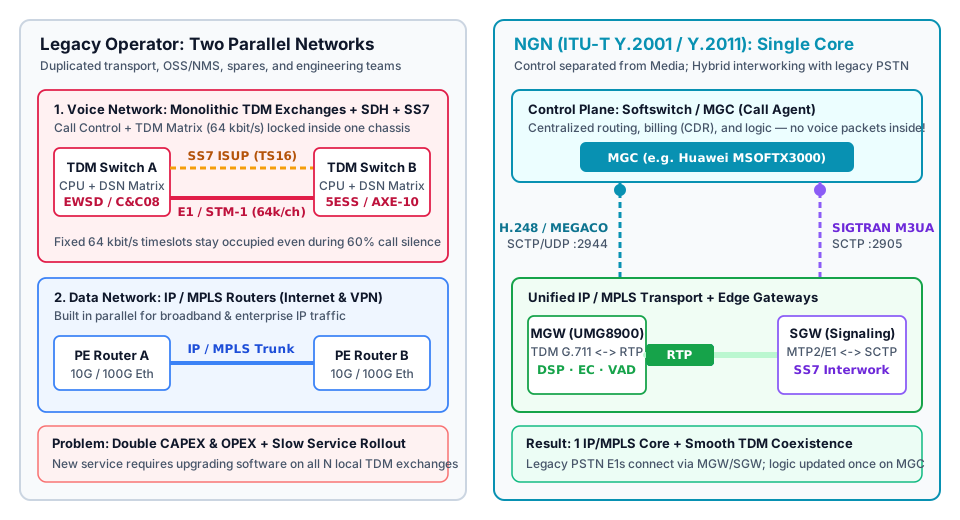
As long as voice telephony was the operator's dominant service, this monolithic design worked reliably. However, with the explosive growth of IP data in the late 1990s and 2000s, four fundamental limitations made pure TDM unsustainable:
- Two parallel networks (Double CAPEX & OPEX). The operator had to build, power,冗余-protect, and maintain two separate infrastructures: a TDM/PDH/SDH + SS7 network for voice and an IP/MPLS network for data. This meant duplicate equipment rooms, two network management systems (NMS/OSS), two spare-parts inventories, and two separate engineering teams.
- Zero statistical multiplexing (paying for silence). Once a TDM call is established, a full-duplex 64 kbit/s timeslot is locked in both directions for the entire duration of the call. According to conversational speech statistics (ITU-T Recommendation P.59), each participant in a two-way phone call speaks only 35–40% of the time, natural pauses between phrases take 10–15%, and roughly 50–60% of the time in each direction is pure silence. In a TDM network, silent intervals continuously transmit idle fill octets (
0xD5in A-law or0xFFin $\mu$-law), and at night entire E1 bundles sit idle while their bandwidth cannot be reused for IP data. - Rigid 64 kbit/s granularity. A classic TDM switching matrix is hardwired around $64\text{ kbit/s}$ channels (G.711). Even if a low-bitrate vocoder (such as G.729A at $8\text{ kbit/s}$ or mobile AMR) compresses speech by a factor of 8, a standard TDM exchange without specialized transcoder/sub-multiplexer units still allocates a full $64\text{ kbit/s}$ timeslot per call.
- Slow and expensive service innovation. Because call control logic resides inside every individual TDM exchange, rolling out a new intelligent call feature or routing rule requires upgrading software and purchasing vendor licenses across dozens of local and transit switches nationwide.
# Audit of a classic TDM network node prior to NGN migration
legacy_operator_audit:
  transport_networks:
    voice_core: "SDH / PDH (STM-1/STM-4, E1 2048 kbit/s trunks)"
    signaling_core: "SS7 (MTP2/MTP3 nailed up in E1 timeslot TS16)"
    data_core: "IP / MPLS (10G/100G Ethernet)"
    duplication_penalty: "Double CAPEX on chassis and double OPEX on operations"
  channel_efficiency:
    timeslot_rate_kbps: 64.0
    speech_activity_factor: 0.40
    wasted_silence_ratio: "60% of call duration transmits idle byte 0xD5 at 64 kbit/s"
    night_utilization: "< 5% (idle E1 timeslots cannot carry IP data traffic)"
  service_agility:
    call_control_location: "Distributed across every local and transit TDM switch"
    time_to_market: "6–18 months (software upgrades required on all exchanges)"
The NGN vision (ITU-T Y.2001 / Y.2011): gateway decomposition and a single packet core
To eliminate duplicated transport networks and monolithic switch lock-in, the ITU-T standardized the NGN (Next Generation Network) architecture in Recommendations Y.2001 (General overview of NGN) and Y.2011 (General principles and general reference model for Next Generation Networks).
The core engineering breakthrough of NGN is the functional decomposition of the monolithic TDM exchange into decoupled horizontal strata and specialized network elements:
- A unified packet transport core (Transport Stratum): voice, video, broadband Internet, and enterprise VPNs all share a single IP/MPLS backbone engineered with strict Quality of Service (QoS: EF / DSCP 46 strict-priority queuing for RTP voice, and CS3 / AF31 guaranteed bandwidth for signaling).
- Strict separation of Call Control from Media Switching:
- Softswitch / Media Gateway Controller (MGC): the "brain" of the network (for example, Huawei MSOFTX3000). Running on high-availability server blades, the MGC performs number analysis, routing, admission control, and billing (CDR generation), without a single byte of voice media passing through it.
- Media Gateway (MGW): the media-plane "muscle" at the TDM boundary (for example, Huawei UMG8900). It terminates physical E1/STM-1 trunks, performs carrier-grade echo cancellation (ITU-T G.168), transcodes 64 kbit/s PCM samples into RTP packets (G.711, G.729A, AMR), and streams RTP directly to the remote MGW across the IP/MPLS core under instructions from the Softswitch via H.248 (MEGACO).
- Signaling Gateway (SGW): the signaling translator. It extracts classic SS7 (MTP2) or ISDN PRI (Q.931/LAPD) frames from E1 timeslot TS16, strips the low-level TDM link layer, and transports upper-layer signaling messages (ISUP, SCCP, Q.931) to the Softswitch over reliable SCTP/IP associations using the SIGTRAN protocol suite (M3UA, M2UA, M2PA, IUA).
| Architectural Dimension | Classic PSTN (TDM) Network | Converged NGN (ITU-T Y.2001 / Y.2011) |
|---|---|---|
| Transport network | Dedicated TDM network (E1 / PDH / SDH) for voice only | Single converged IP/MPLS core for voice, video, and data |
| Control vs. switching | Monolithic: CPU and $64\text{ kbit/s}$ DSN matrix in one cabinet | Decoupled: call control on MGC (Softswitch), media on MGW |
| Bandwidth allocation | Rigid: 64 kbit/s locked for the entire call (even in silence) | On demand: RTP packets with compression (G.729A) and VAD/CNG |
| Off-peak / night capacity | Timeslots sit idle (cannot carry Internet or VPN packets) | All unused voice bandwidth is dynamically used by IP data traffic |
| New service deployment | Upgrade software/licenses on dozens of local/transit exchanges | Configure centrally on 1–2 redundant MGC / Application Servers |
| SS7 interconnection | Native MTP1/MTP2 boards inside every exchange | Terminated on SGW and backhauled to MGC over SIGTRAN (SCTP) |
💡 Architectural verdict: Decomposing the monolithic exchange into
MGC + MGW + SGWallows an operator to keep compact Media Gateways in regional POPs to aggregate physical E1 trunks while centralizing all call routing, numbering plans, and billing logic onto a geo-redundant pair of Softswitches in primary data centers.
Transport economics: how NGN achieves 3x to 8x bandwidth savings
Migrating voice onto an IP/MPLS core delivers a twofold economic benefit: backbone consolidation (retiring separate SDH voice circuits) and statistical multiplexing combined with speech compression.
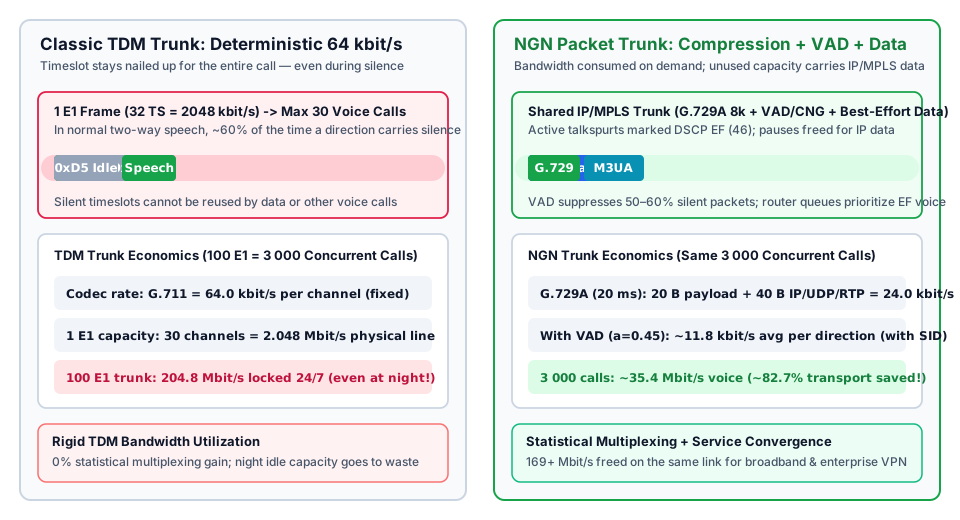
Let us trace the exact packet math for a single voice channel and for an entire intercity trunk bundle:
- In a classic E1 trunk (
2048 kbit/s):
* Out of 32 timeslots at $64\text{ kbit/s}$ each, 30 timeslots carry voice (TS1–TS15 and TS17–TS31), while TS0 and TS16 carry frame alignment and signaling.
* The physical line rate consumed per active voice channel is:
$$R_{\text{E1/ch}} = \frac{2048\text{ kbit/s}}{30} \approx 68.27\text{ kbit/s}$$ - In an uncompressed NGN packet trunk (
G.711codec, packetization interval $T_{\text{pkt}} = 20\text{ ms}$, $50\text{ packets/s}$):
* Each packet carries $160\text{ bytes}$ of PCM audio + $40\text{ bytes}$ of IPv4 ($20\text{ B}$) + UDP ($8\text{ B}$) + RTP ($12\text{ B}$) headers = $200\text{ bytes}$ ($1,600\text{ bits}$) at the IP layer.
* Without silence suppression, the continuous IP-layer bitrate per direction is $1,600\text{ bits} \times 50\text{ pps} = 80.0\text{ kbit/s}$ (higher than $64\text{ kbit/s}$ due to packet headers!).
* However, enabling VAD/DTX silence suppression (with an effective activity factor $\alpha \approx 0.45$ including periodic Comfort Noise SID frames) lowers the average G.711 IP bitrate to:
$$R_{\text{G.711+VAD}} = 80.0 \times 0.45 = 36.0\text{ kbit/s}$$ - In a compressed NGN packet trunk (
G.729Aat $8\text{ kbit/s}$, $T_{\text{pkt}} = 20\text{ ms}$) with VAD silence suppression:
* A $20\text{ ms}$ packet carries only $20\text{ bytes}$ of compressed speech + $40\text{ bytes}$ of IP/UDP/RTP headers = $60\text{ bytes}$ ($480\text{ bits}$) at the IP layer.
* Continuous IP bitrate without VAD: $480\text{ bits} \times 50\text{ pps} = 24.0\text{ kbit/s}$.
* With VAD/CNG enabled ($\alpha \approx 0.45$ effective bandwidth factor), the average IP bitrate drops to $10.8\text{–}11.8\text{ kbit/s}$ per direction — nearly 6 times less than an E1 voice channel!
Worked example: sizing a trunk for 3,000 concurrent calls
Let us perform the complete engineering calculation for the CTO's intercity trunk migration scenario.
Given:
- Busy-Hour concurrent calls: $N = 3,000$ active bidirectional calls.
- Legacy TDM infrastructure: $100\text{ E1 trunks}$ ($30\text{ voice channels per E1}$).
- Target NGN packet trunk: G.729A codec ($8\text{ kbit/s}$, packetization $20\text{ ms}$, IPv4/UDP/RTP headers = $40\text{ bytes}$), VAD/CNG enabled with an effective bandwidth factor $\alpha = 0.45$.
# Engineering bandwidth calculation: migrating 100 E1 trunks to an NGN IP/MPLS trunk
trunk_migration_calculation:
  given:
    concurrent_calls: 3000
    tdm_e1_trunks: 100
    codec: "G.729A (8 kbit/s, ptime = 20 ms, 50 pps)"
    ip_udp_rtp_header_bytes: 40
    vad_effective_factor: 0.45

  step_1_tdm_baseline:
    formula: "100 E1 * 2.048 Mbit/s"
    tdm_locked_bandwidth_mbps: 204.80

  step_2_ngn_single_call_ip_rate:
    voice_payload_bytes: 20
    total_ip_packet_bytes: 60          # 20 B payload + 20 B IP + 8 B UDP + 12 B RTP
    packets_per_second: 50             # 1000 ms / 20 ms
    continuous_rate_kbps: 24.0         # 60 * 8 * 50 = 24,000 bit/s
    vad_average_rate_kbps: 10.8        # 24.0 * 0.45 = 10.8 kbit/s (IP layer)

  step_3_total_trunk_comparison:
    ngn_continuous_3000_calls_mbps: 72.00   # 3000 * 24.0 kbit/s
    ngn_with_vad_3000_calls_mbps: 32.40     # 3000 * 10.8 kbit/s
    freed_bandwidth_mbps: 172.40            # 204.80 - 32.40 Mbit/s
    bandwidth_savings_percent: "84.2%"
💡 Architectural verdict: Replacing 100 transit E1 trunks with an NGN packet trunk (
G.729A + VADover IP/MPLS) reduces the Busy-Hour IP bandwidth required for 3,000 calls from 204.8 Mbit/s to 32.4 Mbit/s, freeing over 172 Mbit/s (84.2% savings) for commercial broadband and VPN traffic during peak hours and nearly 100% of the capacity overnight.
Why operators cannot turn off TDM overnight: the hybrid network reality
New telecom engineers often ask: "If packet switching and SIP are so much more efficient, why didn't operators simply shut down all TDM exchanges and SS7 networks in a single year and move everyone straight to pure SIP?"
In real carrier networks, an overnight "forklift upgrade" is impossible for four practical reasons:
- Massive installed base of legacy access lines and enterprise PBXs. Millions of analog copper loops, thousands of enterprise PBXs (banks, hospitals, factories, government agencies) connected via E1 ISDN PRI or SS7, and emergency dispatch centers rely on synchronous G.703/G.704 interfaces and line powering.
- National and international interconnect agreements. Interconnects between domestic and international carriers were built over decades on E1/STM-1 circuits and SS7 ISUP signaling. Even after an operator migrates its own core to IP, peering operators may still require physical TDM interconnects or transparent ISUP encapsulation inside SIP (SIP-I / SIP-T).
- Capital expenditure (CAPEX) amortization. Carrier switching equipment has a 15-to-25-year depreciation lifecycle. Scrapping working local exchanges (Class 5) and remote subscriber units prematurely destroys capital; instead, operators first replace the transit backbone (Class 4 tandem exchanges) with
Softswitch + MGW + SGW, and phase out local TDM switches gradually over years. - Full service and signaling transparency. When a call originates on TDM Exchange A, crosses the NGN packet core, and terminates on TDM Exchange B, neither the subscribers nor the switches may lose any signaling semantics: ITU-T Q.850 release cause codes, Calling Party Category (CPC), redirection counters, and Intelligent Network queries (INAP/CAP/MAP) must traverse the IP core without losing a single bit.
That is why NGN was specifically engineered as a hybrid bridge between the TDM/SS7 world and the IP/SIP world: H.248 (MEGACO) controls Media Gateways terminating E1 trunks, SIGTRAN transports SS7 and ISDN signaling over SCTP/IP, and BICC or SIP-I carries ISUP call control transparently across the packet core.
What can go wrong and how to find it
When migrating voice from dedicated TDM trunks onto a shared IP/MPLS core, engineers face failure modes that never existed on synchronous E1 circuits:
- Voice clipping and distortion during data bursts (missing QoS policy). On a TDM E1, a file download could never steal bits from timeslot 5. On a shared NGN link, if RTP packets from the MGW are not marked DSCP EF (46) or lack a Strict Priority / LLQ queue on MPLS provider-edge (PE) routers, bursty TCP data delays or drops voice packets, causing choppy audio and failed fax transmissions.
- Control-plane isolation (Split-Brain between MGC and MGW). In a monolithic TDM switch, the CPU and switching matrix sat on the same backplane. In NGN, the Softswitch (MGC) may sit in a central data center 500 km away from the regional MGW. If an IP routing fault or firewall rule blocks H.248 (port
2944) or SIGTRAN M3UA (port2905), the physical E1 trunks on the MGW stay green (LOS=0), yet zero new calls can be established. - "Dead-air" effect from aggressive VAD without Comfort Noise (CNG). If an engineer enables VAD on the Media Gateway to save bandwidth but forgets to enable CNG / SID comfort noise generation, pauses in speech produce total digital silence (
0noise floor), causing callers to think the call has dropped ("Hello? Are you still there?").
! Verifying strict-priority voice queuing (EF) and signaling protection (CS3) on an NGN Core PE router
Router-Core-PE1# show policy-map interface TenGigabitEthernet0/0/1 output
 TenGigabitEthernet0/0/1

  Service-policy output: NGN-CORE-QOS-OUT

    Class-map: VOICE-RTP-EF (match-all)
      148920450 packets, 8935227000 bytes
      30 second offered rate 32410000 bps, drop rate 0000 bps
      Match: ip dscp ef (46)
      Priority: Strict, b/w exceed drops: 0

    Class-map: SIGTRAN-H248-CS3 (match-all)
      4120890 packets, 527473920 bytes
      30 second offered rate 840000 bps, drop rate 0000 bps
      Match: ip dscp cs3 (24) af31 (26)
      Bandwidth: 5% (500000 kbps), queue-limit 1024 packets
      (pkts matched/bytes matched) 4120890/527473920
      (total drops/no-buffer drops) 0/0
Practice
Exercise 1 (Architectural classification): An operator audits network incidents and bottlenecks. Classify each of the four scenarios below into either (A) classic TDM limitations solved by migrating to NGN, or (B) operational challenges introduced inside an NGN architecture that require proper NGN engineering:
- Overnight, 80 intercity E1 voice trunks sit below 3% utilization, while database backups between the same two cities take hours because the parallel IP link is congested.
- All physical E1 trunks on a regional gateway show
LOS=0andAIS=0, but because the SCTP association to the central Softswitch dropped, subscribers hear fast-busy reorder tone on every call attempt. - To introduce a new short number
195for a customer support center, engineers must log into 18 regional TDM exchanges and manually update digit-analysis tables on every switch. - During evening broadband peak hours, voice calls crossing the packet core experience metallic distortion because RTP packets are falling into the default
best-effortrouter queue.
Exercise 2 (Trunk sizing calculation): A regional link carries 20 E1 trunks (supporting up to $20 \times 30 = 600$ concurrent calls during the Busy Hour). The operator migrates this route to an NGN Media Gateway. Calculate:
- What physical bandwidth did the 20 E1 trunks occupy on the TDM transport network?
- What IP-layer bandwidth will 600 concurrent calls require using uncompressed G.711 ($64\text{ kbit/s}$, $20\text{ ms}$ packetization, IP/UDP/RTP headers = $40\text{ B}$) without VAD? Why is this figure higher than $600 \times 64\text{ kbit/s}$?
- What average IP-layer bandwidth will the same 600 calls require using G.729A ($8\text{ kbit/s}$, $20\text{ ms}$) with VAD enabled ($\alpha = 0.45$)? What is the percentage bandwidth saved compared to the 20 E1 trunks?
Self-check
- Which three functional subsystems are tightly coupled inside a classic TDM exchange chassis, and how does the ITU-T Y.2001 / Y.2011 NGN architecture separate them?
- Why is a classic $64\text{ kbit/s}$ TDM channel unable to save trunk bandwidth during the 50–60% of a conversation when a party is listening in silence?
- What is the exact functional difference between a Media Gateway (MGW) and a Signaling Gateway (SGW)? Which one processes voice timeslots (TS1–15, TS17–31) and which one processes timeslot TS16?
- Why does a single G.711 ($20\text{ ms}$) voice stream without VAD consume $80\text{ kbit/s}$ at the IP layer instead of $64\text{ kbit/s}$, and how does an NGN packet trunk still achieve major economic savings over dedicated E1 trunks?
- List four engineering and economic reasons why a carrier cannot shut down all legacy TDM exchanges overnight and must operate a hybrid NGN-PSTN network for years.
Review and the criterion for moving on
Review from prerequisite courses:
- how many timeslots in an E1 frame carry voice and what the two remaining timeslots are used for (
pstn7); - the roles of MTP2, MTP3, and ISUP in the SS7 protocol stack (
ss74–5); - how to calculate the total IP packet size and bitrate of an RTP stream for a $20\text{ ms}$ packetization interval (
voipmedia30).
Criterion for moving on: without looking at notes, you can explain the decomposition of a monolithic TDM switch into MGC + MGW + SGW, calculate the IP bandwidth of an NGN trunk for $N$ concurrent calls including IP/UDP/RTP overhead and VAD factor within one minute, and explain why H.248 and SIGTRAN are essential in a hybrid network. In the next lesson, we will examine the four-plane NGN architecture model and the exact interfaces connecting every node.
Standards and sources
- ITU-T Recommendation Y.2001 (12/2004) — General overview of NGN (core definition of Next Generation Networks and decoupling of service/control from transport).
- ITU-T Recommendation Y.2011 (10/2004) — General principles and general reference model for Next Generation Networks (reference model separating the Transport Stratum and Service Stratum).
- ITU-T Recommendation P.59 — Artificial conversational speech (statistical model of human telephone conversation, talkspurt and pause distributions).
- ITU-T Recommendation G.711 Appendix II / G.729 Annex B — Voice Activity Detection (VAD), Discontinuous Transmission (DTX), and Comfort Noise Generation (CNG/SID).
