
You already know how exchanges agree on a call with CAS: the abcd bits in TS16 or R2 tones. It works, but this kind of signalling has limits (lesson 48 of the pstn course). This lesson opens the ss7 course and answers the question "what was invented instead". The idea is simple: one common channel of messages for many voice channels. It is called common-channel signalling, and the particular system is SS7 (Signalling System No. 7; the same names: SS7 = CCS7 = No.7 = N7). We will see what it gives, how it differs from the D channel in ISDN and how many voice channels it saves.
Goal and prerequisites
After this lesson you will be able to:
- name the four limits of CAS and say what a common signalling channel does about each;
- explain the idea of SS7: one signalling link for many voice channels, messages with fields instead of signals, a separate signalling network with its own nodes;
- tell the D channel in ISDN (a common channel on the subscriber section) from SS7 (a common channel between exchanges);
- name the four gains of SS7: faster setup, more information, queries to databases, signalling without seizing a voice channel;
- count the voice channels of
NE1 streams:30 × Nwith CAS and31 × N − 1with one signalling link; - say what an SS7 message can carry and what the four
abcdbits cannot.
What you need to know first: from the telbasics course — TS16, CAS and CCS (lesson 33); from the pstn course — types of signalling, CAS, the abcd bits, R2 MFC and the limits of CAS (lessons 42–48, especially 43, 44, 45 and 48); from the isdn course — the D channel (lesson 2) and the protocol layers of ISDN (lesson 5). From the ss7 course — nothing: this is lesson 1.
A real-life task
Ayten is an engineer at an operator. She has to lay a route Baku — Ganja for 490 voice channels. With CAS every E1 stream gives 30 channels: 490 / 30 = 16.3, so 17 streams are needed. Management adds three wishes. First: the receiving exchange should see not only "channel busy" but also the number of the caller, the caller's category and the reason for the clear-down. Second: before connecting, the exchange should be able to ask a database whether the number has been ported (lesson 27 of the pstn course). Third: if possible, the route should fit into 16 streams. All three wishes come down to one thing — how signalling between exchanges is built.
The second example is a taxi. Each car has its own lamp on the roof: "free" or "busy". The dispatcher knows only that, and only when looking at that very car. Now the fleet has one radio for everybody. Every phrase starts with the number of the car and can be as detailed as you like: "car 12, such-and-such an address, order cancelled". The dispatcher checks the address in a database before sending the car, and the radio works even when the car stands empty. The lamp on the roof is CAS. The radio for the whole fleet is common-channel signalling. By the end of the lesson you will match this picture with an E1 stream.
What we already know: CAS and its limits
In lesson 33 of the telbasics course you saw two ways to use TS16. With CAS each of the 30 channels has its own share of TS16 — four abcd bits, 2 kbit/s per channel — and the channel is recognised by the place where the signal lies. With CCS the whole TS16 is one common channel, and every message names the channel it is about. Lesson 48 of the pstn course named four limits of CAS. Let us repeat them together with the answer of the common channel.
| Limit of CAS | What a common signalling channel does |
|---|---|
| Speed: a separate exchange for every digit | the number usually goes in one message |
| Few signals: four bits, 15 combinations in a tone group | a message is a set of fields, and the needed information fits in |
| Tied to the voice channel | the message names the channel, so it can travel without seizing it; a question to a database is a message too |
| In-band: a tone in the speech band | the common channel lies outside the speech band, the voice of a subscriber does not get into it |
A detailed analysis of each limit is in lesson 48. The general conclusion matters here: CAS speaks about the state of a channel, but exchanges need to speak about a call.
Common-channel signalling and SS7
Common-channel signalling (CCS) is a method in which one channel carries labelled messages about many voice channels and, if needed, other information too, for example for network management (this is how Recommendation Q.700 defines it). The analogy is the radio of a taxi fleet: one link, and every phrase names the car.
SS7 is a particular system of common-channel signalling, described in the ITU-T Q.7xx series of Recommendations; the same name is written in different ways: SS7 = CCS7 = No.7 = N7. According to Q.700, its objectives are: a general-purpose common-channel system for digital networks and stored-program-controlled exchanges; it serves telephony, ISDN and circuit-switched data transmission, and also reliably carries other information between exchanges and specialised centres. Reliably means in the correct order, without loss and without duplication. Where the different names come from and which variants of the standard exist will be explained in lesson 2.
SS7 has three main components. Let us take them one by one.
- Signalling link is the channel in which the messages travel. In an E1 stream it is one 64 kbit/s timeslot. The standard bit rate of a link on a digital path is 64 kbit/s; the standard place in an E1 stream is TS16, and if it is not available, any timeslot suitable for a 64 kbit/s channel will do (Q.702, clause 5.1). The timeslot is given to the link entirely: nothing but signalling travels in it (Q.702, clause 1.6). One link serves many voice channels at once. Every link has error detection and correction (Q.700, clause 1.2).
- Message is a piece of information with a type and fields. Instead of one combination from a small table (as in CAS), a message carries several fields, and among them is the number of the voice channel the message belongs to.
- Signalling network is the nodes in which SS7 works and the links between them (Q.700, clause 2.1). It is a second network on top of the network of voice channels, with its own nodes.
A message instead of a signal
A CAS signal is a state: the channel is free, busy, answered. Four abcd bits cannot hold a number, a category or a cause, and there is no field in them. An SS7 message is built differently: it has a type and a set of fields. For a call, ISUP (this is a name, it is ahead: lesson 35) has such fields: the called number, the caller's number, the caller's category, the cause of the clear-down. They are described in Q.763 (clauses 3.9–3.12).
Worked example: two messages instead of two signals
message 1 (set up the call)         message 2 (end the call)
  channel     12                      channel     12
  called      5550123                 cause       called party busy
  caller      5550100
  category    ordinary subscriber
This is an illustrative record for understanding the idea, not a format from the standard. Line by line:
channel 12— every message names the voice channel. In CAS there is no number, and the place where the signal lies identifies the channel.called 5550123— the called number as a whole. In CAS it is passed digit by digit in separate exchanges.caller 5550100andcategory ordinary subscriber— information about the caller. Four bits have no room for it. In R2 the number of the caller exists only in national variants (lesson 47 of thepstncourse).cause called party busy— the reason for the clear-down. In CAS a "clear" is just a change of a bit, with no cause.
💡 A good test of "is this CAS or a common channel": can you find the number of the channel in the signal? If not, the place identifies the channel, and this is CAS. If the number is named in the message itself, it is a common channel.
The signalling network
In CAS the signal of a channel goes along the same cable as the voice, and their path is one. In SS7 it is not so. Links and nodes form a separate network, and the path of a message does not have to coincide with the path of the voice. Nodes can be exchanges, transit nodes that only forward messages (they are called STP: lesson 3), nodes with databases and operation and maintenance centres (Q.700, clause 2.2.1). A message from exchange A to exchange B may pass through such a transit node, while the voice goes straight along its own trunk group. Which paths messages can take will be explained in lesson 4.
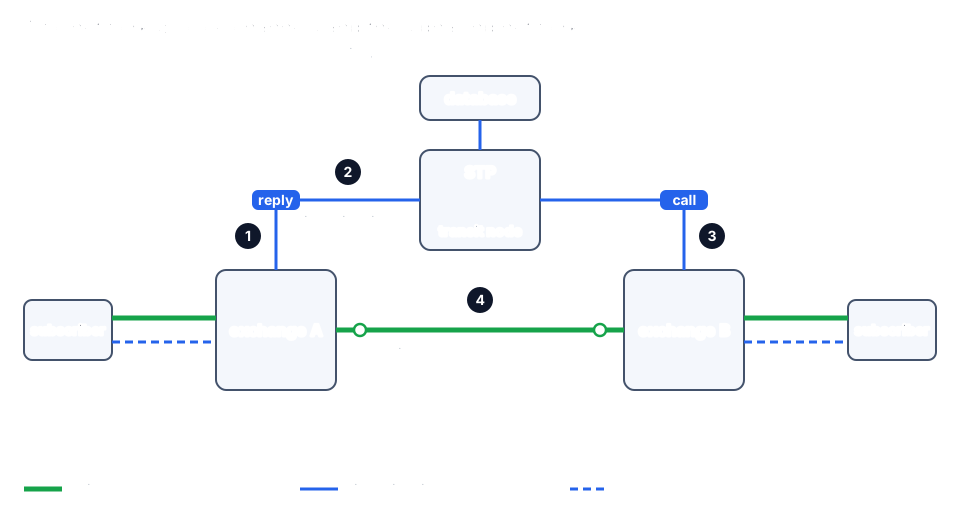
The diagram is read by numbers, like the steps of a call: ① exchange A writes a message about a new call on channel 12; ② it goes along the signalling links, in this diagram through the STP transit node; ③ exchange B answers with a message; ④ the voice goes along channel 12 straight between the exchanges. Every node of the signalling network has its own unique address (Q.700, clause 2.2.1); how it is built will be explained in lessons 10–12.
The D channel and SS7: one technique in two places
In lesson 5 of the isdn course the D channel was named the common signalling channel on the subscriber section: one channel for all B channels of a line. SS7 is the same technique between exchanges. The idea is one, the places are different.
| D channel (ISDN) | SS7 | |
|---|---|---|
| Where | subscriber section: telephone or subscriber's exchange ↔ operator's exchange | between exchanges and nodes of the signalling network |
| Idea | a common channel of messages for all B channels of a line | a common channel of messages for many voice channels |
| Messages | Q.931 over Q.921 (DSS1) | for telephone calls — ISUP (lesson 35) |
| Bit rate | 16 kbit/s in BRI, 64 kbit/s in PRI | 64 kbit/s is the standard |
A call between two ISDN subscribers passes three sections: the D channel on one side, SS7 between the exchanges, the D channel on the other side. Each section has its own messages, and the exchange at the border translates one into the other (lesson 54 is devoted to this).
💡 "Is the D channel SS7 too?" No. The idea is the same (a common channel of messages), but the D channel works on the subscriber line and carries Q.931 messages, while SS7 works between exchanges.
Four gains of SS7
- Faster setup. The digits of a number usually go in one message, not one by one in separate exchanges (they may also go in parts: lesson 39). No seconds are named here: the time depends on the line and the nodes, and we have no verified general figure. So we count exchanges (the example is below).
- More information. A message holds the called number, the caller's number, the category, the cause of the clear-down — and whatever is added later: a new field does not need a new combination from a table.
- Queries to databases. An exchange can ask a database and get the answer in a message: for example, where a number has been ported (lesson 27 of the
pstncourse). Such queries are used by freephone numbers, number portability and mobile communication — you will meet these names later. Q.700 (clause 1.1) names among its applications access to network databases and mobile networks. - Signalling without seizing a voice channel. A message does not have to belong to a call: Q.700 (clause 1.1) says that SS7 covers both circuit-related and non-circuit-related signalling. A question to a database or a message for network management goes without seizing a single voice channel.
An example for the first gain: the number of exchanges for a number of 12 digits.
number of 12 digits
CAS (R2 MFC):   13 handshakes one after another (12 digits + category)
common channel:  1 message with the whole number
The price of a common channel is that it is common. One signalling link serves many voice channels, and if it goes down, signalling stops for all these channels at once. So SS7 is normally applied with redundant links and automatic diversion of messages to alternative paths (Q.700, clause 1.2). How this is built will be explained in lessons 5–7 and 28.
The calculation: how many channels N E1 streams give
An E1 stream is 32 timeslots. TS0 is for synchronization (lesson 32 of the telbasics course), and the other 31 can carry 64 kbit/s channels. With CAS, in every stream TS16 is busy with signalling, and voice gets 30 timeslots. With SS7 the link needs one timeslot for the whole group of streams. For example, TS16 of the first stream. In the other streams TS16 can be given to voice: G.704 (clause 5.1.2) allows TS16, in some cases, to be used as a 64 kbit/s channel if signalling is not needed in it.
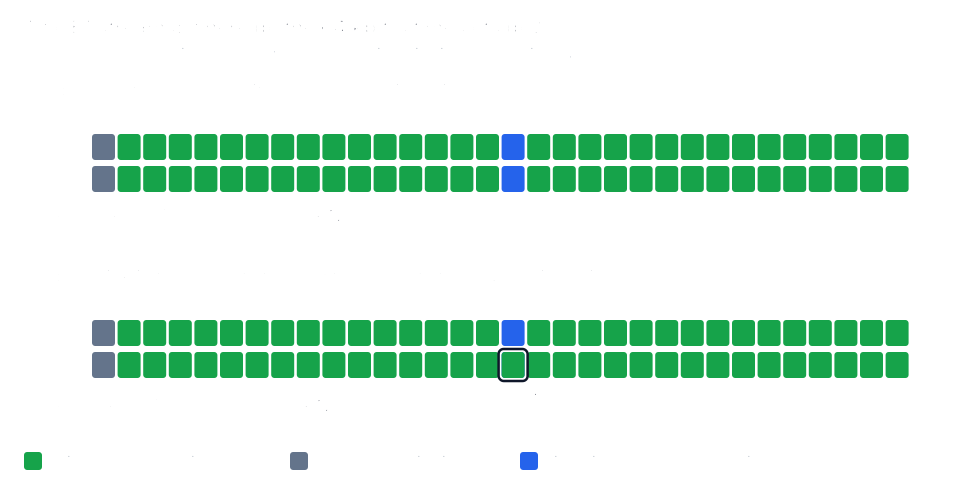
E1 stream = 32 timeslots; TS0 is synchronization, 31 can carry 64 kbit/s

CAS:  every stream spends its TS16 on signalling
      voice channels = 30 x N

SS7:  one signalling link = one timeslot (for example TS16 of stream 1)
      voice channels = 31 x N - 1
      gain           = (31 x N - 1) - 30 x N = N - 1
The numbers for small N (calculated with a script):
N   CAS (30 x N)   SS7 (31 x N - 1)   gain
1   30             30                 0
2   60             61                 1
4   120            123                3
8   240            247                7
16  480            495                15
With N = 1 there is no gain: the only TS16 is busy with the link anyway.
Worked example: Ayten calculates the route
need: 490 voice channels

CAS:  30 x N >= 490        N = 17   (17 x 30 = 510)
SS7:  31 x N - 1 >= 490    N = 16   (16 x 31 - 1 = 495)

check: CAS, N = 16: 480 < 490;  SS7, N = 15: 15 x 31 - 1 = 464 < 490
saved: 1 E1 stream
Line by line:
- For CAS the channels must be at least 490:
490 / 30 = 16.3, rounded up to 17 streams (510 channels). - For SS7
31 × N − 1 ≥ 490, that isN ≥ 491 / 31 ≈ 15.84— rounded up as well: 16 streams give16 × 31 − 1 = 495. - Checking the borders: 16 streams with CAS give only 480 channels, and 15 streams with SS7 give 464. Fewer will not do.
- Result: the route fits into 16 streams instead of 17. The gain is a whole E1 stream.
⚠️ The gain in channels is small (
N − 1) and not guaranteed: for 480 or 600 channels the number of streams is the same in both cases. The main reason to move to SS7 is the four gains above. And we counted ideally: one link for the whole group. In practice links are normally made redundant (Q.700, clause 1.2), and every additional link takes one more timeslot: with two links in different streams the channels will be31 × N − 2.
What can go wrong and how to find it
| Symptom | Possible cause | What to check |
|---|---|---|
| E1 streams are fine, no alarms, but new calls do not pass on any channel | the signalling link is down: it is one for all channels | the state of the link at both exchanges; whether there is a second link |
| The link does not come up after connecting | the link is in different timeslots at the two ends, or at one end TS16 is given to voice (Q.702, clause 5.1: the standard timeslot is TS16, if it is not available another one will do) | the timeslot of the link in the settings of both exchanges; the purpose of TS16 |
| One side waits for signalling in the shares of TS16, the other sends messages | the TS16 modes do not match: CAS on one side, CCS on the other | the signalling mode at both ends (lesson 33 of the telbasics course) |
| Calls pass, but the number of the caller is missing | the field is not sent or is lost at the interconnection | where the number disappears; whether the field is in the message or is empty (lesson 52) |
| There is voice, but the call lands "in the wrong place" or on a busy channel | the sides count voice channels differently: the message names channel 12, but the voice goes in another timeslot | the match between channel numbers and timeslots at both exchanges (lesson 36) |
⚠️ A common beginner mistake is to think that a clean E1 stream with voice means working signalling. In SS7 voice and signalling live separately: the stream can be fine and the link can be down. The state of the link is looked at separately.
Practice
- Predict. How many voice channels will 8 E1 streams give with CAS and with one signalling link in TS16 of the first stream?
- Check. Calculate with the formulas
30 × Nand31 × N − 1. Does the gain matchN − 1? - Explain. Which of this information can be carried by the four
abcdbits, and which only by a message: seizure of a channel, the number of the caller, the answer of the called party, the cause of the clear-down, a question to a database? - Change. The link was backed up with a second one, in TS16 of another stream. How many channels do 8 streams have now?
- Do it yourself ⭐. A customer asks for 480, 490 and 600 channels. How many streams are needed with CAS and with one link? For which orders does SS7 save a stream?
Self-check
Question 1. Is the D channel in ISDN SS7 too?
Explanation. No. The idea is common: one channel of messages for many voice channels. But the D channel works on the subscriber section and carries Q.931 messages over Q.921, while SS7 works between exchanges.
Question 2. The E1 streams are fine, there are no alarms, but not a single new call passes. Why is this possible with SS7?
Explanation. The signalling link is a separate object. It can be down while the stream is clean, and then messages about new calls do not arrive on any channel. With CAS the signalling of each channel travels in the same stream as the voice, so a healthy stream is a good sign. With SS7 the state of the link is looked at separately.
Answers to the practice. 1 — CAS: 30 × 8 = 240; one link: 31 × 8 − 1 = 247. 2 — the gain is 247 − 240 = 7, that is N − 1. 3 — the abcd bits can carry the seizure and the answer (states of a channel); the number of the caller, the cause of the clear-down and a question to a database — only a message. 4 — 31 × 8 − 2 = 246: the second link takes one more timeslot. 5 — 480 channels: CAS 16 streams (480), SS7 also 16 (495); 490: CAS 17, SS7 16; 600: CAS 20, SS7 also 20 (619). A stream is saved only for 490.
Review and the criterion for moving on
Move on to the next lesson if, without hints, you can:
- name the four limits of CAS and say what a common signalling channel does about each;
- explain how a message with fields differs from a signal of four bits, and what a signalling link and a signalling network are;
- say where the D channel works and where SS7 works;
- count the voice channels of
NE1 streams with CAS and with one link, and say why there is no gain forN = 1.
Next is lesson 2: the names of SS7 and the ITU-T standards. In lesson 3 you will meet the nodes of the signalling network.
Standards and sources
- ITU-T Q.700 (03/93), "Introduction to CCITT Signalling System No. 7": clause 1.1 (objectives of SS7, fields of application, 64 kbit/s, circuit-related and non-circuit-related signalling), clause 1.2 (definition of common-channel signalling, redundancy of links), clause 2.1 (the signalling network), clause 2.2.1 (nodes of the signalling network), clause 2.2.3 (a message goes either directly between two nodes or through other nodes).
- ITU-T Q.702 (11/88), "Signalling data link": clause 1.6 (the link channel carries nothing but signalling), clause 2.1.1 (standard bit rate 64 kbit/s), clause 5.1 (a link in a 2048 kbit/s stream: TS16 is the standard timeslot, otherwise any suitable one).
- ITU-T G.704 (10/98): clause 5.1.2 (TS16 as a 64 kbit/s channel if signalling is not needed), clause 5.1.3.1 (TS16 for common-channel signalling).
- ITU-T Q.763 (12/99): clauses 3.9–3.12 — formats of the parameters: the called number, the caller's number, the caller's category, the cause.
- From earlier lessons: TS16 — lesson 33 of the
telbasicscourse; CAS and its limits — lessons 42–48 of thepstncourse; the D channel — lessons 2 and 5 of theisdncourse. - The calculations
30 × Nand31 × N − 1and the illustrative record of messages are the calculation and the illustration of this lesson, not text of a standard. Call setup times are not given: we have no verified figure.
