
You call a friend, send a text message, watch a video on your phone — behind each of these actions is the same scheme. In this lesson we take it apart: what a message and a signal are, what the signal travels through, and why we need exchanges instead of wires from everyone to everyone.
Goal and prerequisites
After this lesson you will be able to:
- explain what telecommunications is and how a message differs from a signal;
- break any communication session into five parts: source, transmitter, channel, receiver, destination;
- tell simplex, half-duplex and full duplex apart using everyday examples;
- calculate how many lines "everyone to everyone" needs and explain why an exchange is needed.
What you need to know first: nothing. This is the first lesson of the track.
A real-life task
A grandmother in Ganja wants to talk to her grandson in Baku. They are more than 300 km apart. A voice is a vibration of the air, and even the loudest shout fades after a hundred metres. What has to happen for the grandson to hear his grandmother as if she were next to him? The answer to that question is how telecommunications works.
What telecommunications is
Telecommunications is the transfer of messages over a distance using electrical signals: over wires, by radio or through optical fiber. The International Telecommunication Union (ITU) defines it broadly: any transmission and reception of signs, text, images, sounds or information of any kind by wire, radio, optical or other electromagnetic systems.
A phone call, a text message, mobile internet, television — all of this is telecommunications. Only the kind of message and the way it is carried differ.
Message and signal
These are two different ideas, and they must not be mixed up.
- A message is what you want to convey: the phrase "Hi, how are you?", the text of an SMS, a photo.
- A signal is the physical carrier of the message: electric current in a wire, a radio wave, pulses of light in a fiber. The signal changes in such a way that the message is "written" into it.
A postal analogy: the message is the text of a letter, the signal is the envelope with paper that physically travels to the addressee. The envelope can get dirty or crumpled, but if the text is still readable, the message arrives.
💡 The question "is this a message or a signal?" is easy to settle: if you can measure it with instruments (voltage, frequency, power), it is a signal. If it is meaning, it is a message.
The communication model: five parts
Every communication session — from the telegraph to a 5G video call — breaks down into five parts. In short, the chain is written like this:
source → transmitter → channel (+ noise) → receiver → destination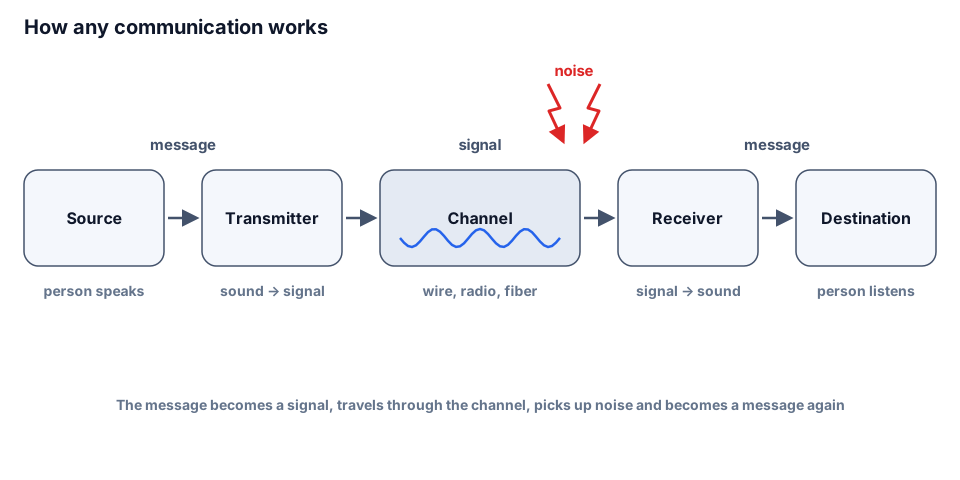
| Part | What it does | In the grandmother's call |
|---|---|---|
| Source | creates the message | the grandmother speaks |
| Transmitter | turns the message into a signal | the microphone and electronics of her phone |
| Channel | carries the signal over the distance | the operator's lines and equipment |
| Receiver | turns the signal back into a message | the electronics and speaker of the grandson's phone |
| Destination | takes in the message | the grandson listens |
Interference (noise) always acts on the channel: crackling, pickup from neighbouring wires, radio interference. The destination gets not a perfect signal but a signal mixed with noise. The whole job of communication technology is to keep noise from spoiling the message.
What the signal travels through: transmission media
The transmission medium is the physical thing the signal travels through.
| Medium | Signal | Where you meet it |
|---|---|---|
| Copper wire | electric current | the phone line into a flat, cables inside a building |
| Radio | electromagnetic wave | mobile networks, Wi-Fi, satellites |
| Optical fiber | pulses of light | trunks between cities, fiber to the home |
A single call usually passes through several media: from the phone to the tower by radio, from the tower to the operator's node over fiber, to an old home phone over copper.
Which way communication goes
| Mode | How it works | Example |
|---|---|---|
| Simplex | one direction only | a radio receiver, a TV set |
| Half-duplex | both directions, but in turn | a walkie-talkie: press the button to talk, release it to listen |
| Full duplex | both directions at the same time | a phone conversation |
Telephone communication is full duplex: you can interrupt the other person, and they will hear you.
The network: why exchanges are needed
At first, phones were connected directly by a wire. With two phones this works. But if everyone must be able to call everyone, the number of lines grows very quickly.
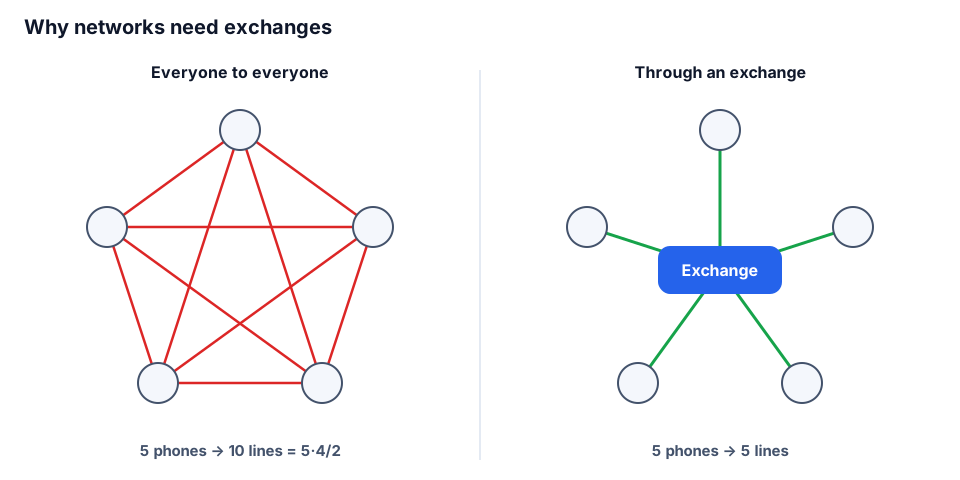
Worked example: how many lines are needed
Each of n subscribers connects to the n − 1 others. Each line is then counted twice (from A to B and from B to A), so we divide by 2:
lines = n × (n − 1) / 2

n = 2    → 2 × 1 / 2     = 1
n = 5    → 5 × 4 / 2     = 10
n = 100  → 100 × 99 / 2  = 4950
A city with 100,000 subscribers would need almost 5 billion lines — no network can be built like that. The solution is an exchange (a switching node): every subscriber is connected to it by one line, and the exchange connects the required pair on request. For n subscribers only n lines are needed.
This is how a communication network appears: nodes (exchanges, switches, base stations) and the lines between them.
Subscriber, operator, service
- A subscriber uses communication under a contract: they have a number and a line (or a SIM card).
- A telecom operator is a company that owns a network and sells services.
- A service is what the subscriber pays for: telephony, SMS, mobile internet, television.
The same subscriber can use services of different operators: a home phone with one, a mobile with another. Operators connect their networks to each other, so you can call any number.
What can go wrong and how to find it
The five-part model is the best tool for finding a fault: move along the chain and check each part.
| Symptom | Where to look | Why |
|---|---|---|
| The other person cannot hear you, but you hear them | the transmitter on your side | the microphone is faulty or covered |
| Crackling and noise during the call | the channel | interference on the line, weak radio signal |
| Every subscriber in the building lost service | the channel or a node | a damaged cable, a failure at the exchange |
| Calls go nowhere | a network node | the exchange cannot connect the pair |
⚠️ A common beginner mistake is to blame "the network" right away. Check the ends of the chain first: the phone, the cable to it, the settings. It is faster, and that is where the cause most often is.
Practice
- Predict. You are talking on a walkie-talkie, and at the same moment your friend presses their button. Will you hear each other? Why?
- Check. Find the answer in the table of communication modes. Did it match yours?
- Explain. Name all five parts of the communication model for an SMS.
- Modify. How does the number of lines change if a building has 10 subscribers instead of 5 and they are connected everyone to everyone? And through an exchange?
- Do it yourself (starred ⭐). An office has 20 employees. The director suggests connecting everyone with direct lines, everyone to everyone. Count the lines and suggest a cheaper option.
Self-check
Question. Which of these is a signal: the text of an SMS, the radio wave from the phone to the tower, the meaning of the phrase "I will be late"?
Explanation. Only the radio wave is a signal: it is a physical carrier with a frequency and a power. The SMS text and the meaning of the phrase are the message.
Question. A building has 10 flats. How many lines does everyone-to-everyone need, and how many through one exchange?
Explanation.
everyone to everyone: 10 × 9 / 2 = 45 lines
through an exchange:  10 lines
Through an exchange there are 4.5 times fewer lines, and the gap grows with the number of subscribers.
Answers to the practice. 1 — no: a walkie-talkie is half-duplex, you talk in turn. 3 — source: you type the text; transmitter: the phone turns the text into a radio signal; channel: the operator's network; receiver: your friend's phone; destination: your friend reads it. 4 — 10 × 9 / 2 = 45 lines instead of 10; through an exchange, 10 instead of 5. 5 — 20 × 19 / 2 = 190 lines; cheaper: install an office exchange (PBX) with 20 lines connected to it.
Review and the criterion for moving on
Move on to the next lesson if, without hints, you can:
- name the five parts of the communication model and give an example of each;
- explain the difference between a message and a signal using the letter example;
- count everyone-to-everyone lines for any
nand explain why an exchange is needed.
Standards and sources
- ITU Constitution and Convention — the definition of telecommunication.
- ITU-T and ITU-R — the telecommunication and radio standardization sectors; more about them in the lesson "Who writes the rules".
- C. E. Shannon, "A Mathematical Theory of Communication" (1948) — the "source — transmitter — channel — receiver — destination" model.
