
You pick up the home phone and hear the dial tone, you dial a number and the call goes out. An analog subscriber line has worked this way for decades, but it has four limits that no amount of tuning can remove: one conversation per pair of wires, interference on the last mile, a poor language of signals, and no way to talk and send data at the same time. This is the introductory lesson of the course: we will name these limits, put numbers on them and see what idea the ISDN network offered to remove them. The details come in the next lessons.
Goal and prerequisites
After this lesson you will be able to:
- name the four limits of an analog subscriber line and recognize each one from a customer complaint;
- calculate how many analog pairs are needed for a given number of simultaneous conversations;
- estimate how long pulse dialing of a number takes and explain why the "language" of analog signalling is poor;
- explain the idea of ISDN: digital all the way to the subscriber, integration of services and a separate channel for signalling;
- say where ISDN is used today and why it is studied in this course.
What you need to know first: the whole telbasics and pstn courses. From telbasics you will need: the 300–3400 Hz channel band (lesson 16), attenuation, noise and crosstalk (lesson 17), analog and digital (lesson 21), the 64 kbit/s channel (lesson 25). From pstn: the subscriber line (lesson 3), line feeding and going off-hook (lessons 9–10), exchange tones and ringing (lessons 11–12), pulse dialing (lesson 13), caller ID (lesson 14), DTMF (lesson 18) and the drawbacks of CAS (lesson 48).
A real-life task
Nigar is a manager at a small travel agency in Baku. The agency has one city line: one pair of wires and one number. Nigar is talking to a customer, and a second customer calls at that moment and hears a busy tone. The director, Rashad, wants to send a fax, and while the fax is going out the telephone is silent. In the evening he connects a computer to the internet through a modem, and again not a single call gets through. On the old dial telephone in the director's office, a number with many zeros takes forever to dial. Rashad asks the operator: "Make it so that my line carries two conversations at once, the number goes out fast, and I can work with data."
The second case is at Nigar's parents' village. The exchange is 5 km of cable away, and the voice in the handset is quiet with a hiss. The technician explains: "The exchange is digital, everything inside the network is clean, so the problem is on your line."
Both cases run into the limits of the same analog line. Let us go through them one by one and see what the ISDN network offered.
What an analog line can do: a short reminder
Everything that happens on an analog line goes over one pair of wires a and b (lesson 3 of the pstn course). The exchange sends a DC feed current into it (lesson 9), and the telephone answers by closing and opening the loop (lesson 10). The table reminds you what the line uses to carry each piece of "news".
| What has to be carried | How the analog line carries it | pstn lesson |
|---|---|---|
| Handset lifted or put down | the loop is closed or open: current flows or it does not | 10 |
| Ringing for the subscriber | ringing signal, an alternating voltage (the bell) | 12 |
| Call status for a person | exchange tones: dial tone, busy tone, ringback tone | 11 |
| The dialed number | a series of loop openings (10 pulses per second) or a DTMF tone pair | 13, 18 |
| The caller's number | a short FSK burst in the pause between rings | 14 |
| The conversation | the analog voice signal in the 300–3400 Hz band | telbasics, 16 |
It all goes over one pair, and part of the "news" goes right inside the voice band. The limits follow from this.
Limit 1: one conversation per pair
The pair of wires a and b is one two-wire path "there and back" (lesson 18 of the telbasics course). While it is busy with a conversation, a second conversation on the same pair is impossible. An analogy is a single-lane road: cars go one behind another and cannot fit side by side. Telephones connected in parallel to one line do not create a second conversation: they are attached to the same pair, and if you lift the handset of the second telephone you hear the conversation already in progress.
If you need two conversations at once, you need a second pair, and with it a second port in the exchange and its own pairs on every section of cable up to the cabinet (lesson 3). If n people in an office talk at once, you need n analog lines.
Worked example: how many pairs the agency needs
calls at once   analog pairs
1               1
2               2
4               4
12              12

rule: pairs = calls at once (1 pair = 1 call)
Line by line:
- One pair carries one conversation, so one conversation needs one pair.
- Two simultaneous conversations need two pairs, four need four pairs.
- For 12 simultaneous conversations you need 12 pairs, 12 exchange ports and 12 "conductor pairs" in the cable all the way. The growth is linear: every new conversation is a new pair.
Limit 2: interference and loss on the last mile
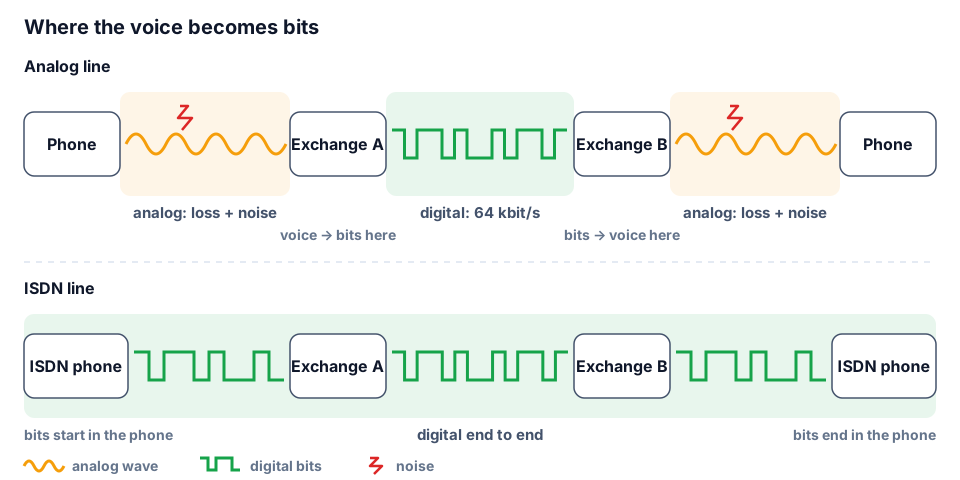
Inside a modern network the voice has been turned into bits, a 64 kbit/s channel (lesson 25 of the telbasics course). But the last section, the subscriber line, is analog: the voice travels over the copper pair as a wave, and only on the exchange's line card does the codec digitize it (lesson 30 of the pstn course). Whatever the line did to the wave is digitized together with the voice.
What the line does we know from lesson 17 of telbasics: attenuation (the signal gets weaker with length), distortion and crosstalk. They cannot be cleaned off: the receiver cannot tell voice from noise, and an amplifier makes both the voice and the noise louder.
Worked example: a 5 km line
We take the reference values from pstn lesson 3 and telbasics lesson 17: a 0.5 mm conductor, a loss of 1.2 dB/km at 800 Hz, a loop resistance of 180 Ω/km, and an exchange limit that is a teaching assumption of 1000 Ω.
line: 5 km, 0.5 mm, tone 800 Hz

loss: 5 km × 1.2 dB/km = 6 dB
      6 dB = 3 dB + 3 dB → power is 4 times weaker
loop resistance: 5 km × 180 Ω/km = 900 Ω → less than 1000 Ω, fits

two such lines in one call (caller and called party):
6 dB + 6 dB = 12 dB = 4 × 3 dB → power is 2 × 2 × 2 × 2 = 16 times weaker
Line by line:
- Loss:
5 × 1.2 = 6 dB. Every 3 dB is roughly half the power, so6 dBis a quarter. - Loop resistance
5 × 180 = 900 Ωis below the1000 Ωlimit: the line is fine for feeding. But it still loses 6 dB. - A conversation involves two subscriber lines, the caller's and the called party's. If both are like this, the losses add up:
12 dB, so the power is16times weaker. We count only the cables of the two lines, not the exchanges and amplifiers.
The quality of a conversation is decided by the weakest link, and that is the analog subscriber line. The idea of ISDN is to move the "analog / digital" border to the subscriber, into the telephone itself: the voice turns into bits in the set, and the line carries bits, not a wave. As long as the receiver can tell ones from zeros (lesson 21 of the telbasics course), the line's noise does not become part of the voice.
Limit 3: signals are slow and the "language" is poor
Let us recall how an analog line tells the exchange where the subscriber is calling.
Pulse dialing (lesson 13): a digit is a certain number of loop openings at a speed of 10 pulses per second. The digit 0 is ten pulses, a full second. A pause is needed between digits: it lets the exchange tell where one digit ended and the next began.
Worked example: the time to dial the number 5017
The teaching model from lesson 13: each pulse takes 100 ms, and the pause between digits is 0.8 s.
digit  pulses  time (100 ms per pulse)
5      5       0.5 s
0      10      1.0 s
1      1       0.1 s
7      7       0.7 s
pulses: 23  -> 2.3 s
pauses: 3 × 0.8 s = 2.4 s
total: 4.7 s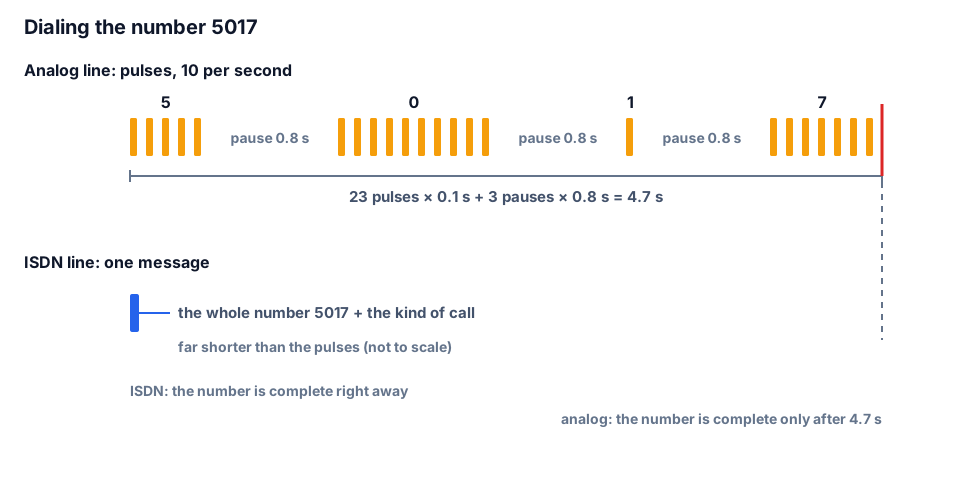
Line by line:
- The digits
5,0,1,7give5 + 10 + 1 + 7 = 23pulses, that is23 × 0.1 = 2.3 s. - A four-digit number has three pauses between digits:
3 × 0.8 = 2.4 s. - The total is
2.3 + 2.4 = 4.7 sbefore the exchange has the whole number.
DTMF tone dialing (lesson 18) is faster, but it speaks a language of 16 "words", the tone pairs of a 4×4 matrix, and it travels in the same band as the voice: the receiver sometimes mistakes a piece of speech for a digit (talk-off, lesson 20). Caller ID (lesson 14) is possible only as a short burst in the pause between two rings.
The main point is the poverty of the language. The line can say: "the handset is lifted", "here is a digit", "I am calling". But "I need a data channel, not a voice call", "I am calling from this number but do not show it" or "the call failed for this reason" cannot be said at all: there are no "words" for this information. On top of that, many signals travel in the conversation band, where they disturb the voice and get distorted themselves.
You have already seen the same limits in channel-associated signalling (CAS) between exchanges (lesson 48 of the pstn course): slow, few signals, tied to the speech channel, in-band tones that can be spoofed. The way out was common-channel signalling, SS7 (= CCS7 = No.7 = N7; the ss7 course). ISDN applies the idea of a separate channel on the "subscriber to exchange" section: messages travel not in the conversation band but in their own channel.
Limit 4: data and voice do not fit together
An analog line passes only the 300–3400 Hz band (lesson 16 of the telbasics course). To send computer data over it you need a modem: it turns bits into sounds of this band and back. The consequences:
- while a modem (or fax) session is running the line is busy: a conversation is impossible, and the other way round;
- speed is limited by the narrow band: according to ITU-T standards, analog modems give up to
33.6 kbit/sin both directions and up to56 kbit/sin one direction.
💡 DSL technology appeared later: it sends data on frequencies above the voice, and then voice and data go over one pair at the same time. But that is a separate method, and it does not change the line inside the conversation band. ISDN solves the task differently, with digital channels.
The idea of ISDN
Now we have a list of complaints. The ISDN network (Integrated Services Digital Network) answers them with three ideas. Each is hidden in the name or in the design of the network.
- Digital: digital all the way to the subscriber. The voice turns into bits already in the subscriber's set. The line carries the same 64 kbit/s channels as inside the network (lesson 25 of the
telbasicscourse), not an analog wave. Bits can be recognized and restored, so line noise does not spoil the voice step by step. - Integrated services. Voice, data and other services go through one line and one set of standard ways of connecting, instead of a separate line for each service. Data travels over a digital channel without a modem.
- A separate channel for signalling. Instead of pulses, tones and current in the conversation band, there are messages in a channel of their own: one message can carry the whole number, the kind of call (voice or data) and other details. It is the same idea of a common channel as in SS7.
According to the ITU-T definition (Recommendation I.112), an ISDN is an integrated services network that provides digital connections between the points where subscribers connect to it.
| Feature | Analog line | ISDN line |
|---|---|---|
| Simultaneous conversations | 1 per pair | 2 per pair (a line for the home); 30 on an E1 stream (a line for a PBX) |
| Voice | analog wave, 300–3400 Hz | bits, 64 kbit/s per conversation |
| Dialing | pulses or tones, digit by digit | one message with the whole number |
| Information about the call | almost none; the caller's number is a short FSK burst | in signalling messages |
| Data | a modem in the voice band, the line is busy | a digital channel, the conversation goes in another channel |
| Noise on the line | builds up in the voice | bits can be restored |
Two forms of ISDN: BRI and PRI
For now these are just names; we study them in lessons 6 and 13.
- BRI (basic rate interface, also written BRA in Huawei documents) is a line for the home and a small office: an ordinary copper pair, two conversations at once and a signalling channel.
- PRI (primary rate interface, also written PRA in Huawei documents) is a high-capacity line, for example for a PBX: an E1 stream, thirty conversations at once and a signalling channel.
Q.921 and Q.931 are the names of two protocols used for the exchange in the signalling channel. We study them in sections 4 and 5 of the course.
Worked example: how many pairs an office needs
An office needs 5 simultaneous conversations. We calculate for two options.
calls at once: 5

analog:  1 pair = 1 call          → 5 pairs
ISDN:    1 pair = 2 calls         → 5 / 2 = 2.5 → round up → 3 pairs

calls at once: 8
analog:  8 pairs
ISDN:    8 / 2 = 4 pairs
Line by line:
- Analog: as many pairs as conversations, that is 5.
- ISDN, a line for the home: a pair carries two conversations, so
5 / 2 = 2.5. A pair cannot be cut into parts, so we round up to 3 pairs. The signalling channel goes over the same pairs, no separate pair is needed. - For 8 conversations we get exactly
8 / 2 = 4pairs, half as many as with analog.
Where ISDN came from and where it is today
ISDN standards are written by ITU-T (until 1 March 1993 it was called CCITT: on that day ITU-T replaced it). They are collected in the I series. Two documents are enough for an introduction: I.112 ("vocabulary of terms") and I.120 ("general principles of ISDN"). The texts themselves state that the first edition dates from 1984 (Malaga-Torremolinos); they were then revised in 1988 and 1993 (the 03/93 editions are in force). I.120 says that ISDN grows out of the digital telephone network and that the transition may take "one or more decades".
Today BRI for subscribers is increasingly rare: in many countries operators are moving customers to IP telephony. PRI, however, is still found where a company's PBX meets the operator, which is why this course is practical: you will learn to read the message exchange on a PRI line and understand how a PBX and an exchange agree on a call. The idea of a separate signalling channel will be needed later in the track too.
What can go wrong and how to find it
| Symptom | Possible cause | What to check |
|---|---|---|
| The second employee hears a busy tone while the first one is talking | the line carries one conversation: one conversation per pair | how many pairs the office has; whether the telephones are connected in parallel to one pair |
| Quiet and hissing on a long line | attenuation and noise of the analog section, a bad contact | loop resistance and loss for the line length (lessons 3 and 16 of the pstn course), contacts in the cabinet and the box |
| Someone else's conversation is audible | crosstalk: the twisting of the pair is broken or the insulation is damaged | switch the subscriber to a spare pair and compare |
| A voice menu does not accept all digits | DTMF tones travel in the speech band and the line distorts them | tone level, the P/T dialing mode (lessons 19–21 of the pstn course) |
| The caller's number is not displayed | the number comes as a short FSK burst in the pause between rings | whether another set on the same line shows the number; whether the network passes it on (lesson 14) |
| Nobody can call during a modem session | this is not a fault: voice and modem share one pair | a second line or another way of access |
⚠️ ISDN does not cure the physics of the line. A break, a bad contact and a damp cable remain faults on a digital line too: what travels over the pair changes, not the pair itself. Start troubleshooting at the lowest level, by checking the pair and its contacts.
Practice
- Predict. An office needs 6 simultaneous conversations. How many analog pairs does it need? How many pairs are needed if one pair carries two conversations?
- Check. Calculate with the rule "analog: as many pairs as conversations; ISDN: divide by 2 and round up". Does it match your prediction?
- Explain. Why can a fax and a telephone conversation not run at the same time over one analog line?
- Change. Calculate the dialing time of the number
7090in the model (100 ms per pulse, 0.8 s pause). What time do you get for the number1111? - Do it yourself (with a star ⭐). Two subscribers are connected through digital exchanges, and each has an analog line of
5 km(a0.5 mmconductor,1.2 dB/kmat800 Hz). How many dB build up on the two lines together, and how many times weaker is the power? How would the picture change if the voice were turned into bits in the telephone itself?
Self-check
Question. The exchange is digital, everything inside the network goes over 64 kbit/s channels, yet the subscriber hears a hiss. Why?
Solution. Noise and loss build up on the analog subscriber line before the exchange's line card, where the voice is digitized. The codec digitizes everything that arrived over the line: the voice together with the noise. After that the noise cannot be separated any more, because it has become part of the samples. To keep the line's noise out of the voice, you have to digitize the voice earlier, in the telephone itself: that is the idea of "digital all the way to the subscriber".
Question. An office needs 7 simultaneous conversations and one connection for data through a modem. How many analog pairs does it need? And how many pairs on an ISDN line with two channels per pair, if the data goes in a separate channel and the conversations in the rest?
Solution. Analog: the modem occupies the line completely, so 7 + 1 = 8 pairs. ISDN: you need 7 + 1 = 8 channels (data goes over a digital channel without a modem), 8 / 2 = 4 pairs.
Answers to the practice. 1 — analog: 6 pairs; with two conversations per pair, 6 / 2 = 3 pairs. 2 — it matches: with ISDN there are half as many pairs. 3 — both a fax and a modem send their signal in the same 300–3400 Hz band as the voice and occupy the whole pair, so a conversation is impossible during their session. 4 — the number 7090: 7 + 10 + 9 + 10 = 36 pulses, 3.6 s; three pauses of 0.8 s give 2.4 s; total 6.0 s. The number 1111: 4 pulses, 0.4 s plus 2.4 s of pauses, 2.8 s. 5 — 6 dB + 6 dB = 12 dB, the power is 16 times weaker. If the voice turned into bits in the telephone, line loss would not distort the voice step by step: as long as the receiver can tell ones from zeros, the voice at the output is the same. When the line is too long, it is no longer the quality that goes but the connection itself: the receiver stops telling the bits apart.
Review and the criterion for moving on
Move on to the next lesson if you can, without hints:
- name the four limits of an analog line and give a customer complaint for each;
- calculate the number of pairs for a given number of simultaneous conversations on analog and on ISDN (two conversations per pair);
- calculate the pulse dialing time of a number and explain why a message is faster and "richer";
- retell the three ideas of ISDN: digital all the way to the subscriber, integration of services, a separate signalling channel.
Next is lesson 2: the channels that an ISDN line is built from will get the names B, D and H.
Standards and sources
- ITU-T I.112 (03/93) "Vocabulary of terms for ISDNs": the definition of ISDN (term 308): an integrated services network that provides digital connections between the points where subscribers connect (put here in plain words).
- ITU-T I.120 (03/93) "Integrated services digital networks (ISDNs)": the principles of ISDN, support for voice and non-voice applications in one network, compatibility of new services with 64 kbit/s switched digital connections, evolution from the digital telephone network; the heading reads Malaga-Torremolinos, 1984, with revisions in 1988 and 1993.
- Q.921 and Q.931 are the names of the signalling channel protocols, studied in sections 4 and 5. The I-series Recommendations for BRI and PRI lines come in lessons 6 and 13.
- ITU-T V.34 (02/98): analog modems up to 33 600 bit/s; ITU-T V.90 (09/98): up to 56 000 bit/s in one direction and up to 33 600 bit/s in the other.
- The
telbasics(lessons 16, 17, 21, 25) andpstn(lessons 3, 9–14, 18, 30, 48) courses, for a review of the limits of the analog line.
