
You dial an ordinary city phone number, and a few seconds later the phone rings on the other side. There is no single long wire between the two telephones: the call passes through a chain of lines and exchanges that is called the public switched telephone network. This is the first lesson of the sub-course. In it we name all the parts of the network, follow one call from phone to phone and count how many channels it occupies. The sub-course builds on the telbasics course, so its lessons will be referred to often.
Goal and prerequisites
After this lesson you will be able to:
- spell out the name PSTN letter by letter and explain how such a network differs from a private one;
- name the parts of the network (telephone set, subscriber line, local exchange, trunks, transit exchange) and say what each one does;
- follow the path of a call between two cities and show where the voice is analog and where it is digital;
- calculate how many E1 streams are needed between two exchanges for a given number of simultaneous conversations;
- from a subscriber's complaint, name the part of the path where the search for the fault should start.
What you should know beforehand: the whole telbasics course, especially lessons 1, 3, 16, 25, 31 and 42. From lesson 1: exchange, subscriber, operator and the number of everyone-to-everyone lines n × (n − 1) / 2. From lesson 3: a call, the three parts of a network (access, transport, core) and the two planes: control ("agreeing on the connection") and user (the voice itself). From lesson 16: the 300–3400 Hz voice channel. From lesson 25: the 64 kbit/s digital channel (DS0). From lesson 31: the E1 stream, with 32 timeslots of which 30 carry voice. From lesson 42: circuit switching, where a call occupies one channel on every line between exchanges.
A real-life task
It is morning at an operator's duty desk, and three complaints have come in. First: in flat 12 the phone is silent, while the neighbours' phones work. Second: in a whole district, no subscriber's phone has worked since eight o'clock. Third: calls inside the city go through, but many subscribers hear frequent short beeps when they call Baku. Where should you look for the fault in each case? You can answer only by knowing what parts the path of a call consists of and who is connected to which part. This is the map we are going to build.
What the PSTN is
The PSTN is the public switched telephone network. People also call it "the city telephone network" or "the ordinary phone", and the service of an ordinary analog phone is often called POTS (plain old telephone service). All these words refer to the same network. The name PSTN reads letter by letter:
| Letter | Word | What it means |
|---|---|---|
| P | public | Anyone can become a subscriber, get a number and call any other number of the network. The network is not limited to a group of users. Analogy: city roads that everyone drives on, unlike the closed territory of a factory |
| S | switched | For the duration of each call the exchanges set aside a separate path, and after the call ends they release it (circuit switching, telbasics course, lesson 42). Analogy: booking a hotel room |
| T | telephone | The network was created for voice: the channel is designed for the 300–3400 Hz band (telbasics course, lesson 16) and in digital form carries 64 kbit/s (lesson 25) |
| N | network | Nodes (exchanges) and the lines between them (telbasics course, lesson 1) |
The words "public" and "switched" are standard. Recommendation ITU-T P.10/G.100 (clause 6.204) calls a PSTN any network that provides transmission and switching and whose features are available to the general public, not only to a specific user group. A private network, for example the exchanges of one company that connect only its own offices, does not fit this definition. It can, however, connect to the PSTN through its own exchange: an office exchange is called a PBX (details in lesson 7).
💡 The PSTN is not all of telecommunications. The mobile network and the internet are other networks. The PSTN joins them at interconnection points, and a call from a city phone to a mobile phone passes through both networks (telbasics course, lesson 3).
What the PSTN is made of: the path of a call
Let us take the call from the first telbasics lesson: a grandmother in Ganja calls her aunt in Baku on a city number. The numbers of the items below match the numbers on the diagram.
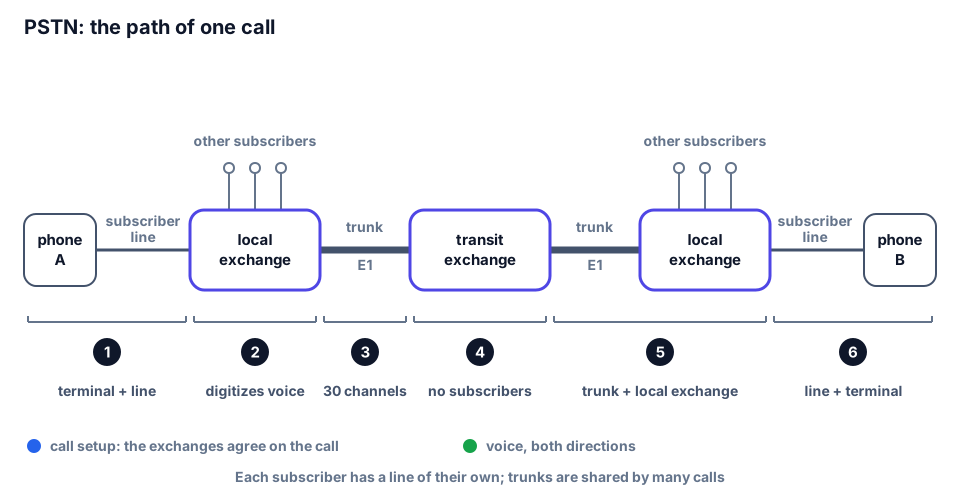
- The phone and the subscriber line. The telephone set is the most familiar terminal (end device): the end of the chain, where the signal enters and leaves the network. It turns voice into an electrical signal and back (telbasics course, lesson 13). A terminal can also be a fax machine, a modem, or an office exchange (PBX) connected as a "subscriber". From the phone to the exchange runs the subscriber line: a pair of copper wires. Every subscriber has a line of their own, so there are as many lines as subscribers (telbasics course, lesson 1). The signal on it is analog. Details in lesson 3.
- The local exchange. The subscriber lines of a district come together here. The exchange notices that a subscriber wants to call, accepts the dialed number and decides where to send the call. If the called subscriber is connected to the same exchange, it connects the two subscribers itself and the call never leaves it. At the entrance of the exchange the voice is digitized: 8000 samples per second of 8 bits each give 64 kbit/s (telbasics course, lesson 25). Details in lessons 2 and 4.
- The trunk is a line between two exchanges. Unlike a subscriber line, it is shared by many conversations and it is digital. Most often it is an E1 stream with 30 voice channels (telbasics course, lesson 31). One call occupies one channel on such a line (telbasics course, lesson 42).
- The transit exchange. It joins exchanges to one another, and no subscribers are connected to it. A call arrives on one trunk and leaves on another, like a train changing tracks at a junction station. Why such exchanges are needed is the topic of lesson 2.
- The second half of the path is a mirror image: a trunk and the local exchange of the called city. It finds the aunt's line, checks that it is free and sends the call to her phone. Here the digital voice becomes an analog signal again.
- The subscriber line and phone B. The aunt lifts the handset, and the conversation goes both ways at once (full duplex, telbasics course, lesson 1).
The blue dots on the diagram are the agreement about the call (the control plane), the green ones are the voice (the user plane). First the exchanges agree, then the conversation goes (telbasics course, lesson 3).
Worked example: the Ganja to Baku call
element                    what it does                        signal
phone A                    voice <-> electric signal           analog
subscriber line A          copper pair to the exchange         analog
local exchange 1 (Ganja)   takes the number, sets up the path  analog -> digital
trunk 1 (E1)               30 channels shared by many calls    digital
transit exchange           joins two exchanges                 digital
trunk 2 (E1)               30 channels shared by many calls    digital
local exchange 2 (Baku)    finds line B, rings phone B         digital -> analog
subscriber line B          copper pair from the exchange       analog
phone B                    electric signal <-> voice           analog
Line by line:
- Phone A and line A are the analog part. They belong to subscriber A alone, so they take no shared resources of the network.
- The Ganja exchange accepts the number, chooses the path and turns the voice into numbers.
- On the first trunk the voice travels in digital form, in one of the 30 channels of the E1 stream. The other 29 channels are meanwhile busy with other conversations or free.
- The transit exchange moves the voice from a channel of the first line to a channel of the second (telbasics course, lesson 41). It has no subscribers.
- The Baku exchange finds line B and sends the call. When the aunt answers, the voice is turned into current for her phone.
Now let us count how many shared resources this call holds:
exchanges on the path:  N = 3
trunks between them:    N - 1 = 2
channels held:          2   (one per trunk, used both ways)
speed held:             2 x 128 kbit/s = 256 kbit/s
subscriber lines:       not counted (they belong to the subscribers)
We applied the formula from the telbasics course (lesson 42) to three exchanges: two channels of 2 × 64 = 128 kbit/s, 256 kbit/s in total. A call between two subscribers of the same local exchange occupies 0 channels: the exchange connects them inside itself.
Analog at the edges, digital inside
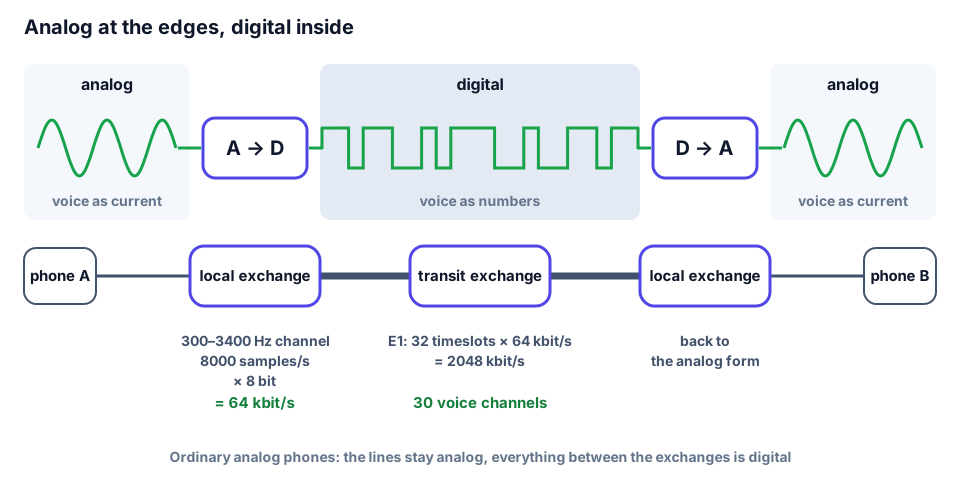
With an ordinary analog phone the voice travels along the subscriber line as a current that changes together with the sound (telbasics course, lesson 13). As soon as the current enters the local exchange, it is digitized: the channel is designed for the 300–3400 Hz band, 8000 samples per second are taken from it, each is coded with 8 bits, and the result is 64 kbit/s (telbasics course, lesson 25; Recommendation G.711). From there on the voice is numbers: channels of 64 kbit/s are packed into E1 frames, and the frames travel along the trunks (telbasics course, lessons 30 and 31). At the called party's exchange the numbers turn into current again, and it travels along the line to phone B.
Why is it built this way? A digital signal can be regenerated on the way, so noise does not accumulate, and it is easy to multiplex into streams (telbasics course, lessons 17 and 21). For the shared trunks between exchanges this pays off. The phone and the subscriber line stay analog because every subscriber has them of their own, they are already laid, and the phone itself is simple and cheap. Digital subscriber lines also exist, but that is a separate topic.
💡 Remember the boundaries: from the entrance of the first exchange to the exit of the last one the voice is digital, and on the subscriber lines themselves it is analog.
Operators: one network made of many
The exchanges and lines of the PSTN belong to operators (telbasics course, lesson 1). A country has several of them, and each builds its own network. The networks are connected to one another at interconnection points, usually with the same E1 streams, so a subscriber of one operator can call a subscriber of another. "Public" does not mean "one company"; it means "one system of numbers and interconnection points open to everyone". Details in lesson 6.
Four calls from everyday life:
- You call a neighbour who is connected to the same exchange. The call never leaves it, and no trunks are occupied.
- You call another city. The call goes over trunks, possibly through a transit exchange.
- You call a mobile phone from a city phone. The call leaves the PSTN at an interconnection point with the mobile network, and from there the core of the mobile network carries it (telbasics course, lesson 3).
- An employee calls the city from an office. The call goes through a PBX, which is connected to the operator's exchange as a large "subscriber" (details in lesson 7).
Worked example: how many E1 streams are needed
Between the district's local exchange and the transit exchange, up to 190 people talk at once in the busy hour. How many E1 streams (E1 links) should be ordered?
simultaneous calls:        190
voice channels in one E1:  30   (TS0 and TS16 carry no voice)
E1 streams = ceil(190 / 30) = ceil(6.33) = 7
voice channels = 7 x 30 = 210, spare = 210 - 190 = 20

counting 32 per E1 gives ceil(190 / 32) = 6 E1:
6 x 30 = 180 voice channels -> 10 calls are blocked
Line by line:
- An E1 stream has 30 voice channels, not 32: TS0 and TS16 carry no voice (telbasics course, lesson 31).
190 / 30 = 6.33. You cannot buy part of a stream, so we round up: 7.- Seven streams give
7 × 30 = 210channels, a spare of210 − 190 = 20. - If you wrongly count 32 per stream, you get 6 streams and only 180 voice channels: ten calls are blocked in the busy hour (telbasics course, lesson 42).
What awaits you in the sub-course
The sub-course has 70 lessons. Here is its map in plain words:
| Section | What it is about |
|---|---|
| PSTN architecture | levels of exchanges, the subscriber line, types of exchanges, call zones, operators, the office exchange |
| The analog subscriber | the telephone set, line feeding, lifting the handset, exchange tones, ringing, dialing, caller ID, a full call |
| Tone dialing (DTMF) | how a phone sends digits as tones |
| Numbering | how telephone numbers and their formats are built |
| How an exchange works | switching, call processing, number analysis, routes, charging |
| Signalling between exchanges | the older ways of agreeing on a call over the lines between exchanges |
| Traffic and quality | how many channels are needed and how to calculate it |
| The access network | how subscribers are gathered into nodes placed away from the exchange |
| Problems and solutions | fault investigations and the final project |
What can go wrong and how to find it
The path of a call is a chain, and a fault is searched for along the chain. The first question is how many subscribers are affected and where calls do not go through (as in the telbasics course, lesson 3). The diagram below matches the scale of a complaint with a part of the path.
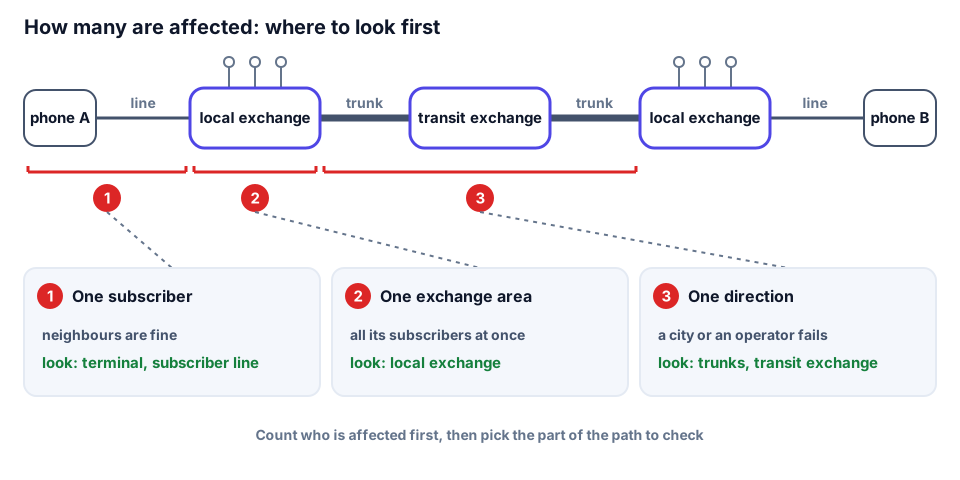
| Symptom | Possible cause | What to check |
|---|---|---|
| The phone does not work for one subscriber only, the neighbours are fine | this subscriber's phone or subscriber line | another phone on the same line; the line from the socket to the exchange |
| Phones do not work for all subscribers of one exchange's district | the local exchange, or the cable that brings the district's lines to it | whether the affected subscribers are confirmed to be on one exchange; the state of the exchange |
| Calls inside the city go through, but calls to another city give frequent short beeps | trunks: all channels are busy (blocking) or the E1 stream has an alarm; or the transit exchange | calls to other cities through the same transit exchange; the number of busy channels; alarms of the E1 stream (telbasics course, lesson 36) |
| Calls fail only to the subscribers of one operator | the interconnection point with that operator | calls to other operators; the trunks at the interconnection point |
| The subscriber answers, but only silence is heard | the voice did not get through (user plane): the path is not connected in one of the exchanges | whether the channels are connected in both directions in every exchange |
⚠️ A common mistake is to blame "the exchange" at once: there are at least two exchanges and two subscriber lines on the path. First find out how many subscribers and which directions are affected, and only then choose the part of the path to check.
Practice
- Predict. Two subscribers are connected to the same local exchange. How many trunk channels does their call occupy?
- Check. A call goes through 4 exchanges: a local one, two transit ones and another local one. How many lines are there between exchanges, how many channels and what speed is held? Use the formula from the worked example:
N − 1channels of128 kbit/s. - Explain. Why is the voice analog on the subscriber line and digital between exchanges? Give two reasons.
- Modify. In the worked example the busy hour has 215 conversations instead of 190. How many E1 streams are needed? How many calls would be blocked if you wrongly counted 32 channels per stream?
- Do it yourself (starred ⭐). Between a local and a transit exchange, 250 simultaneous conversations are expected in the busy hour. How many E1 streams are needed and what is the spare of channels? What happens if the operator installs one stream fewer?
Self-check
Question. Name in order the elements of the path of a call between subscribers of two cities and say where the signal is analog.
Explanation.
phone A -> subscriber line A -> local exchange -> trunk -> transit exchange
        -> trunk -> local exchange -> subscriber line B -> phone B
analog:  phones and subscriber lines
digital: from the entrance of the first local exchange to the exit of the last
The phones and the subscriber lines are analog. Between the entrance of the first local exchange and the exit of the last one the voice is digital: it travels along the trunks in E1 streams.
Question. Exactly 120 simultaneous conversations pass between two exchanges. How many E1 streams are needed, and what happens to the 121st call?
Explanation. 120 / 30 = 4 — the division is exact, so no rounding is needed. Four streams give 4 × 30 = 120 channels, with no spare. The 121st call is blocked: there is no free channel, and the caller hears frequent short beeps.
Answers to the practice. 1 — none: the exchange connects both lines inside itself. 2 — four exchanges give 3 lines between them, 3 channels and 3 × 128 = 384 kbit/s. 3 — first, every subscriber has a line of their own that is already laid, and the phone is simple and cheap; second, a digital signal can be regenerated on the way, it does not accumulate noise and it multiplexes well into streams where the line is shared. 4 — ceil(215 / 30) = ceil(7.17) = 8 streams, 8 × 30 = 240 channels, spare 25. Counting 32: ceil(215 / 32) = ceil(6.72) = 7 streams, 7 × 30 = 210 channels, 215 − 210 = 5 calls blocked. 5 — ceil(250 / 30) = ceil(8.33) = 9 streams, 9 × 30 = 270 channels, spare 20. One stream fewer means 8 streams and 240 channels: 250 − 240 = 10 calls are blocked.
Review and the criterion for moving on
Move on to the next lesson if, without hints, you can:
- spell out PSTN and explain the words "public" and "switched";
- name the five parts of the path of a call, say what each one does and draw the path between two cities;
- explain where the voice is analog, where it is digital, and why;
- calculate the channels for a call through N exchanges and the E1 streams for a given number of conversations;
- from a complaint, choose the part of the path to start the search with.
Next comes lesson 2 on the levels of exchanges and why a transit exchange is needed. Later in the track come the courses isdn, ss7 and sip; for now these are only names, and the details will come in their time.
Standards and sources
- ITU-T P.10/G.100 (11/2017), clause 6: 6.204 "public switched telephone network (PSTN)" — a network whose features are available to the general public; 6.201 "private branch exchange (PBX)"; 6.203 "private network".
- ITU-T Q.9 (11/1988) — vocabulary of switching and signalling terms; see the telbasics course, lesson 42.
- ITU-T G.711 (11/88) — 8000 samples per second, 8 bits, 64 kbit/s (telbasics course, lesson 25).
- ITU-T G.704 (10/98), clause 5.1 — the E1 frame: 32 timeslots, telephone channels in timeslots 1–15 and 17–31 (telbasics course, lesson 31).
