
An LTE network does one thing: it moves IP packets fast. It has no "telephone" circuit-switched domain of its own, like 2G and 3G had. Yet the subscriber still presses the green button and expects the call to connect quickly, sound clean, and not stop the navigation app or the music. In this lesson we look at how operators provided voice in LTE before VoLTE — through CSFB (the phone drops to 2G/3G for the duration of the call) — briefly recall the forgotten options SVLTE and VoLGA, and see why the industry settled on VoLTE: voice as an IMS service over LTE. At the end we calculate, with assumed numbers, how much time a subscriber loses on every CSFB call.
Goal and prerequisites
After this lesson you will be able to:
- explain why an LTE network has no voice of its own and which four problems the interim
CSFBsolution creates; - put the steps of an outgoing
CSFBcall in order and show exactly where the time is lost; - describe
VoLTEas an IMS service (MMTel) over LTE with twobearers: one for signalling and a guaranteed one for voice; - compare
CSFB,VoLTEand a messenger call (OTT) by quality, emergency calls,E.164number, roaming and call continuity; - calculate the call setup time from given components and explain why
VoLTEopens the way for an operator to switch off 3G.
Prerequisites:
- course
lte: lesson 3 (theEPSsystem — IP only, noCSdomain), lesson 5 (EPCinterfaces, includingSGs), lessons 48–50 (theEPS Bearer,DefaultandDedicated Bearer,GBRandnon-GBRclasses), lesson 67 (Service Request— leaving idle mode), lesson 72 (setting up aDedicated Bearerat the request of the IMS core), lesson 95 (CSFB:SGs,Combined Attach, falling back to 2G/3G and returning) and lesson 97 (moving to 3G/2G when LTE coverage is lost); - course
ims: lesson 1 (why IMS, and how an operator call differs fromOTT), lesson 4 (P-CSCF— the entry to IMS), lesson 7 (emergency calls via theE-CSCF), lessons 9 and 85 (theMMTel ASapplication server andMMTelservices).
A real-life task
Example 1. A call during navigation. Leyla, a courier, is driving through Baku using a navigation app: the map and traffic data load over LTE, and the waybill for the next order is downloading in the background. A customer calls. Leyla's plan and phone have no VoLTE, so the network uses CSFB: the phone leaves LTE for 2G/3G. Leyla notices three things: the call connected a couple of seconds later than she expected; the map stopped updating and the download stopped; and after the call the screen shows "3G" for a long time and the Internet is slow.
Example 2. An operator wants to switch off 3G. An operator's CTO reasons: almost all Internet traffic already goes over LTE, while 3G occupies a 10 MHz band that could be given to LTE. He proposes switching 3G off in six months. The core engineer objects: "As long as most subscribers' voice goes through CSFB, every call from LTE drops to 3G. If we switch off 3G, the calls will go to an overloaded 2G or disappear wherever there is no 2G."
As the voice services engineer, you need to explain to the CTO: why CSFB slows down both calls and the Internet; what VoLTE changes; how VoLTE differs from a messenger call that "already works over LTE"; and calculate how much time a subscriber saves on each call.
1. LTE carries only packets: voice has "nowhere to live"
In 2G and 3G the core network had two halves: the circuit-switched domain (CS) for voice — with the MSC switch — and the packet-switched domain (PS) for the Internet. When 3GPP created LTE, it kept only the packet half (course lte, lesson 3). The MME, S-GW and P-GW nodes deliver IP packets perfectly well, but the EPC core has no node that understands a telephone number, sets up a call, plays busy and ringback tones. So the ordinary call has to "live" somewhere.
Analogy: LTE is a new high-speed motorway. Any cargo travels on it fast, but there is no bus station with a timetable on it. Until the station is built, passengers have to be dropped onto the old road, where there is one.
Operators had four options:
| Approach | Idea | Outcome |
|---|---|---|
CSFB | For the call, the phone leaves LTE for 2G/3G and calls the old way | Mass interim solution |
SVLTE | The phone has two radio chains: one always in LTE, the second in the old network for voice | Seen in early LTE smartphones, faded away |
VoLGA | Voice of the old CS core is "packed" into LTE through a special gateway | Never caught on |
VoLTE | Voice is an IMS service; the whole call stays in LTE | The industry's target solution |
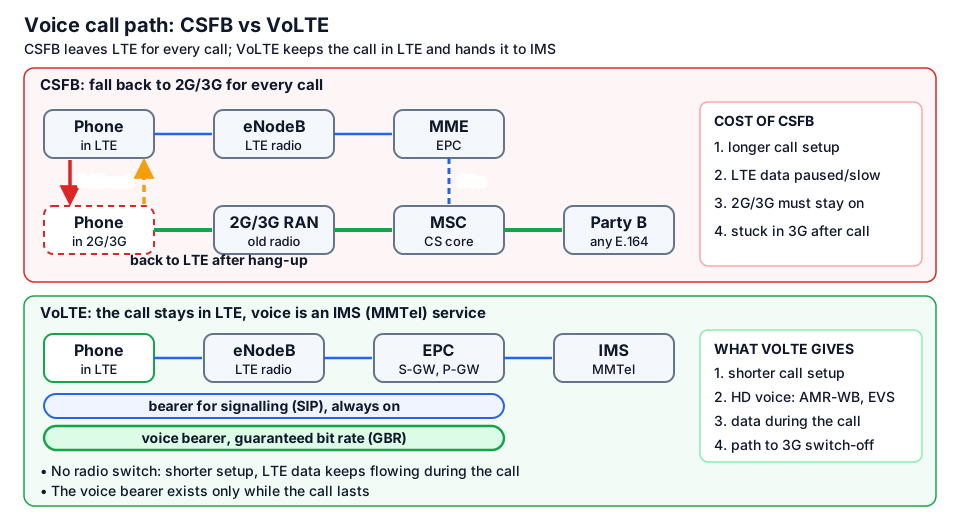
The diagram shows the key difference. With CSFB (top) the phone first tells the MME about the call, then leaves LTE for 2G/3G, and the voice goes through the MSC switch; after hang-up the phone returns to LTE. With VoLTE (bottom) the phone goes nowhere: SIP signalling passes through the EPC into IMS, and the voice travels in a separate guaranteed bearer.
2. CSFB: a call that falls back to 2G/3G
CSFB (Circuit Switched Fallback) is a procedure defined in 3GPP TS 23.272: the phone stays in LTE, but for a voice call it temporarily moves to a 2G or 3G network and talks through that network's CS domain. CSFB relies on the SGs interface between the MME and the MSC/VLR switch (course lte, lessons 5 and 95). Thanks to SGs, the phone performs a combined registration (Combined Attach) at power-on: it is registered both in LTE and in the old CS domain, so the MSC knows through which MME to find the subscriber.
Analogy: you live in a new flat without a phone line, but the neighbours let you use their phone. Every time someone calls you, or you call someone, you have to get up, leave the flat and walk to the neighbours. It works — but each time it takes time, and while you are at the neighbours' nothing happens at home.
An outgoing call step by step

The step numbers match the numbers on the diagram:
1. UE -> MME        Extended Service Request (MO CS fallback)
                    "I want to call: I need the CS domain"
2. MME -> eNodeB    UE Context Modification (CS Fallback Indicator)
                    "move this subscriber to 2G/3G"
3. eNodeB -> UE     RRC Release + redirect to 3G
                    the phone is released from LTE and told the 3G frequency
4. UE               retune to 3G, read system info
                    radio retuning and reading the 3G cell parameters
5. UE -> MSC        CM Service Request (via 3G RAN)
                    an ordinary call request in the CS domain
6. UE <-> MSC       voice in the CS domain
                    conversation; after hang-up, back to LTE
Line by line:
- Step 1. The subscriber pressed "call". A phone in LTE cannot set up a voice call itself, so it asks the
MMEto move it to theCSdomain with anExtended Service Requestmarked "mobile-originatedCSFB". - Step 2. The
MMEchecks that the subscriber is registered viaSGsand tells theeNodeBbase station to move it to 2G/3G (UE Context Modificationwith theCSFBindicator). - Step 3. The
eNodeBreleases the LTE radio connection and names the 3G frequency to go to (redirection). From this moment the phone no longer works in LTE. - Step 4. The phone retunes its radio chain to the 3G frequency and reads the cell's system information — without it, it cannot start transmitting.
- Step 5. In 3G the phone sets up a radio connection and sends the usual
CM Service Requestto theMSCswitch. Only here does what would be the whole call in 2G/3G begin. - Step 6. The conversation runs over a
CSdomain channel. After hang-up the phone has to return to LTE.
An incoming call is the mirror image:
1. MSC -> MME       SGs paging         "someone is calling this user, find them"
2. MME -> eNodeB    paging in LTE      search across the tracking area
3. UE -> MME        Extended Service Request (MT CS fallback)
4. ...              then as steps 2-6 of the outgoing call:
                    fallback to 2G/3G, paging response in the CS domain, conversation
The cost of CSFB: four problems
- Extra setup delay. Steps 2–4 — the move to 2G/3G, radio retuning, reading system information, a new radio connection — happen before the ordinary call setup in the
MSC. The subscriber waits longer for ringback. If the location area in 2G/3G is not the expected one, the phone must also update its location — and the delay grows (courselte, lesson 95). - Lost or slower LTE data. During the call the phone is not in LTE. In a 3G network data continues, but at 3G speed. In a 2G network, where simultaneous voice and data is often not supported, data transfer is suspended until the call ends — TS 23.272 describes this as a separate suspend procedure. That is exactly why Leyla's navigation app "froze".
- A mandatory 2G/3G network and its load. Every voice call of an LTE subscriber is a call in 2G/3G. So wherever there is LTE, the operator must keep 2G/3G with enough capacity: base stations, frequencies, the switch,
SGs. The more subscribers in LTE, the more voice load falls on the old network. - Getting "stuck" in 2G/3G after the call. After hang-up the phone does not return to LTE instantly. If the 2G/3G network did not send it back (fast return, course
lte, lesson 95), the phone waits for a normal cell change and stays in the slow network for a while, even though LTE is right there.
3. SVLTE and VoLGA: historical context
Alongside CSFB, two other approaches were tried. Today they matter only as a history lesson — why the industry chose IMS.
SVLTE(Simultaneous Voice and LTE) — a phone with two radio chains: one always works in LTE for data, the other in the old network for voice. There is no need to leave LTE, and data is not interrupted during the call. The price: two radio modules at once mean higher battery drain, a more expensive and complex phone, and the old voice network is still needed. AsVoLTEarrived, this design was abandoned.VoLGA(Voice over LTE via Generic Access) — the voice of the oldCScore is carried over LTE through a special gateway that connects to the existingMSCswitch. A group of companies promoted it as a quick interim option, but it never became a 3GPP standard. The industry choseCSFBas the interim solution and IMS as the target one, andVoLGAnever caught on.
Analogy:
SVLTEis carrying two phones;VoLGAis laying the old telephone cable inside the new motorway. Both work, but neither solves the main issue — neither gets rid of the old voice network.
4. VoLTE: voice as an IMS service over LTE
VoLTE (Voice over LTE) is a voice call that runs entirely in LTE: SIP signalling and RTP voice travel as IP packets through the EPC, and the call is controlled by the IMS core as defined in 3GPP TS 23.228. The telephone service itself — number, ringback, hold, forwarding — is MMTel, IMS multimedia telephony (course ims, lessons 9 and 85).
The call path: phone → eNodeB → S-GW → P-GW (this is the EPC) → the IMS entry P-CSCF → the IMS core and the MMTel AS server → the called party.
To make voice in LTE sound like a "real" telephone call, the network gives VoLTE two separate bearers (course lte, lessons 48–50):
- A
bearerforSIPsignalling. It exists all the time the phone is registered in IMS and has high priority — so theINVITEdoes not queue behind video and updates. - A voice
bearerwith a guaranteed bit rate (GBR). It is created at the start of the conversation at the request of the IMS core (courselte, lesson 72) and removed after hang-up. While it exists, the base station scheduler reserves the needed rate for the voice, even when the cell is loaded.
The exact parameters of these bearers are covered in section 1 of the course.
Analogy:
VoLTEis when the bus station has finally been built right on the motorway. The passenger does not have to turn off onto the old road, and the trip gets its own lane, valid for as long as the bus is on the way.
What VoLTE gives
| Benefit | Why |
|---|---|
| Fast setup | No move to 2G/3G, no radio retuning, no reading of another cell: the call is set up straight away in LTE |
| HD voice | VoLTE is designed for wideband codecs (names: AMR-WB, EVS) — speech sounds more natural than in the narrow band of a telephone channel |
| Data during the call | The phone stays in LTE: navigation and downloads keep working at LTE speed alongside the conversation |
| A path to switching off 2G/3G | Voice no longer depends on the old network: it can be shrunk, and the freed frequencies can be refarmed for LTE (refarming) |
Spectrum refarming is when the band an old network (for example, 3G) used is handed over to a newer technology after that network is switched off. The frequencies are the same, but LTE fits noticeably more data into them.
Important: VoLTE works only if the phone, the network and the subscriber's subscription all support it. If any one link "cannot", the phone calls the old way — through CSFB. That is why operators run both mechanisms for years.
CSFB, VoLTE and an OTT messenger
A messenger also "calls over LTE". What is the difference? Recall lesson 1 of course ims: for the operator, an OTT call is just packets in the shared Internet channel.
| Feature | CSFB | VoLTE | OTT messenger |
|---|---|---|---|
| Where the voice goes | 2G/3G CS domain via the MSC | LTE → EPC → IMS (MMTel) | The shared Internet channel to the app's server |
Quality guarantee (QoS) | A CS channel, as in 2G/3G | A GBR voice bearer for the call | None: voice shares the channel with other traffic |
| Call setup | Longer: first the fallback to 2G/3G | Shorter: the call starts in LTE | Depends on the app and on network load |
| Data during the call | In 2G often stopped, in 3G slower | Continues in LTE | Continues, but in the same channel as the voice |
| Emergency calls | Yes, as an ordinary 2G/3G call | Yes, via IMS (E-CSCF) | Not guaranteed |
E.164 number | Yes | Yes | Usually an app account; calls stay inside the app |
| Roaming | If the visited network has 2G/3G and CSFB | If the roaming agreement includes VoLTE, otherwise the old way | Over mobile data, no guarantees |
| Leaving LTE coverage mid-call | No problem: the call is already in 2G/3G | A separate mechanism must hand the call over to 2G/3G, otherwise it drops | The app tries to continue over 3G data: gaps, possible drop |
| Is a 2G/3G network needed | Yes, for every call | No (only for old phones and coverage edges) | No |
Note the second-to-last row: VoLTE has a weak spot that CSFB does not. If the subscriber moves beyond the edge of LTE coverage during a call, the call must be handed over to 2G/3G without dropping it. How this is done is a separate big topic of the course.
Worked example: call setup time
Let us calculate how long Leyla waits for ringback with CSFB and with VoLTE. All components are an assumption of the task, not standard values: real values depend on the network, its settings and the phone.
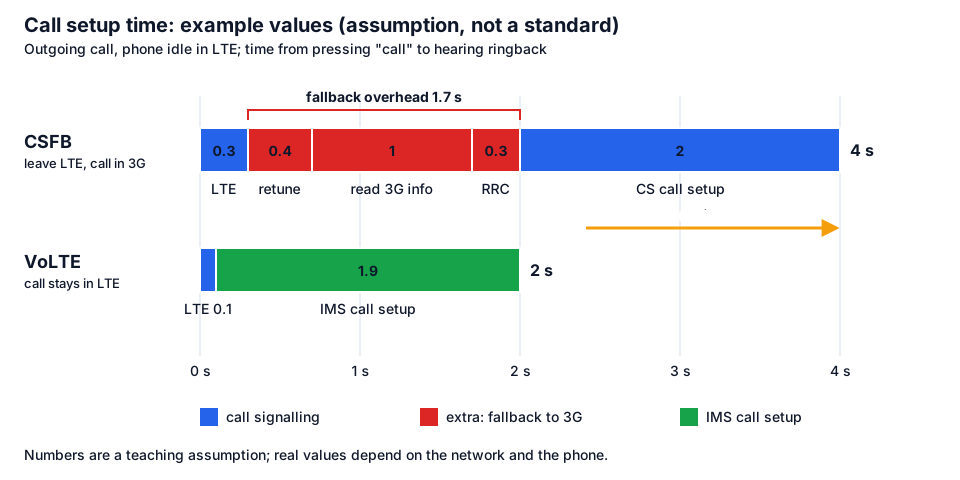
Given (outgoing call, phone idle in LTE):
CSFB: signalling in LTE (steps 1–2) —0.3 s; release in LTE and retuning to 3G (steps 3–4) —0.4 s; reading the 3G cell's system information —1.0 s; radio connection in 3G —0.3 s; call setup in theMSCup to ringback —2.0 s.VoLTE: leaving idle mode (Service Request, courselte, lesson 67) —0.1 s; call setup through IMS together with the voicebearer, up to ringback —1.9 s.
# Time from pressing "call" to ringback, seconds (assumed values)
csfb:
  t1_lte_signalling: 0.3    # Extended Service Request + order to eNodeB
  t2_retune_to_3g: 0.4      # release in LTE, retune to 3G
  t3_read_3g_info: 1.0      # 3G cell system information
  t4_rrc_in_3g: 0.3         # radio connection in 3G
  t5_cs_call_setup: 2.0     # CM Service Request ... ringback
  total: 4.0                # 0.3 + 0.4 + 1.0 + 0.3 + 2.0
  fallback_overhead: 1.7    # t2 + t3 + t4: the price of leaving LTE

volte:
  v1_service_request: 0.1   # leaving idle mode in LTE
  v2_ims_call_setup: 1.9    # SIP through IMS + voice bearer
  total: 2.0                # 0.1 + 1.9

difference: 2.0             # 4.0 - 2.0
ratio: 2.0                  # 4.0 / 2.0
Line by line:
csfb.total = 4.0: add the five components: $0.3 + 0.4 + 1.0 + 0.3 + 2.0 = 4.0$ s.fallback_overhead = 1.7: steps 2–4 (retuning, reading the cell, radio connection in 3G) exist only because the phone has to leave LTE: $0.4 + 1.0 + 0.3 = 1.7$ s — more than a third of the total.volte.total = 2.0: $0.1 + 1.9 = 2.0$ s — there is no leaving LTE.difference = 2.0,ratio = 2.0: under these assumptionsCSFBis twice as slow; the subscriber waits2.0 slonger.
| Metric | CSFB | VoLTE |
|---|---|---|
| Time to ringback | 4.0 s | 2.0 s |
| Of which leaving LTE | 1.7 s | 0 s |
| Data during the call | Stopped in 2G, slower in 3G | Continues in LTE |
| After hang-up | Return to LTE, possibly "stuck" | The phone is already in LTE |
💡 Architectural verdict: under the given assumptions
VoLTEcuts the wait for ringback from4.0 sto2.0 s, keeps LTE data flowing during the call and, most importantly, removes the dependence of voice on 2G/3G. The answer to the CTO from example 2: 3G can be switched off only after most calls have moved toVoLTEand a decision has been made on where phones withoutVoLTEwill call from.
What can go wrong and how to find it
| Symptom | Possible cause | What to check |
|---|---|---|
| The phone is in LTE, the Internet works, but neither incoming nor outgoing calls go through | No SGs association: the combined registration failed or the SGs interface between the MME and the MSC is down | The Combined Attach result and the SGs state (course lte, lessons 95 and 137) |
| Calls go through, but setup takes noticeably longer than usual | After falling back to 2G/3G the phone lands in another location area and updates it first; the network does not pass the 3G cell parameters in advance | The TAC → LAC mapping in the MME, the 3G cell information in the release command (course lte, lesson 95) |
| Navigation and downloads stop during the call | The call went to 2G, where data is suspended for the duration of the call | Which network — 2G or 3G — the phone is sent to on CSFB |
| After the call the phone shows 3G and slow Internet for a long time | The 3G network does not return the phone to LTE straight away; it waits for a normal cell change | The fast-return-to-LTE setting on the 3G network (course lte, lesson 95) |
| After 3G is switched off, some subscribers cannot call | The phone does not support VoLTE or VoLTE is not enabled in the subscription, and there is nowhere left to fall back to with CSFB | The share of calls via CSFB and the phone models without VoLTE before switch-off; the subscriber's subscription |
⚠️ A typical mistake: deciding the fate of 3G only from the Internet traffic graph. There may be almost no data in 3G, while the voice of every subscriber without
VoLTEstill goes there viaCSFB. First look at the share of voice calls viaCSFB, then switch the network off.
Practice
- Predict. A subscriber in LTE is streaming music and driving with a navigation app. An incoming call arrives; the network uses
CSFBand sends the phone to 2G. What happens to the music and the navigation during the call and right after hang-up? - Check. Are these statements true: a) with
CSFBthe conversation goes through theEPCcore; b) forVoLTEvoice the network creates a separatebearerwith a guaranteed bit rate; c) anOTTmessenger gets a quality guarantee because it also works over LTE; d) without theSGsinterface between theMMEand theMSC,CSFBdoes not work. - Explain. Why can an operator whose voice relies only on
CSFBnot switch off 3G (and 2G), even if all Internet traffic already goes over LTE? - Modify. In the worked example, the network has learned to pass the 3G cell parameters to the phone in advance, and reading system information has shrunk from
1.0 sto0.2 s. The other components are unchanged. Calculate the newCSFBtime, the new price of leaving LTE and the difference fromVoLTE. - Do it yourself ⭐. Other assumed values.
CSFB:0.2 s+0.5 s+1.2 s+0.4 s+2.3 s.VoLTE:0.1 s+2.3 s. The network carries500 000outgoing calls a day, and all of them move fromCSFBtoVoLTE. Calculate the setup time forCSFBandVoLTE, the difference per call, and how many hours of waiting the subscribers save together per day (round to one decimal place).
# Task 5: components, seconds (assumed values)
csfb: [0.2, 0.5, 1.2, 0.4, 2.3]
volte: [0.1, 2.3]
calls_per_day: 500000
Self-check
- Why does a call take longer to set up with
CSFBthan withVoLTE, even if theMSCand IMS are equally fast?
Explanation: withCSFB, steps thatVoLTEdoes not have at all are added to the ordinary call setup: theMMEorder to the base station, the release of the LTE radio connection, retuning the phone to the 2G/3G frequency, reading the new cell's system information and a new radio connection. Only after that does the phone send theCM Service Request. WithVoLTEthe phone stays in LTE and sends aSIP INVITEto IMS straight away. In our example, leaving LTE alone cost1.7 s. - What does
VoLTEgive an operator who wants to switch off 3G, and why isVoLTEin the network alone not enough?
Explanation: withVoLTEvoice does not drop to 2G/3G, so the old network is no longer required for every call, and its frequencies can be refarmed for LTE. ButVoLTEis also needed in the phone and in the subscriber's subscription. While a noticeable share of subscribers still call viaCSFB, switching 3G off would leave them without calls (or overload 2G). So most calls are moved toVoLTEfirst, and the question of old phones is settled.
Practice answers
- Task 1: during the call the phone is in 2G, where data is suspended for the call: the music plays while the buffer lasts, then goes silent; the map stops updating. After hang-up data resumes, but until the phone returns to LTE it runs at slow 2G/3G speed.
- Task 2: a) false — with
CSFBthe conversation goes through the 2G/3GCSdomain and theMSCswitch; b) true — this is theGBRvoicebearer, created for the duration of the call; c) false —OTTruns in the shared Internet channel with no guarantee; the network does not know there is a conversation inside; d) true — viaSGstheMSCfinds the subscriber in LTE and theMMElearns about the call. - Task 3: with
CSFBevery voice call of an LTE subscriber is physically carried in 2G/3G. If 3G is switched off, calls will remain only in 2G (whose capacity may not be enough) or disappear altogether where there is no 2G. Voice must first be moved toVoLTE. - Task 4:
CSFB$= 0.3 + 0.4 + 0.2 + 0.3 + 2.0 = 3.2$ s; the price of leaving LTE $= 0.4 + 0.2 + 0.3 = 0.9$ s; the difference fromVoLTE$= 3.2 - 2.0 = 1.2$ s. The speed-up helps, but the move to 2G/3G is still there. - Task 5:
CSFB$= 0.2 + 0.5 + 1.2 + 0.4 + 2.3 = 4.6$ s;VoLTE$= 0.1 + 2.3 = 2.4$ s; difference $= 2.2$ s per call. Per day: $500\,000 \times 2.2 = 1\,100\,000$ s $= 1\,100\,000 / 3600 \approx 305.6$ h — almost 13 days of waiting every day.
Review and the criterion for moving on
- LTE has no
CSdomain: voice needs either a fallback to 2G/3G (CSFB) or its own service over IP (VoLTE). CSFB(3GPP TS 23.272) relies onSGs: for every call the phone drops to 2G/3G. The cost: longer setup, LTE data stops or slows down, the 2G/3G network is mandatory and loaded, and after the call the phone may get "stuck" in 2G/3G.SVLTE(two radio chains) andVoLGA(CScore voice through a gateway over LTE) are historical options that never caught on.VoLTEis voice as an IMS service (MMTel) over LTE: abearerfor signalling and aGBRvoicebearer. Benefits: fast setup, HD voice, data during the call, a path to switching off 2G/3G and refarming their frequencies.- An
OTTmessenger gives no quality guarantee, no emergency calls and noE.164number; the weak spot ofVoLTEis leaving LTE coverage during a call.
Criterion for moving on: you can put the six steps of an outgoing CSFB call in order from memory, name the four problems of CSFB, explain why VoLTE needs two bearers, fill in the CSFB / VoLTE / OTT table and calculate the setup time from given components.
Next is lesson 2, "LTE + IMS: nodes and interfaces": which nodes make up VoLTE and how they are connected; further ahead in the course — the GSMA IR.92 profile, VoWiFi and SRVCC.
Standards and sources
- 3GPP TS 23.272 — Circuit Switched (CS) fallback in Evolved Packet System (EPS); Stage 2:
CSFBprocedures, calls viaSGs, suspension of data. - 3GPP TS 29.118 — Mobility Management Entity (MME) – Visitor Location Register (VLR) SGs interface specification: the
SGsinterface. - 3GPP TS 23.228 — IP Multimedia Subsystem (IMS); Stage 2: the IMS architecture on which
VoLTEis built. - 3GPP TS 24.173 — IMS multimedia telephony communication service and supplementary services; Stage 3: the
MMTelservice. - 3GPP TS 23.401 — GPRS enhancements for E-UTRAN access: the
EPCandEPS Bearerchannels. - GSMA IR.92 — IMS Profile for Voice and SMS.
